
About
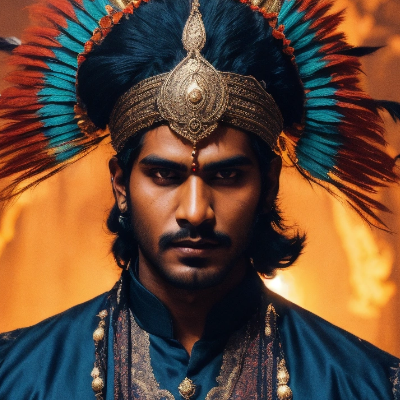
Purukutsa — Ikshvaku King, Slayer of the Gandharvas in the Naga Realm
Purukutsa · Pourkutsa (matronymic variant)
Purukutsa is a king of the solar Ikshvaku dynasty, recorded in the Bhagavata Purana, the Vishnu Purana, and referenced in the Mahabharata. He is the son of Mandhata — one of the most celebrated universal sovereigns of the Ikshvaku line, born miraculously from the body of his father Yuvanashva — and of Bindumati, a princess of the Yadu dynasty and daughter of the chakravartin Shashabindu. Purukutsa is thus of dual royal descent, carrying both the solar Ikshvaku lineage through his father and the lunar Yadu lineage through his mother. His principal episode in the Puranas concerns his journey to the underworld realm of the Nagas, where he destroyed a host of Gandharvas at the Nagas' request, and his subsequent marriage to the Naga princess Narmada. The dynastic line of the Ikshvaku kings continued through Purukutsa after Mandhata.
✦ The Name
The name Purukutsa is a compound of uncertain but ancient formation. The element puru commonly signifies much, many, or abundant in Sanskrit, and is a recurring root in royal names of the lunar and solar dynasties alike. The element kutsa appears in Vedic literature as the name of a celebrated sage and associate of Indra, and the compound Purukutsa may carry resonances of that Vedic figure. The Vishnu Purana records a direct connection between the royal Purukutsa and the Vedic sage Kutsa through the Naga episode, as discussed below. No explicit etymology is given for the compound name in the primary Puranic sources themselves.
✦ Lineage
- Father: Mandhata — emperor of the Ikshvaku solar dynasty, son of Yuvanashva, celebrated in the Puranas as a chakravartin who extended his rule across the earth and the heavens; born miraculously from his father Yuvanashva's body after Yuvanashva drank water consecrated for a fertility ritual
- Mother: Bindumati — princess of the Yadu lunar dynasty, daughter of Shashabindu, the chakravartin king of the Yadu line who was himself the son of Chitraratha and grandson of Rusadru
- Brothers: Ambarisha — a king of the Ikshvaku line, son of Mandhata and Bindumati; and Muchukunda — a celebrated king of the same line, known for his long sleep granted as a divine boon and for his role in the destruction of the demon Kalayavana at the time of Sri Krishna
- Wife: Narmada — a princess of the Naga people, given to Purukutsa in marriage by the Nagas as a reward for his destruction of the Gandharvas in the underworld; her name is also borne by the great river of central India, and the Vishnu Purana records a connection between the two
- Son: Trasadasyu — a king of the Ikshvaku line through whom the solar dynasty continued after Purukutsa
✦ The Naga Episode: Journey to the Underworld
The most substantial narrative attached to Purukutsa in the primary sources concerns his mission to the realm of the Nagas — the serpent beings who inhabit the subterranean world known as Rasatala or Patala. The account is preserved in the Vishnu Purana and is also referenced in the Bhagavata Purana. A group of Gandharvas — celestial musicians and semi-divine beings who inhabit the intermediate regions between earth and heaven — had invaded the Naga realm and were causing devastation among the serpent people. The Nagas, unable to repel the Gandharvas by their own power, appealed to Vishnu for aid. Vishnu directed them to seek the assistance of Purukutsa, the king of the Ikshvaku line, whom he identified as an instrument capable of accomplishing the task.
The Naga princess Narmada was sent to the world of men to bring Purukutsa to the underworld. She came to him, conveyed Vishnu's command and the Nagas' need, and led him down into the subterranean realm. There, empowered by Vishnu, Purukutsa engaged the Gandharvas and destroyed them, delivering the Nagas from the threat that had afflicted them. In gratitude, the Nagas honoured Purukutsa greatly and gave him Narmada as his wife. The Vishnu Purana further records that the Nagas granted a boon: anyone who remembered the names of Purukutsa, Narmada, and the sage Kutsa — a Vedic figure associated with Indra and identified in this context as spiritually connected to Purukutsa — would be protected from the danger of serpent poison. This protective boon is stated in the text as the reason the tradition of reciting these three names together was preserved.
✦ Connection to the Vedic Sage Kutsa
The Vishnu Purana's account of the Naga boon groups Purukutsa's name with that of the sage Kutsa, a celebrated Vedic rishi associated with Indra in the Rigveda, who is credited with composing several hymns and who appears in Vedic legend as a companion taken by Indra into battle. The precise nature of the connection between the royal Purukutsa and the sage Kutsa is not elaborated in detail in the Puranic sources, but the pairing of their names in the protective formula suggests a tradition in which the two figures were regarded as spiritually or mystically linked. The Vishnu Purana presents this association as an established fact within the Naga episode without offering a fuller explanatory narrative.
✦ Connection to the Wider Genealogy
Purukutsa is a crucial figure in the continuity of the Ikshvaku solar dynasty. His father Mandhata was one of the greatest emperors of the line, and after Mandhata the succession passed through Purukutsa to his son Trasadasyu, and from Trasadasyu the line continued through subsequent generations of the solar dynasty. Through his mother Bindumati, Purukutsa also carries the blood of the Yadu lunar dynasty — the line that eventually produced, in far later generations, Sri Krishna. His marriage to the Naga princess Narmada introduced a third lineage into his descendants, connecting the Ikshvaku royal house to the Naga people of the subterranean world.
✦ References
- Bhagavata Purana, Skandha 9, Chapters 6–7: Records Purukutsa as a son of Mandhata and Bindumati and places him in the Ikshvaku dynastic succession leading to Trasadasyu.
- Vishnu Purana, Book 4, Chapters 2–3: Provides the fullest account of the Naga episode, Purukutsa's journey to the underworld, his destruction of the Gandharvas, his marriage to Narmada, and the protective boon granted by the Nagas involving the names of Purukutsa, Narmada, and Kutsa.
- Mahabharata, Adi Parva (genealogical sections): References Mandhata's sons including Purukutsa in the context of the Ikshvaku dynastic succession.
- Rigveda (various hymns): Provides the Vedic background for the sage Kutsa, whose name is linked to Purukutsa in the Vishnu Purana's Naga episode.
- Vettam Mani, Puranic Encyclopaedia (1975): Entry on Purukutsa summarises the Naga episode and his genealogical position, drawing on both the Bhagavata and Vishnu Puranas.