
About
The Fifty Daughters of Mandhata — Wives of the Sage Saubhari
The Fifty Daughters of Mandhata · Mandhata's Daughters · The Wives of Saubhari
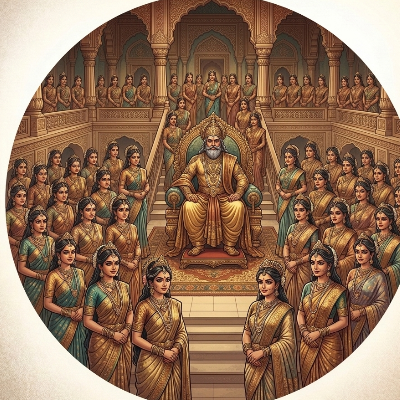
The fifty daughters of Mandhata are a group of princesses of the solar Ikshvaku dynasty recorded collectively in the Bhagavata Purana and the Vishnu Purana. Their father, Mandhata, was one of the most celebrated chakravartins — universal sovereigns — of the Ikshvaku line, born miraculously from the body of his father Yuvanashva after Yuvanashva accidentally drank consecrated water prepared for a fertility ritual. Their mother was Bindumati, a princess of the Yadu lunar dynasty and daughter of the chakravartin Shashabindu. The fifty daughters are not named individually in any of the primary sources that record their story; they appear as a collective group whose significance in the tradition is bound to the episode of their marriage to the sage Saubhari. That episode is narrated at length in the Bhagavata Purana and forms one of the more elaborate accounts of a sage's acquisition of worldly life and his eventual renunciation of it.
✦ Lineage
- Father: Mandhata — emperor of the Ikshvaku solar dynasty, son of Yuvanashva; one of the greatest chakravartins of Puranic tradition, said to have ruled the earth and extended his sovereignty even over the heavens
- Mother: Bindumati — princess of the Yadu lunar dynasty, daughter of Shashabindu, the chakravartin king of the Yadu line descended from Yadu, son of the emperor Yayati
- Brothers: Purukutsa — king of the Ikshvaku line, who descended to the Naga underworld and married the Naga princess Narmada; Ambarisha — king of the Ikshvaku line; and Muchukunda — king of the Ikshvaku line, celebrated for his long sleep and his destruction of the demon Kalayavana
- Husband (collective): Saubhari — an ancient sage of great ascetic power who had spent many years submerged in the waters of the Yamuna river in deep meditation; he sought the daughters in marriage after his asceticism was disrupted by witnessing the pleasures of fish in the river, which awakened in him a desire for worldly life
✦ The Marriage Episode: Saubhari's Request
The Bhagavata Purana narrates that the sage Saubhari had been engaged in intense ascetic practice for a very long period, remaining submerged in the waters of the Yamuna river in a state of sustained meditation. During this time, he observed the fish that inhabited the river moving about freely and enjoying the pleasures of their aquatic existence. The sight of the fish at play — particularly the enjoyment visible in their movements — stirred in Saubhari a longing for the pleasures of sensory and domestic life, a desire for a wife and for the experience of household existence that his asceticism had until then suppressed.
Saubhari emerged from the river and went to the court of Mandhata. He presented himself to the king and requested that one of Mandhata's fifty daughters be given to him in marriage. Mandhata faced a delicate situation: the sage was ancient and of unprepossessing appearance, having spent so long submerged in water, and the king was reluctant to compel any of his daughters to accept such a husband. Yet he also could not afford to offend a sage of Saubhari's ascetic standing, as a rishi's curse could bring ruin upon a kingdom. Mandhata resolved the difficulty by telling Saubhari that it was the established custom of their royal house for each daughter to choose her own husband — the practice of svayamvara — and that whichever daughter chose Saubhari of her own free will, he would give her in marriage without impediment.
Saubhari, understanding the king's intent to evade the request through this convention, employed his ascetic powers before presenting himself to the daughters. He transformed himself into a figure of extraordinary beauty and youthful splendour — a form so magnificent that when he entered the palace chambers where Mandhata's daughters resided, all fifty of them desired him simultaneously. Each princess wished to have him as her husband alone and was unwilling to relinquish him to her sisters. The Bhagavata Purana records that the daughters quarrelled among themselves over him, each insisting on her own exclusive claim. Mandhata, bound by his own declared custom, had no choice but to give all fifty daughters to Saubhari, as all fifty had chosen him freely.
✦ Life with Saubhari and His Renunciation
After the marriage, Saubhari again employed his powers to construct for his fifty wives a life of exceptional luxury and comfort. The Bhagavata Purana describes the palatial residences he created, filled with every pleasure, served by attendants, and provided with all manner of delights. Each of the fifty wives had her own palace, and Saubhari lived among them enjoying the full range of domestic and sensory pleasures. The text uses this description deliberately as a portrait of the seductive power of worldly life and its capacity to consume even a man of great prior asceticism.
However, the Bhagavata Purana records that despite the abundance and pleasure of this existence, Saubhari found that his desires were not extinguished by their satisfaction but only multiplied. Reflecting on his condition — that he had abandoned the path of liberation for sensory enjoyment, and that such enjoyment had brought him no lasting peace — he became deeply disenchanted with the life he had constructed. Recognising the trap of desire and the futility of seeking contentment through its fulfilment, Saubhari resolved to renounce the world. He took the vow of forest-dwelling renunciation, and his fifty wives, unwilling to be separated from him, accompanied him into the forest and also adopted the path of asceticism. The Bhagavata Purana states that all of them, through this renunciation, ultimately attained liberation together with Saubhari.
✦ Theological Significance
The episode of Saubhari and the fifty daughters of Mandhata functions in the Bhagavata Purana as an extended parable on the nature of desire, the dangers that sensory experience poses even to accomplished ascetics, and the ultimate insufficiency of worldly pleasure to satisfy the soul. The daughters themselves, while not individualised by name or character in the text, serve as the instruments through which this teaching is structured. Their collective desire for Saubhari, their life of luxury with him, and their final accompaniment of him into renunciation and liberation give the episode its arc. The Bhagavata Purana presents their collective attainment of liberation as a genuine spiritual outcome — their association with a great sage, even one temporarily diverted from his path, ultimately brought them to the highest goal.
✦ Textual Variants
The Bhagavata Purana and the Vishnu Purana are consistent in the broad outlines of this episode — the sage Saubhari's request, Mandhata's reluctance, the sage's transformation, the daughters' collective desire, and the eventual renunciation. The Vishnu Purana's version is somewhat briefer than the Bhagavata's, which provides the fuller and more elaborated narrative. Neither source names any of the fifty daughters individually, and no independent source within the primary Puranic or epic corpus has been identified that supplies their individual names.
✦ References
- Bhagavata Purana, Skandha 9, Chapter 6: Provides the fullest account of the Saubhari episode, including his emergence from the Yamuna, his request to Mandhata, his transformation, the collective desire of the fifty daughters, the life of luxury, his disenchantment, his renunciation, and the liberation of both Saubhari and his wives.
- Vishnu Purana, Book 4, Chapter 2: Records the same episode in a briefer form, confirming the core narrative of Saubhari's marriage to all fifty daughters of Mandhata and his eventual renunciation.
- Vettam Mani, Puranic Encyclopaedia (1975): Entry on Saubhari summarises the episode and confirms that the daughters are not named individually in the primary sources, treating them as a collective group within the narrative.