
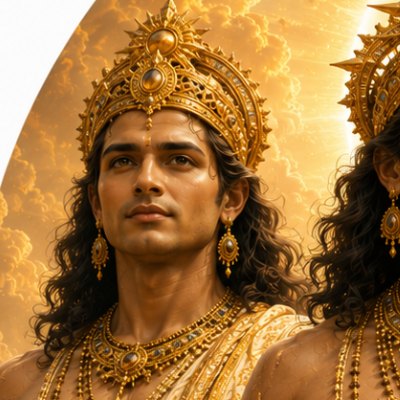
About
Darsha — Son of Dhata and Sinivali
Darsha · Darsa · Darsaka
Darsha is a son of Dhata — one of the twelve Adityas, the class of solar and cosmic deities born of the sage Kashyapa and his wife Aditi, daughter of the patriarch Daksha — and of Dhata's wife Sinivali. He is named in a single verse of the Bhagavata Purana (Book VI, Chapter 18, verse 3), which lists the four wives and corresponding sons of Dhata as part of the genealogical enumeration of Aditi's descendants. No narrative episode, independent function, or further genealogical record concerning Darsha is preserved in any primary source examined.
✦ The Name
The Sanskrit word Darsha derives from the root drsh, meaning to see or to appear, and in its technical ritual and calendrical usage denotes the new moon — specifically the moment when the moon first becomes faintly visible after the dark lunar fortnight, or in some usages the new moon day itself when the moon is not visible. The compound Darsha-Purnamasa refers to the paired Vedic sacrificial rites performed on the new moon and full moon days respectively, one of the foundational obligatory rites of the Shrauta sacrificial system. The name Darsha thus embodies the new moon as a personified divine entity. His mother Sinivali is herself a goddess associated in Vedic tradition with the day before the new moon — the waning crescent — and with fertility and auspiciousness. The pairing of Darsha (new moon) as son of Sinivali (the day preceding the new moon) is therefore internally coherent within the calendrical symbolism of Dhata's household, where all four sons and their mothers represent consecutive or paired divisions of sacred lunar time.
✦ Lineage
- Father: Dhata — the seventh of the twelve Adityas; son of Kashyapa and Aditi; a deity of cosmic order, health, and creation; attested in the Mahabharata and the Bhagavata Purana
- Mother: Sinivali — one of the four wives of Dhata named in the Bhagavata Purana (VI.18.3); her name in Sanskrit denotes the day of the waning crescent moon just before the new moon; she is an ancient Vedic goddess of fertility and auspicious power, invoked in the Rigveda in connection with the granting of offspring
✦ References
Primary Sources
- Bhagavata Purana, Book VI, Chapter 18, verse 3 (G. V. Tagare translation, Motilal Banarsidass, 1950): The sole primary source; names Darsha as the son of Dhata and Sinivali within the genealogical list of the Aditya households.
- Rigveda, various hymns invoking Sinivali: Establishes the independent Vedic identity of Darsha's mother Sinivali as a goddess of the lunar cycle and fertility; contextualises the cosmological meaning of the name Darsha within the broader Vedic lunar framework.
Modern Reference Works
- Mani, Vettam — Puranic Encyclopaedia (1975): Records Dhata's household including all four sons; no individual entry for Darsha.
- Monier-Williams, M. — Sanskrit-English Dictionary (1899), entry "Darsha": Records the meaning as the new moon and its technical usage in the Darsha-Purnamasa sacrificial rites of the Shrauta system.
- Wisdomlib.org — entries "Darsha" and "Darshapurnamasa": Confirms the Puranic citation (Bhagavata Purana VI.18.3) for Darsha as son of Dhata and Sinivali, and provides context for the ritual significance of the new moon designation.