
About
Purnamasa — Son of Dhata and Anumati
Purnamasa · Purnamasha · Purna-masa
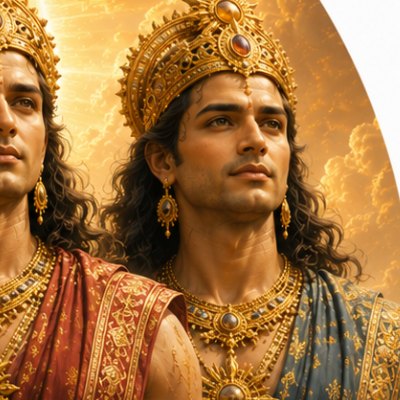
Purnamasa is a son of Dhata — one of the twelve Adityas, the solar and cosmic deities born of the sage Kashyapa and his wife Aditi, daughter of the patriarch Daksha — and of Dhata's wife Anumati. He is named in the Bhagavata Purana (Book VI, Chapter 18, verse 3) within the genealogical enumeration of the Aditya households. The Cologne Digital Sanskrit Dictionaries (Bohtlingk and Roth) additionally confirm the citation, recording Purnamasa explicitly as a son of Dhata born of Anumati at Bhagavata Purana VI.18.3. No narrative episode, independent role, or further genealogical record concerning Purnamasa is preserved in any primary source examined beyond this verse.
✦ The Name
The Sanskrit compound Purnamasa is formed from Purna (full, complete) and Masa (month or moon), yielding the meaning full moon — both the lunar phase itself and the ritual occasion associated with it. The full moon day (Purnima or Purnamasi) is among the most sacred occasions in the Vedic and Puranic calendrical system, marking the completion of the lunar month and the occasion for a range of obligatory and optional rites. The Darsha-Purnamasa sacrifices — performed on the new moon (Darsha) and full moon (Purnamasa) days respectively — constitute one of the foundational pairs of Shrauta obligatory rites, and the name Purnamasa as a personified deity thus embodies the culminating phase of the sacred lunar cycle. His mother Anumati is in Vedic tradition a goddess of the full moon — specifically the day before the full moon when divine favour (anumati, meaning consent or approval) is granted — and is associated with blessings, fertility, and the moon's propitious aspect. The pairing of Purnamasa (full moon) as son of Anumati (the goddess of lunar favour and the day preceding the full moon) is the most directly coherent of the four mother-son pairings in Dhata's household, both name and mother pointing to the same culminating lunar moment. It should be noted that the name Purnamasa also appears in the Bhagavata Purana (X.61.14) as a son of Krishna born of his wife Kalindi — an entirely separate figure from the son of Dhata treated here, sharing only the name.
✦ Lineage
- Father: Dhata — the seventh of the twelve Adityas; son of Kashyapa and Aditi; deity of health, cosmic order, and creation; attested in the Mahabharata and the Bhagavata Purana
- Mother: Anumati — one of the four wives of Dhata named in the Bhagavata Purana (VI.18.3); her name in Sanskrit means divine consent or approval and denotes the goddess of the day preceding the full moon, when the moon is at near-complete fullness; she is an ancient Vedic deity associated with blessings, the granting of offspring, and the auspicious power of the waxing lunar phase at its peak
✦ Textual Note
The name Purnamasa is shared by at least two distinct figures in the Puranic corpus. The son of Dhata and Anumati treated in this profile is attested at Bhagavata Purana VI.18.3. A separate Purnamasa, son of Krishna and Kalindi, is named at Bhagavata Purana X.61.14. These two figures have no recorded connection and must not be conflated. The name in both cases reflects the same underlying cosmological meaning — the full moon — but the genealogical and narrative contexts are entirely independent.
✦ References
Primary Sources
- Bhagavata Purana, Book VI, Chapter 18, verse 3 (G. V. Tagare translation, Motilal Banarsidass, 1950): The principal primary source for this profile; names Purnamasa as the son of Dhata and Anumati within the genealogical enumeration of the Aditya households.
- Bhagavata Purana, Book X, Chapter 61, verse 14: Names a separate Purnamasa as a son of Krishna and Kalindi; cited here solely to distinguish that figure from the son of Dhata and Anumati treated in this profile.
- Rigveda, hymns invoking Anumati: Establishes the independent Vedic identity of Purnamasa's mother Anumati as a lunar goddess of divine consent and the near-full moon; contextualises the cosmological significance of the name Purnamasa within the Vedic lunar framework.
Modern Reference Works
- Mani, Vettam — Puranic Encyclopaedia (1975): Records Dhata's household and the four sons including Purnamasa; no individual entry for this figure separately.
- Cologne Digital Sanskrit Dictionaries — Bohtlingk and Roth, Grosses Petersburger Worterbuch, entry "Purnamasa": Explicitly records Purnamasa as son of Dhata born of Anumati, with citation Bhagavata Purana VI.18.3; also notes the separate Purnamasa of Bhagavata Purana X.61.14 as a son of Krishna.
- Monier-Williams, M. — Sanskrit-English Dictionary (1899), entry "Purnamasa": Records the meaning as full moon and the full moon day, and notes the personification as a son of Dhata in the Bhagavata Purana.
- Wisdomlib.org — entry "Purnamasa": Aggregates the Puranic citations and confirms the parentage from Bhagavata Purana VI.18.3; also notes the ritual significance of the full moon designation in the Darsha-Purnamasa sacrificial system.