
About
Kumuda — Celestial Elephant, Guardian of the South-West
Kumuda · Kumudha
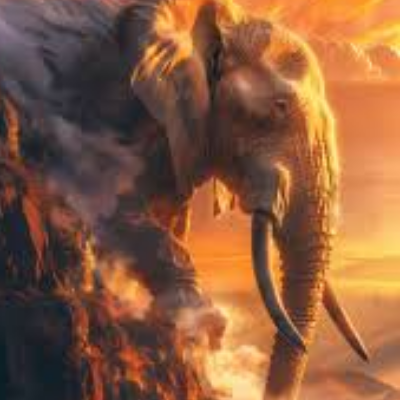
Kumuda is the fourth of the Ashtadiggajas, the eight great celestial elephants who stand as cosmic guardians of the eight directions in the Puranic world-system. He holds the station of guardian of the south-western quarter and is a son of Iravati, who is the daughter of Bhadramada, herself a daughter of Krodhavarsha, wife of Kashyapa the great progenitor sage. Kumuda is named in canonical enumerations of the dik-gajas in the Mahabharata, the Ramayana, and the Matanga-Lila. No individual narrative episodes are attributed to him in the primary sources beyond his place in the group. His consort is Anupama, the fourth of the eight female dik-gaja elephants born of Iravati.
✦ The Name
Kumuda in Sanskrit denotes a white water lily, specifically the night-blooming variety, and is a word associated with beauty, purity, and the lunar light that causes the night lotus to bloom. The name applied to this directional elephant suggests radiance and purity, qualities befitting a celestial being of his stature. The name Kumuda also appears in other contexts in the Puranas — as the name of a Naga, as a name of a mountain, and in various other usages — but in the context of the dik-gajas it designates this specific elephant guardian of the south-western direction.
✦ Lineage
- Paternal great-grandfather: Kashyapa — the foremost progenitor sage
- Paternal great-grandmother: Krodhavarsha — daughter of Daksha, wife of Kashyapa
- Grandmother: Bhadramada — one of the ten daughters of Krodhavarsha
- Mother: Iravati — daughter of Bhadramada; mother of all sixteen dik-gaja elephants
- Siblings (male): Airavata, Pundarika, Vamana, Anjana, Pushpadanta, Sarvabhauma, and Supratika
- Siblings (female): Abhramu, Kapila, Pingala, Anupama, Tamrakarni, Shubhradanti, Angana, and Anjanavati
- Consort: Anupama — fourth of the eight female dik-gaja elephants, daughter of Iravati
- Directional station: Guardian of the South-West
✦ Role as Directional Guardian
The south-western direction in the Puranic system is presided over by Nirriti, the deity associated with dissolution, decay, and the south-western boundary of the ordered cosmos. Kumuda's station at this quarter places him at one of the more liminal boundaries of the cosmic structure. As with the other Ashtadiggajas, his function is collective and cosmological — the eight elephants together maintain the integrity of the world's directional framework — and no individual narrative assigns Kumuda a distinct role beyond this.
✦ References
- Primary Sources
- Mahabharata, Adi Parva and Sabha Parva: Names Kumuda in enumerative lists of the eight directional elephants.
- Valmiki Ramayana: Includes Kumuda among the dik-gajas in cosmological descriptions.
- Matanga-Lila (attributed to Nilakantha): Records Kumuda's place as the fourth dik-gaja and his directional station.
- Secondary Sources
- Mani, Vettam. Puranic Encyclopaedia. Motilal Banarsidass, 1975: Brief entry on Kumuda within the account of the Ashtadiggajas.