
About
Tamrakarni — Celestial Female Elephant, Consort of Anjana
Tamrakarni · Tamrakarni
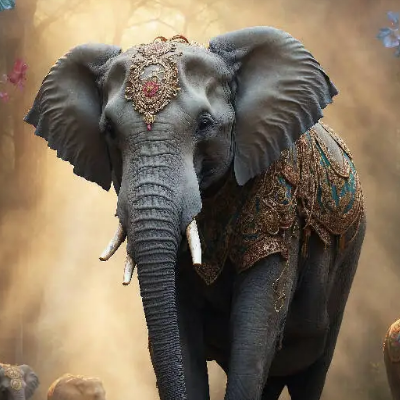
Tamrakarni is the fifth of the eight female celestial elephants who are the consorts and siblings of the Ashtadiggajas. She is a daughter of Iravati, who is the daughter of Bhadramada, one of the ten daughters of Krodhavarsha, a wife of Kashyapa the great progenitor sage. Tamrakarni is paired with Anjana, the fifth of the eight male Ashtadiggajas and guardian of the western direction. She is named in enumerations of the dik-gaja consorts in the Matanga-Lila. The primary sources record no individual narrative episodes for Tamrakarni beyond her identity, lineage, and pairing.
✦ The Name
Tamrakarni is a compound of tamra, meaning copper-coloured or red, and karni, meaning one who has ears or eared, yielding the meaning she of the copper-coloured ears or the red-eared one. The name is a physical descriptor, identifying this female elephant by a distinctive colouring of her ears, which are described as copper-red in hue. Such descriptive names based on physical features are characteristic of Sanskrit elephant nomenclature in the Puranic tradition.
✦ Lineage
- Paternal great-grandfather: Kashyapa — the foremost progenitor sage
- Paternal great-grandmother: Krodhavarsha — daughter of Daksha, wife of Kashyapa
- Grandmother: Bhadramada — one of the ten daughters of Krodhavarsha
- Mother: Iravati — daughter of Bhadramada; mother of all sixteen dik-gaja elephants
- Siblings (female): Abhramu, Kapila, Pingala, Anupama, Shubhradanti, Angana, and Anjanavati
- Siblings (male): Airavata, Pundarika, Vamana, Kumuda, Anjana, Pushpadanta, Sarvabhauma, and Supratika
- Consort: Anjana — the fifth of the eight male Ashtadiggajas, guardian of the western direction
✦ References
- Primary Sources
- Matanga-Lila (attributed to Nilakantha): Names Tamrakarni as the fifth of the eight female dik-gaja elephants and records her pairing with Anjana.
- Secondary Sources
- Mani, Vettam. Puranic Encyclopaedia. Motilal Banarsidass, 1975: Brief reference to Tamrakarni in the context of the dik-gaja consort enumerations.