
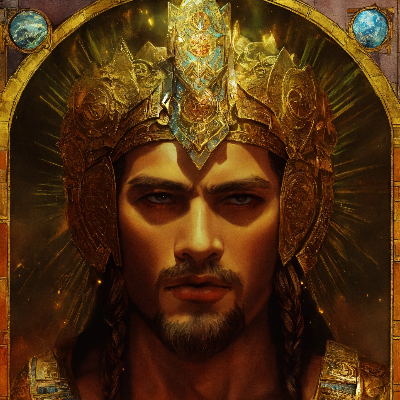
About
Anaranya — Ikshvaku King of Ayodhya, Slain by Ravana
Anaranya · Anaranya II (to distinguish from the earlier Ikshvaku king of the same name)
Anaranya is a king of the solar Ikshvaku dynasty and ruler of Ayodhya, recorded in the Vishnu Purana as the son of Sambhuta and the father of Prishadasva. He is celebrated across the Puranic and epic traditions principally for his fatal confrontation with the demon king Ravana — the ten-headed ruler of Lanka — during the latter's triumphant campaign of conquest across the three worlds. Although Anaranya was defeated and slain in this encounter, the tradition preserves his memory chiefly through the dying curse he pronounced upon Ravana, declaring that a descendant of the Ikshvaku solar line would one day be the instrument of the demon's destruction. That prophecy was fulfilled when Sri Rama — born many generations later in the same solar dynasty — killed Ravana in the great war described in the Ramayana of Valmiki. Anaranya is thus a figure of significant theological and narrative importance in the Puranic tradition: a king who lost his life but whose final words set in motion one of the foundational causal chains of the Ramayana cycle. His story is narrated in the Uttara Kanda of the Valmiki Ramayana and referenced in the Vishnu Purana's dynastic catalogue. He is the second king of this name in the Ikshvaku line — an earlier Anaranya appears in some dynastic lists at a much earlier point in the solar succession — and the two must be carefully distinguished.
✦ The Name
The name Anaranya is a compound of the negative prefix an- and aranya, meaning forest or wilderness. The compound thus carries the sense of one who has no forest — that is, one who rules over all land, leaving no wilderness unclaimed — a name befitting a sovereign of a great and ancient royal house. Alternatively it may be understood as one for whom there is no wilderness, suggesting a king of such completeness of dominion that the untamed world has no place in his realm. The name is shared by at least one earlier figure in the Ikshvaku dynastic lists — an Anaranya appearing in the very early part of the solar succession — and this coincidence of names across a long dynastic line reflects the common Puranic practice of recurring royal names across generations.
✦ Lineage
- Father: Sambhuta — a king of the Ikshvaku solar dynasty, son of Trasadasyu; Trasadasyu was himself a king of remarkable origin, described in the Rigveda as a demi-god granted to his mother Narmada — a Naga princess and wife of the Ikshvaku king Purukutsa — through the boon of the gods Indra and Varuna in response to her sacrifice
- Dynasty: Ikshvaku solar line — the great royal house of the solar dynasty founded by Ikshvaku, son of Manu Vaivasvata, son of Vivasvat the Sun; ruling from the city of Ayodhya on the banks of the Sarayu river in the kingdom of Kosala
- Son: Prishadasva — recorded in the Vishnu Purana as the son of Anaranya and the next king of the Ikshvaku line after his father's death; through Prishadasva the solar dynastic succession continued toward Haryashva, Sumanas, Tridhanwan, Trayyaruna, Satyavrata, and ultimately Sri Rama
✦ The Confrontation with Ravana
The Uttara Kanda of the Valmiki Ramayana narrates the episode of Ravana's world-conquest in detail. After Ravana had obtained his celebrated boon from Brahma — rendering him invincible against gods, demons, Nagas, and Yakshas, with humans and animals explicitly excluded from the boon's protection — he undertook a triumphant campaign across the heavens and the earth, defeating the devas, seizing kingdoms, and demonstrating his unassailable power. The gods, aware of the terms of Ravana's boon, declined to engage him in battle, knowing that they could not prevail. Ravana, finding the celestial realm unwilling to resist him, descended to the earth in search of human opponents.
He arrived at the great city of Ayodhya, seat of the Ikshvaku solar dynasty, then ruled by Anaranya. The king was fully aware of the demon's reputation and power, but the Ramayana tradition presents Anaranya as refusing both flight and submission. He marshalled his forces and met Ravana in battle. The confrontation was fierce, but the outcome was determined from the outset by the supernatural power Ravana had accumulated through his boons and his mastery of sorcery and demonic warfare. The rakshasas fighting under Ravana employed illusions and magical combat that proved overwhelming. Anaranya and his army were defeated. The Ramayana records that Anaranya was struck from his chariot by Ravana's mace — the blow leaving him mortally wounded and unable to continue the fight.
As Anaranya lay dying on the battlefield, Ravana is recorded in the tradition as having derided him and his dynasty — taunting the fallen king and dismissing the Ikshvaku line as incapable of producing a worthy opponent. It is at this moment that Anaranya pronounced his dying curse. According to the accounts preserved in the tradition, he declared that from within the very royal line Ravana was mocking, a king would arise who would destroy him and bring ruin upon his entire race. The Wikipedia article on Anaranya, drawing on the Ramayana narrative, records that he was struck down by Ravana's mace after his army's defeat through demonic sorcery, and that the dying curse he issued upon Ravana was fulfilled generations later by Sri Rama.
✦ The Dying Curse and Its Fulfilment
In the Hindu tradition, the dying curse of a righteous king — particularly one who has been unjustly slain — carries great spiritual authority. Such a curse, uttered at the moment of death by one whose conduct has been dharmic, is regarded as possessed of inevitable efficacy. Anaranya's curse belongs to this category: a king who chose to fight rather than flee or surrender, who died defending his kingdom and his dynasty's honour, and whose final words were not of personal grief but of prophetic declaration concerning the ultimate fate of his killer. The tradition presents the curse not as an act of personal revenge but as a statement of cosmic moral order — the assertion that the Ikshvaku lineage, however mocked by Ravana in that moment, carried within it the seed of the demon's destruction.
The fulfilment of Anaranya's curse many generations later through Sri Rama — the son of Dasharatha, descended through the Ikshvaku line — is understood in the Puranic and epic traditions as one of the several interlocking causal threads that made Rama's destruction of Ravana both inevitable and divinely sanctioned. Alongside other curses and boons operating within the narrative — including Ravana's own boon from Brahma that excluded humans from its protection, and Vishnu's declaration that he would incarnate as a human to destroy the demon — Anaranya's dying prophecy forms part of the tradition's account of how the destruction of Ravana had been cosmically determined long before the events of the Ramayana unfolded.
✦ Textual Variants and Inconsistencies
The position of Anaranya in the Ikshvaku dynastic sequence is subject to notable variation across the primary sources, and the Wilson translation of the Vishnu Purana's footnotes — drawing on a comparison of multiple Puranic recensions — make these variants explicit and must be recorded honestly here.
The Vishnu Purana records the sequence as Trasadasyu — Sambhuta — Anaranya — Prishadasva — Haryashva — Sumanas — Tridhanwan — Trayyaruna — Satyavrata. The Bhagavata Purana omits Sambhuta entirely, placing Anaranya as the direct son of Trasadasyu rather than his grandson, and gives the subsequent sequence as Anaranya — Haryashva — Aruna — Tribandhana — Trishanku, which diverges considerably from the Vishnu Purana's intermediate kings. The Matsya Purana, the Agni Purana, and the Brahma Purana all omit the names between Sambhuta and Tridhanwan entirely — a compression that, as the Wilson footnotes observe, results in the loss of Anaranya himself from those recensions, despite his fame in Hindu narrative tradition. The Linga Purana introduces a further variant by placing Sambhuta not as the father of Anaranya but as the brother of Trasadasyu. The Devi Bhagavata Purana goes directly from Trasadasyu to Anaranya without naming Sambhuta at all. These discrepancies reflect the general variability of the middle sections of the Ikshvaku dynastic lists across the Puranic corpus, where different redactors preserved different recollections of the intermediate kings, and are noted by the Wilson commentary as evidence of careless compilation in at least some of these texts.
There is also the matter of two distinct figures named Anaranya in the Ikshvaku solar line. An earlier Anaranya appears at a much earlier point in the dynastic lists — sometimes identified in extended genealogies as the seventh or eighth king from Ikshvaku himself — who is distinct from the Anaranya who was slain by Ravana and who belongs to a significantly later phase of the dynasty. Several secondary sources and dynastic lists distinguish the two as Anaranya I and Anaranya II respectively. The primary Puranic texts do not themselves make this distinction explicit, referring to each simply by the single name Anaranya in their respective genealogical positions.
✦ Theological and Narrative Significance
Anaranya occupies a distinctive place in the Ramayana's causal architecture. The Ramayana tradition understands the destruction of Ravana as the result of multiple converging forces — divine decree, cosmic necessity, the accumulated weight of the demon's crimes, and the prophetic words of those he wronged. Anaranya's curse is one node in this web of causation. As a king of the great solar line, his dying words carry the authority of royal righteousness and ancestral power, and the tradition presents them as having a binding force upon the future of the dynasty and its greatest enemy alike. In this sense, Anaranya's death — which might appear in narrative terms as a defeat — is reframed by the tradition as a contribution to the ultimate cosmic victory of dharma over adharma that the Ramayana enacts.
✦ Connection to the Wider Genealogy
Through his father Sambhuta, Anaranya is the great-great-grandson of the chakravartin Mandhata and carries the combined descent of the solar Ikshvaku line, the lunar Yadu line through his great-great-grandmother Bindumati, and the Naga lineage through his great-grandmother Narmada. Through his son Prishadasva the Ikshvaku succession continued, passing through Haryashva, Sumanas, Tridhanwan, Trayyaruna, and Satyavrata — also known as Trishanku — then to Harishchandra, Rohitashva, Harita, and through subsequent generations of the solar line to Sagara, Bhagiratha, Dilipa, Raghu, Aja, Dasharatha, and ultimately Sri Rama, the avatar of Vishnu whose destruction of Ravana fulfilled the curse that Anaranya pronounced at the moment of his death.
✦ References
- Valmiki Ramayana, Uttara Kanda: The primary narrative source for the episode of Ravana's world-conquest and his fatal battle with Anaranya, the king of Ayodhya; records Anaranya's defeat, his being struck from his chariot by Ravana's mace, and the dying curse he pronounced upon Ravana declaring that an Ikshvaku descendant would destroy him.
- Vishnu Purana, Book 4, Chapter 3: Records Anaranya as the son of Sambhuta in the Ikshvaku dynastic succession, states that he was slain by Ravana in his triumphant progress through the nations, and places Prishadasva as his son and successor; the Wilson translation's footnotes to this passage document the variant readings across the Matsya, Bhagavata, Linga, Agni, and Brahma Puranas regarding the kings between Trasadasyu and Tridhanwan.
- Bhagavata Purana, Skandha 9, Chapter 6: Includes Anaranya in a variant dynastic sequence placing him as the direct son of Trasadasyu, omitting Sambhuta, and giving a differing series of subsequent kings from the Vishnu Purana's account.
- Wikipedia, article on Anaranya: Summarises the Ramayana episode of the confrontation with Ravana, the defeat through demonic sorcery, the blow of Ravana's mace, and the dying curse, with reference to the Uttara Kanda narrative.
- Wikipedia, article on Ravana: Confirms that Ravana killed Anaranya, the king of Ayodhya, and that Anaranya cursed Ravana to be slain by Rama, situating this episode within the broader account of Ravana's world-conquest.
- Vettam Mani, Puranic Encyclopaedia (1975): Entry on the Ikshvaku dynasty situates Anaranya in the genealogical succession and notes his significance in the Ramayana tradition through his confrontation with Ravana and his dying curse.