
About
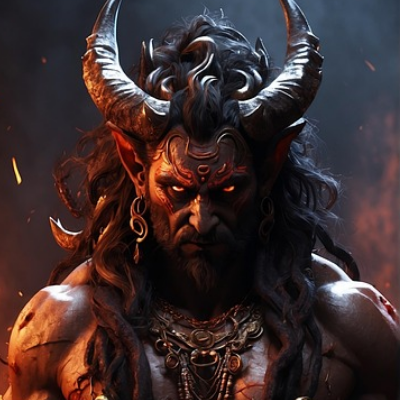
Raktasura — Danava Prince, Son of Mahishasura, Conqueror of Heaven, Slain by Parvati
Raktasura · Raktasura Danava · Son of Mahishasura · The Blood Demon
Raktasura is a Danava prince, son of Mahishasura, the buffalo-demon whose conquest of heaven and destruction at the hands of the goddess Durga forms the central narrative of the Devi Mahatmya of the Markandeya Purana. Driven by grief and the determination to avenge his father's death, Raktasura launched a campaign against the gods and succeeded in conquering the heavens, dethroning Indra, the king of the gods. He was ultimately slain by the goddess Parvati, who assumed a terrifying form to destroy him. His story is recorded in the Saura Purana and the Shiva Purana, which explicitly identify him as a biological son of Mahishasura. Within the broader Puranic tradition, his narrative belongs to the recurring cycle of demonic sons who undertake campaigns of vengeance following their father's destruction, a pattern shared with his brothers Gajasura I, who was slain by Shiva at Kashi, and Gajasura II, who was slain by Durga at Arunachala. Raktasura is distinct from other demon figures of the same name who appear elsewhere in the Puranic corpus in unrelated genealogical contexts.
✦ The Name
The name Raktasura is a Sanskrit compound of rakta, meaning blood or red, and asura, the Puranic designation for a powerful non-divine being standing in opposition to the gods. The compound therefore means the blood-demon or the red demon. The name places him within a well-established Puranic tradition of naming demonic figures after the quality or element most associated with their power or nature. The epithet Raktasura Danava specifies his membership in the Danava class of beings descended from the progenitor sage Kashyapa and his wife Danu, distinguishing him from other figures of the same name in the Puranic corpus who belong to different lineages entirely.
✦ Lineage
- Paternal great-grandfather: Kashyapa — the great progenitor sage, son of Marichi and grandson of Brahma, who fathered the Danava race through his wife Danu and the Deva race through his wife Aditi; the ultimate patrilineal ancestor of Raktasura's entire line.
- Paternal great-grandmother: Danu — a daughter of the progenitor Daksha and wife of Kashyapa; the mother of the Danava race, from whom the class takes its name.
- Paternal grandfather: Rambha — a Danava chieftain, son of Kashyapa and Danu, who performed intense austerities to obtain a boon of a supremely powerful son; he united with a she-buffalo named Mahishi near the river Indus while in buffalo form and was subsequently killed by a jealous rival bull.
- Paternal grandmother: Mahishi — the she-buffalo consort of Rambha who immolated herself on his funeral pyre; Mahishasura was born from that sacred fire, making her Raktasura's paternal grandmother through the miraculous birth narrative recorded in the Devi Bhagavata Purana.
- Father: Mahishasura — the buffalo-demon and king of the Danavas, who conquered the three worlds and expelled the gods from heaven; slain by the goddess Durga, manifested through the combined divine energies of Brahma, Vishnu, Shiva, and the assembled gods, as recorded in the Devi Mahatmya of the Markandeya Purana; his death was the direct cause of Raktasura's campaign of vengeance.
- Brother: Gajasura I — a son of Mahishasura who performed austerities to avenge their father's death, obtained a boon of invincibility from Brahma, seized Indra's capital, and directed his assault against the sacred city of Kashi; slain by Shiva, who wore his flayed hide as a garment, giving rise to the epithet Krittivasa, as recorded in the Shiva Purana.
- Brother: Gajasura II — a son of Mahishasura who likewise undertook austerities to avenge their father's death and directed his assault against the sacred site of Arunachala; slain by the goddess Durga in her protective form at that sacred mountain, as recorded in the Skanda Purana's Arunachala Mahatmya.
- Children: None recorded in any primary source.
✦ The Campaign of Vengeance and the Conquest of Heaven
Following the death of his father Mahishasura at the hands of the goddess Durga, Raktasura resolved to avenge him and to restore the dominion of the Mahishasura line over the three worlds. The Saura Purana and the Shiva Purana record that he undertook this campaign with sufficient force and power to accomplish what his father had done before him: he conquered the heavens and succeeded in dethroning Indra, the king of the gods, from his celestial sovereignty. This successful conquest of heaven distinguished Raktasura's campaign from those of his brothers Gajasura I and Gajasura II, whose narratives focus on their assaults against specific sacred sites — Kashi and Arunachala respectively — rather than upon the seizure of Indra's throne. In replicating his father's most defining act of power, Raktasura directly continued the political and military ambition of the Mahishasura lineage and restored, at least temporarily, the Danava supremacy over the divine order that his father's death had ended.
✦ The Destruction by Parvati
Raktasura was slain by the goddess Parvati, the consort of Shiva and the supreme goddess in her aspect as the daughter of Himavan, the king of mountains. In order to destroy him she assumed a terrifying form, a manifestation structurally parallel to that of Durga, who had assumed her own fierce form to destroy Raktasura's father Mahishasura. The texts identify this terrifying form of Parvati as the means by which the demon's power was overcome and his life ended. The precise details of the battle as given in the Saura Purana and Shiva Purana are not elaborated beyond the core account of his defeat and death at her hands. The theological significance of the episode lies in the parallel it establishes between the destruction of the father by one form of the supreme goddess and the destruction of the son by another form of the same divine feminine power, presenting the goddess in her dual manifestations of Durga and Parvati as the consistent force that brings the Mahishasura lineage's successive campaigns to an end.
✦ Theological Significance
Within the structure of the Mahishasura cycle, Raktasura's narrative reinforces the Shakta theological principle that the supreme goddess, whether manifesting as Durga, Chandika, Parvati, or any of her other forms, is the ultimate sovereign power capable of defeating demonic forces that the gods themselves cannot overcome. His successful conquest of heaven — an achievement that temporarily replicated his father's greatest victory — demonstrates that the threat represented by the Mahishasura lineage was not extinguished by Mahishasura's death alone. It required successive interventions by the goddess across multiple generations to fully bring the lineage's power to an end. The fact that Parvati assumes a terrifying form specifically to destroy him mirrors the original creation of Durga through the combined tejas of the gods to destroy Mahishasura, suggesting that each generation of this lineage required the goddess to manifest an aspect of her power appropriate to the scale of the threat presented.
✦ Connection to the Wider Genealogy
Raktasura stands alongside his brothers Gajasura I and Gajasura II as a terminal figure in the Danava lineage descending from Kashyapa and Danu through Rambha and Mahishi to Mahishasura. All three sons of Mahishasura undertook campaigns of vengeance following their father's death, and all three were destroyed by manifestations of the supreme divine power — Gajasura I by Shiva, Gajasura II by Durga at Arunachala, and Raktasura by Parvati in her terrifying form. No children are recorded for any of the three figures, and together their narratives constitute the complete closure of the Mahishasura lineage. Taken as a whole, the destruction of Mahishasura and his three sons by Durga, Shiva, and Parvati respectively presents the Shaiva-Shakta divine order as comprehensively extinguishing every branch of the Mahishasura line across successive generations and sacred sites.
✦ References
- Primary Sources:
- Saura Purana: One of the two principal sources explicitly identifying Raktasura as a biological son of Mahishasura; records his campaign of vengeance, his conquest of heaven, his dethroning of Indra, and his destruction by the goddess Parvati in her terrifying form.
- Shiva Purana: The second principal source explicitly naming Raktasura as a son of Mahishasura; corroborates the core narrative of his vengeance campaign and his defeat at the hands of Parvati.
- Markandeya Purana, Chapters 81–93 (Devi Mahatmya): The foundational source for the death of Mahishasura that forms the essential backdrop to Raktasura's story; does not mention Raktasura directly but establishes the paternal death that motivates his campaign.
- Devi Bhagavata Purana, Book 5, Chapters 2–3: Provides the full genealogical origin narrative covering Rambha, Mahishi, and the miraculous birth of Mahishasura, establishing the complete patrilineal context within which Raktasura belongs.
- Secondary Sources:
- Mani, Vettam. Puranic Encyclopaedia. Motilal Banarsidass, 1975: Provides consolidated entries on the Mahishasura lineage and notes the multiple figures named Raktasura across the Puranic corpus, assisting in the disambiguation of this specific figure from others of the same name.