
About
Gajasura I — Danava Prince, Son of Mahishasura, Slain by Shiva at Kashi
Gajasura · Gajasura Danava · Nila · The Elephant Demon of Kashi
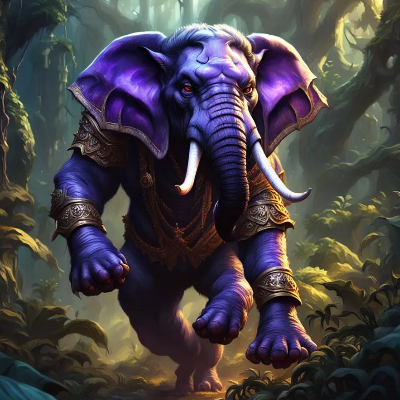
Gajasura I is a Danava prince, son of Mahishasura, the buffalo-demon whose conquest of heaven and destruction at the hands of the goddess Durga is the central narrative of the Devi Mahatmya of the Markandeya Purana. Driven by grief and the desire to avenge his father's death, Gajasura performed extreme austerities and obtained a boon of near-invincibility from Brahma, the creator. He subsequently terrorised the gods and ultimately attacked the sacred city of Kashi and the devotees of Shiva, the great god of destruction and liberation. Shiva confronted him, nullified his boon, and slew him with his trident, thereafter flaying the demon's hide and wearing it as a garment — an act that gave rise to the epithet Krittivasa, meaning one who is clad in hide. This victory is commemorated in Hindu tradition and iconography as the Gajasurasamhara, the destruction of the elephant demon, understood theologically as the conquest of ego. The primary source for his narrative is the Shiva Purana, Chapter 57, supplemented by the Linga Purana and the Skanda Purana. He is distinct from Gajasura II, another son of Mahishasura who undertook a parallel campaign of vengeance and was slain by the goddess Durga at the sacred site of Arunachala, as recorded in the Skanda Purana's Arunachala Mahatmya.
✦ The Name
The name Gajasura is a Sanskrit compound of gaja, meaning elephant, and asura, the Puranic designation for a powerful non-divine being standing in opposition to the gods. The compound therefore means the elephant-demon, reflecting both his form in combat and his demonic nature. The epithet Gajasura Danava specifies his membership in the Danava class of beings descended from the progenitor sage Kashyapa and his wife Danu. In certain texts, most notably the Kurma Purana, this figure is identified by the alternate name Nila, though the narrative attached to that name follows the same broad outline of an elephant-formed demon destroyed by Shiva. The name Krittivasa, meaning one clad in hide or wearer of the flayed skin, is the epithet acquired by Shiva himself as a consequence of this encounter, and is not a name applied to the demon.
✦ Lineage
- Paternal great-grandfather: Kashyapa — the great progenitor sage, son of Marichi and grandson of Brahma, who fathered the Danava race through his wife Danu and the Deva race through his wife Aditi; the ultimate patrilineal ancestor of Gajasura's entire line.
- Paternal great-grandmother: Danu — a daughter of the progenitor Daksha and wife of Kashyapa; the mother of the Danava race, from whom the class takes its name.
- Paternal grandfather: Rambha — a Danava chieftain, son of Kashyapa and Danu, who performed intense austerities to obtain a boon of a supremely powerful son; he united with a she-buffalo named Mahishi near the river Indus while in buffalo form and was subsequently killed by a jealous rival bull.
- Paternal grandmother: Mahishi — the she-buffalo consort of Rambha who immolated herself on his funeral pyre; Mahishasura was born from that sacred fire, making her Gajasura's paternal grandmother through the miraculous birth narrative recorded in the Devi Bhagavata Purana.
- Father: Mahishasura — the buffalo-demon and king of the Danavas, who conquered the three worlds and expelled the gods from heaven; slain by the goddess Durga, manifested through the combined divine energies of Brahma, Vishnu, Shiva, and the assembled gods, as recorded in the Devi Mahatmya of the Markandeya Purana; his death was the direct cause of Gajasura's campaign of vengeance.
- Brother: Gajasura II — another son of Mahishasura who likewise undertook austerities to avenge their father's death and waged war against the gods, directing his assault specifically against the sacred site of Arunachala; he was slain by the goddess Durga in her form as the protector of Arunachala, as recorded in the Skanda Purana's Arunachala Mahatmya.
- Children: None recorded in any primary source.
✦ The Austerities and the Boon
Following the death of his father Mahishasura at the hands of the goddess Durga, Gajasura was overcome with grief and the consuming desire for vengeance. In the manner characteristic of powerful Danava figures in the Puranic tradition, he resolved to acquire the divine power necessary to challenge the gods through the performance of extreme austerities. The Shiva Purana records that he stood upon his big toes for thousands of years, generating through the intensity of his tapas a spiritual heat so ferocious that it scorched and disturbed all three worlds. Brahma, the creator, propitiated by this immense exertion, appeared before him and offered a boon. Gajasura asked for invincibility, and Brahma granted it with a crucial qualification: he could not be killed by any being who was subject to or overwhelmed by lust or desire. This condition, embedded within the boon itself, contained the mechanism of his eventual destruction, as the tradition of Puranic boons frequently establishes an inherent vulnerability within the very protection that is granted.
✦ The Campaign of Terror and the Assault on Kashi
Armed with his boon and emboldened by the power it conferred, Gajasura launched his campaign against the gods. The Shiva Purana records that he seized Indra's capital in heaven, replicating the pattern of his father Mahishasura's earlier conquest. Blinded by pride at his own invincibility, he extended his aggression to the earthly plane and turned his attention to Kashi, the sacred city on the banks of the Ganga that is the most pre-eminent of all Shaiva pilgrimage sites, the city over which Shiva himself is held to preside as lord. By attacking Kashi and terrorising Shiva's devotees within it, Gajasura transformed his campaign from a political conflict with the gods into a direct assault upon the domain and the devotional community of Shiva himself.
✦ The Confrontation with Shiva and the Death of Gajasura
Shiva confronted Gajasura directly in response to his attack upon Kashi and its devotees. The critical theological point in this encounter, as the Shiva Purana presents it, is that the boon granted by Brahma — protection against any being overwhelmed by lust — was entirely without force against Shiva. Shiva bears the epithet Kama-dahana, the destroyer or burner of Kama, the god of desire and lust, having reduced Kama to ash by the fire of his third eye in a well-known episode of the Puranic tradition. He is therefore by his very nature the being most completely free of lust in the entire cosmos, and Gajasura's boon, which depended on his adversary being subject to desire, offered him no protection whatsoever against Shiva. Shiva pierced Gajasura with his trident, the trishula, and slew him. He then flayed the demon's hide from his body.
✦ The Dying Request and the Epithet Krittivasa
As Gajasura lay dying, he underwent a transformation in consciousness parallel in structure to that of his brother Gajasura II in the Arunachala narrative. Recognising the supreme sovereignty of Shiva and submitting to his power, Gajasura made a final request: that Shiva wear his flayed hide as a garment. Shiva accepted this request. From this acceptance arose one of Shiva's most celebrated epithets, Krittivasa, meaning he who wears the hide or he who is clothed in skin. The elephant hide thus became a permanent element of Shiva's iconographic identity, visible in sculptural and painterly representations of the god across the Hindu tradition. Gajasura's dying request transformed his defeat into a form of honour and perpetual association with the deity who destroyed him, a motif consistent with the Puranic principle that demons slain by the supreme deity attain a sanctified status through the very act of their destruction.
✦ Textual Variants and Inconsistencies
Several variant traditions attach to the narrative of Gajasura's destruction by Shiva. The Kurma Purana identifies the elephant-formed demon destroyed by Shiva under the alternate name Nila, presenting the same essential narrative of an elephant demon's defeat but without the detailed account of the boon's qualifying condition or the dying request found in the Shiva Purana. Regional Tamil traditions, including those associated with the Vazhuvoor temple, offer a substantially different origin for the elephant demon: in these accounts the creature was not a Danava prince at all but was conjured from a sacrificial fire by arrogant sages who wished to use it as a weapon against Shiva, removing the entire genealogical and filial-vengeance dimension of the narrative. This regional variant is a distinct tradition and should not be harmonised with the Shiva Purana account. A further variant tradition, found in some Puranic and popular accounts, states that the severed head of Gajasura was subsequently used to restore Lord Ganesha, the elephant-headed son of Shiva and Parvati, after his own head was accidentally removed; this detail is not uniformly attested across the major Mahapuranas and represents a narrative strand that links the Gajasurasamhara episode to the well-known account of Ganesha's origin. The identification of Gajasura I as a son of Mahishasura, which places him within the Danava lineage descending from Kashyapa and Danu, is the tradition recorded in the Shiva Purana and reflected in the iconographic understanding of the Gajasurasamhara as the destruction of a demon of Mahishasura's lineage.
✦ Theological and Iconographic Significance
The Gajasurasamhara, the destruction of the elephant demon by Shiva, is one of the major iconographic episodes of the Shaiva tradition. It is represented in sculpture across South and North India, most notably in the Nataraja temples and in Shaiva cave temples such as those at Ellora. In the theological interpretation of this episode, the elephant is understood as a symbol of pride and ego — gaja in certain symbolic readings being associated with the quality of uncontrolled arrogance — and Shiva's destruction of Gajasura represents the conquest of ego by divine consciousness. The boon structure of the narrative reinforces this reading: Gajasura's invincibility was contingent on his adversary being subject to desire, and his destruction came precisely from his failure to recognise that the being he challenged was entirely beyond desire. His pride blinded him to the nature of the god he confronted, and that blindness was the mechanism of his downfall. The wearing of the elephant hide by Shiva thereafter is understood as the god incorporating and displaying his conquest of ego, carrying the symbol of that victory as a permanent aspect of his divine form.
✦ Connection to the Wider Genealogy
Gajasura I stands alongside his brother Gajasura II as a terminal figure in the Danava lineage running from Kashyapa and Danu through Rambha and Mahishi to Mahishasura. Both sons of Mahishasura undertook campaigns of vengeance following their father's death, both obtained boons of near-invincibility through austerities, and both were ultimately destroyed by a supreme deity — Gajasura I by Shiva at Kashi and Gajasura II by Durga at Arunachala. No children are recorded for either figure in any primary source, and both narratives function as closure episodes for the Mahishasura cycle, bringing the lineage that began with Rambha's austerities to its final end across two separate sacred sites. The destruction of both sons by the two great deities of the Shaiva-Shakta tradition — Shiva and his Shakti Durga — creates a structural symmetry in which the entire Mahishasura lineage is brought to its conclusion by the divine pair together, each taking one of the lineage's final generation.
✦ References
- Primary Sources:
- Shiva Purana, Chapter 57: The principal primary source for Gajasura I's narrative; records his austerities, the boon obtained from Brahma with its qualifying condition, his assault on Indra's capital and Kashi, Shiva's confrontation and nullification of the boon through his nature as Kama-dahana, the slaying by trident, the flaying of the hide, and the dying request that gave rise to the epithet Krittivasa.
- Linga Purana: Corroborates the account of Shiva's destruction of the elephant demon and the iconographic significance of the episode within the Shaiva tradition.
- Skanda Purana: Contains references to the Gajasurasamhara episode in sections separate from the Arunachala Mahatmya, which deals with the distinct figure of Gajasura II.
- Kurma Purana: Identifies the elephant-formed demon destroyed by Shiva under the alternate name Nila; presents the same essential narrative without the detailed boon condition and dying request found in the Shiva Purana.
- Devi Mahatmya, Markandeya Purana, Chapters 81–93: The foundational source for the death of Mahishasura that forms the necessary backdrop to Gajasura I's story; does not mention Gajasura directly but establishes the paternal death that motivates his campaign.
- Devi Bhagavata Purana, Book 5, Chapters 2–3: Provides the full genealogical origin narrative covering Rambha, Mahishi, and the birth of Mahishasura, establishing the complete patrilineal context within which Gajasura I belongs.
- Secondary Sources:
- Mani, Vettam. Puranic Encyclopaedia. Motilal Banarsidass, 1975: Provides consolidated entries on Gajasura and the Gajasurasamhara episode, noting variant traditions and the multiple figures bearing this name across the Puranic corpus.
- Rao, T. A. Gopinatha. Elements of Hindu Iconography. Motilal Banarsidass, 1914: Documents the iconographic tradition of the Gajasurasamhara in temple sculpture and its theological interpretation as the conquest of ego, providing context for the episode's significance beyond the textual tradition.