
About
Raktabija — The Demon Whose Blood Spawned Armies
Raktabija · Raktavija · Raktavirya · Rambhasura reborn
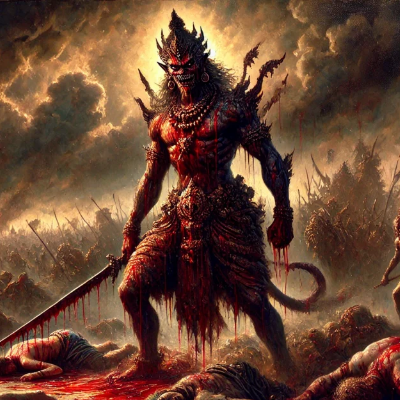
Raktabija is a powerful Asura — a demon — who figures as one of the principal commanders in the war between the divine forces and the demon brothers Shumbha and Nishumbha. His defining characteristic is a boon granted to him by the god Shiva: every drop of his blood that fell upon the earth would instantly generate a duplicate of himself, identical in size, strength, and ferocity, rendering him virtually indestructible by conventional means. He appears principally in the Devi Mahatmya, the celebrated hymn to the Goddess embedded within the Markandeya Purana, and in the Devi-Bhagavata Purana. Both texts identify him as the rebirth of the Asura king Rambha — also called Rambhasura — who was the father of the buffalo-demon Mahishasura. Raktabija and Mahishasura emerged simultaneously from Rambha's funeral pyre, making Raktabija Rambha reborn in a new form and Mahishasura's companion in birth. His destruction by the goddess Kali, who consumed his blood before it could reach the ground, forms one of the most theologically significant episodes in the Shakta textual tradition.
✦ The Name
The name Raktabija is a Sanskrit compound formed from rakta, meaning blood, and bija, meaning seed. The compound therefore translates as blood-seed or he whose seed is blood — a name that is not an epithet assigned in retrospect but a direct description of his essential supernatural nature. The variant form Raktavija, attested in the Devi-Bhagavata Purana, carries the same meaning with a minor orthographic difference. The name Raktavirya, occasionally applied to him, means he of bloody valour and places emphasis on his martial prowess rather than his reproductive capacity. The name Rambhasura — the form of Rambha from which he is reborn — combines the personal name Rambha with the suffix asura, marking him as a demon of that lineage.
✦ Lineage
- Previous birth (father): Rambha, also called Rambhasura — an Asura king, son of Danu and Kashyapa, who obtained a boon from the fire god Agni that he would have a desired son; he married a she-buffalo, fathered Mahishasura upon her, and was killed in a fight with a rival buffalo; Raktabija is Rambha reborn from his own funeral pyre in a new humanoid Asura form
- Grandfather (of previous birth): Danu — a primordial Asura progenitress, one of the daughters of the progenitor Daksha and wife of the sage Kashyapa; her descendants form the Danava clan of Asuras
- Grandfather (of previous birth): Kashyapa — the great sage and progenitor, father of Danavas, Devas, Nagas, and many other orders of being through his various wives
- Paternal uncle (of previous birth): Karambha — brother of Rambha, who performed austerities alongside him at Pancanada but was killed by Indra, the king of the gods, who drowned him in the guise of a crocodile before Rambha's boon could be fulfilled
- Birth-companion: Mahishasura — the great buffalo-demon, son of Rambha and the she-buffalo, who emerged simultaneously from Rambha's funeral pyre; Raktabija and Mahishasura are thus born of the same pyre-event, with Mahishasura being the son of Rambha's prior life and Raktabija being Rambha himself reborn; Mahishasura later became king of the Asuras and conquered the three worlds before being slain by the goddess Durga
- Commanders served under: Shumbha and Nishumbha — two Asura brothers who, having obtained boons making them invincible against male beings, conquered the heavens, expelled the Devas from their stations, and commanded the army in which Raktabija served as a senior general
- Fellow commanders: Dhumralochana, Chanda, and Munda — Asura generals who preceded Raktabija into battle against the Goddess and were destroyed before him
✦ The Birth from the Funeral Pyre
The Devi-Bhagavata Purana and the Vamana Purana both record the circumstances of Raktabija's origin in connection with the death of the Asura king Rambha. Rambha had obtained a boon from Agni — the god of fire — that he would have a son by the female he desired. On his return journey he encountered a she-buffalo and took her as his consort, eventually fathering a child upon her. He brought her to the underworld realm of Patala to protect her from rival buffalo bulls. There he was killed when another buffalo, inflamed with desire for Rambha's consort, gored him fatally with its horns. Rambha's consort, the she-buffalo, then threw herself upon his funeral pyre.
From the centre of that burning pyre two beings emerged. The she-buffalo gave birth to Mahishasura from her womb even as she died in the flames — he came forth as a powerful Danava in buffalo form. Simultaneously, Rambha himself rose from the fire transformed — his prior self consumed and a new form arising, driven according to the Devi-Bhagavata Purana by his affection for his son. In this new form he was known as Raktabija. The two thus shared a single birth-event: one was the son of Rambha's prior life, the other was Rambha himself continuing in a new body. Both grew rapidly to full Asura power, vowed to avenge Rambha's death, and eventually joined forces with Shumbha and Nishumbha in their war against the Devas.
✦ The Boon of Blood-Replication
After his emergence from the pyre Raktabija performed severe austerities directed at the god Shiva — the destroyer deity who is also a great grantor of boons to devoted supplicants — and obtained from him a specific and extraordinary boon: that every single drop of his blood contacting the earth would immediately produce from that point of contact a new Asura identical to himself in form, strength, weapons, and ferocity. The practical consequence of this boon was that any weapon that wounded him and drew blood would multiply rather than diminish the enemy. The more vigorously his opponents struck him, the vaster the army that arose around him. Conventional combat was thus structurally incapable of defeating him, regardless of the power of the warrior who wielded the weapon.
✦ The Battle Against the Goddess and the Matrikas
The broader context of Raktabija's final battle is the war described across the second and third episodes of the Devi Mahatmya. Shumbha and Nishumbha, having conquered Svarga — the heavenly realm — and expelled Indra and the other Devas from their positions, were challenged by the Goddess in her form as Ambika. The Goddess dispatched the demons' commanders one by one. Dhumralochana was destroyed first. Chanda and Munda were slain by Kali — the ferocious black goddess who sprang from the brow of Ambika — who brought their severed heads to her mistress and thereby earned the epithet Chamunda. As the demon army continued to suffer defeat, Raktabija entered the battle at the head of a large Asura force.
The Goddess and the Matrikas — the group of fierce divine mother-goddesses who had emerged from the bodies of the great male gods, including Brahmani from Brahma, Maheshvari from Shiva, Kaumari from Kumara, Vaishnavi from Vishnu, Varahi from Varaha, Narasimhi from Narasimha, and Aindri from Indra — engaged Raktabija with their weapons. Every blow they struck drew blood. Every drop of that blood that fell upon the earth became another Raktabija, fully formed, fully armed, and equally powerful. The battlefield multiplied rapidly with his copies until the divine forces found themselves fighting not one demon but an ever-expanding multitude of identical opponents. The Matrikas and the Goddess struck harder and with greater urgency; the army of duplicates grew proportionally faster. No increase in the application of force could alter the outcome.
✦ The Destruction of Raktabija by Kali
At the crisis of the battle the Goddess turned to Kali and gave her the decisive instruction: Kali was to stretch her mouth across the battlefield and consume every drop of Raktabija's blood before it could reach the ground. While the Matrikas continued to strike Raktabija with their weapons, Kali held her vast open mouth over the wound sites and drank the flowing blood directly as it left his body. Each existing duplicate she seized and devoured. With his blood now flowing into Kali's mouth rather than onto the generative earth, the mechanism of replication was broken. No new duplicates arose. Those already formed were consumed. Raktabija, drained progressively of his blood and the supernatural power seated within it, weakened and finally fell, killed by the accumulated wounds inflicted by the divine army.
The Devi Mahatmya describes Kali as intoxicated by the vast quantity of blood she consumed — her eyes reddened, her form swollen with absorbed power. This detail has been the subject of extensive iconographic and theological reflection within the Shakta tradition. The act of drinking is simultaneously a martial strategy, a ritual of absorption, and a demonstration of the Goddess's unique capacity to contain and neutralise a power that would overwhelm any bounded or limited form.
✦ Textual Variants and Inconsistencies
The Devi Mahatmya within the Markandeya Purana does not itself provide the backstory of Raktabija's origin as Rambha reborn. It introduces him directly as a commander of Shumbha and Nishumbha's army without reference to his prior life. The account of his birth from Rambha's funeral pyre belongs to the Devi-Bhagavata Purana (5th Skandha) and the Vamana Purana (Chapter 17). These two sources agree on the essential event — Rambha reborn as Raktabija from the pyre alongside Mahishasura — but the Devi-Bhagavata provides more narrative elaboration and theological framing.
The Devi-Bhagavata Purana uses the form Raktavija rather than Raktabija in its account of the pyre-birth, while the Devi Mahatmya and the Vamana Purana use Raktabija. These are variant spellings of what is understood to be the same figure and the same name.
The boon-granting deity is identified as Shiva in the accounts given in the Vamana Purana and sources deriving from it. Some later regional and commentarial traditions attribute the boon instead to Brahma — the creator god — but this attribution is not firmly established in the earliest stratum of the primary sources. The identification of Shiva as the boon-granter has the stronger textual basis.
The number and composition of the Matrikas who fight alongside Kali against Raktabija varies between recensions. The Devi Mahatmya names a specific group of seven or eight, while the Devi-Bhagavata and other Shakta texts sometimes expand this roster. All versions are consistent that Kali alone performs the act of drinking the blood and that this act is the specific and decisive cause of Raktabija's death.
✦ Theological and Philosophical Significance
Raktabija occupies a theologically significant position in the Shakta tradition because he embodies a form of destructive power that multiplies when attacked through ordinary force. His boon represents a challenge that cannot be resolved by the usual instruments of divine power — weapons, strength, heroism — held by the male gods. The Devi's resort to Kali and the strategy of consumption rather than combat encodes a key Shakta theological argument: the Goddess possesses a mode of action entirely beyond the range of masculine divine power.
Commentators within the tradition have read the Raktabija episode allegorically. His blood-seeds have been interpreted as representing mental tendencies — desires, compulsions, habitual thoughts — that proliferate precisely when they are directly suppressed or attacked. Kali's method of consuming rather than striking has been read as the spiritual approach of radical absorption, in which the root of a tendency is dissolved rather than resisted. The episode thus carries a contemplative dimension alongside its narrative and cosmological ones.
The connection between Raktabija and Rambha adds a further dimension: the boon that Rambha originally received from Agni — to have a son who would challenge the gods — finds its fullest and most paradoxical expression not in Mahishasura but in Rambha's own rebirth as Raktabija, whose blood itself becomes generative. The seed promised by Agni is literalised in the blood-seed of his reborn form.
✦ Iconography
Raktabija does not have an independent tradition of worship or a dedicated iconographic programme. He appears in visual representations always within the scene of his destruction, in association with Kali and the Matrikas. In sculptural and painted illustrations of the Devi Mahatmya — common particularly in eastern Indian traditions — he is depicted as a large, armed Asura warrior whose body streams blood, with diminutive duplicates arising from the drops that have already fallen at his feet. Kali stands before or above him with her tongue extended and her mouth open, consuming the stream of blood. The compositional contrast between the proliferating demon and the all-consuming Goddess is the iconographic core of the image.
✦ Connection to the Wider Genealogy
Raktabija belongs genealogically to the Danava lineage through his prior birth as Rambha. Rambha was the son of Danu — a primordial Asura progenitress and daughter of the patriarch Daksha — and the great sage Kashyapa, whose unions with Daksha's daughters produced the various orders of beings including Devas, Asuras, Nagas, and others. Through this descent Raktabija shares lineage with the broader Danava clan.
His birth-companion Mahishasura — who emerged from the same funeral pyre — is the son of Rambha's prior form and the she-buffalo, and therefore occupies an unusual dual relationship to Raktabija: son of Raktabija's former self, and simultaneous co-emergent from the pyre. Mahishasura went on to become the supreme Asura king who conquered the three worlds before being destroyed by the goddess Durga — an event narrated in the first great episode of the Devi Mahatmya, which precedes the Raktabija episode in the same text.
Within the army of Shumbha and Nishumbha, Raktabija functions as a senior commander alongside Dhumralochana, Chanda, and Munda — all of whom are destroyed before him in the narrative sequence of the Devi Mahatmya. He represents the final and most formidable obstacle before the Goddess's direct confrontation with Shumbha and Nishumbha themselves.
✦ References
- Primary Sources
- Markandeya Purana, Devi Mahatmya, Chapters 88–90: The principal source for the Raktabija battle episode; describes his boon, the proliferation of duplicates, and Kali's defeat of him through drinking his blood; does not provide his origin story.
- Devi-Bhagavata Purana, Skandha 5, Chapter 2: Provides the account of Raktabija's birth as the rebirth of Rambha from the funeral pyre, simultaneous with the birth of Mahishasura; uses the name Raktavija; also retells the battle episode with expanded narrative detail.
- Vamana Purana, Chapter 17: Corroborates the Devi-Bhagavata account of Rambha's rebirth as Raktabija from the funeral pyre alongside Mahishasura; names Shiva as the deity who granted the blood-replication boon.
- Kalika Purana: Contains references to the Raktabija episode within the broader context of Kali's mythology and iconography.
- Secondary and Reference Sources
- Vettam Mani, Puranic Encyclopaedia (1975): Provides a summary entry for Raktabija cross-referencing the Devi Mahatmya, Devi-Bhagavata Purana, and Vamana Purana accounts, including the identification of Raktabija as Rambha reborn.
- Thomas B. Coburn, Devi-Mahatmya: The Crystallization of the Goddess Tradition (1984): Analyses the Raktabija episode in the context of the Devi Mahatmya's theological argument for the supremacy of the Goddess.
- David Kinsley, Hindu Goddesses: Visions of the Divine Feminine in the Hindu Religious Tradition (1986): Discusses Kali's role in the Raktabija episode and its significance for Kali's iconographic and theological tradition.
- C. Mackenzie Brown, The Triumph of the Goddess (1990): Analyses the Devi-Bhagavata Purana's treatment of the Raktabija narrative in comparison with the Devi Mahatmya version.
- Wisdomlib.org, entry on Raktabija and Devi-Bhagavata Purana Book 5 Chapter 2: Aggregates verse references from multiple Puranic sources and provides an English rendering of the relevant Devi-Bhagavata passage describing the pyre-birth of Raktabija and Mahishasura.