
About
Shumbha — Danava King, Conqueror of Heaven, Slain by the Goddess Ambika
Shumbha · Shumbhasura · Son of Kashyapa · Brother of Nishumbha
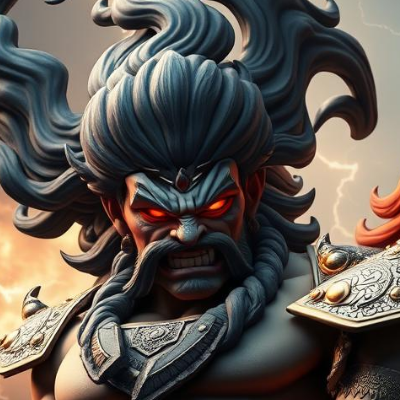
Shumbha is a Danava king of supreme power who, together with his younger brother Nishumbha, conquered the three worlds, dethroned Indra, and seized the sovereignty of heaven. He belongs to the Danava lineage descended from the progenitor sage Kashyapa and his wife Danu, the mother of the Danava race. His conflict with the goddess Ambika, a radiant manifestation of Parvati, forms the third and final great battle narrative of the Devi Mahatmya, which constitutes the central section of the Markandeya Purana and stands as the foundational text of the Shakta goddess tradition. Shumbha's campaign began with an attempted marriage proposal to the goddess and escalated through the systematic destruction of his finest generals — Dhumralochana, Chanda, Munda, and Raktabija — before culminating in his personal entry into battle and his death at the goddess's trident. The Devi Bhagavata Purana and the Harivamsha corroborate his genealogy and provide supplementary detail. In Shakta philosophical interpretation he represents the principle of Asmita, the false sense of ego or I-ness, whose destruction by the goddess signifies the liberation of consciousness from the delusion of a separate self.
✦ The Name
The name Shumbha does not receive a detailed etymological gloss in the primary sources. It functions as a proper noun identifying this Danava king throughout the tradition. The extended form Shumbhasura combines his name with the suffix asura, the Puranic term for a powerful non-divine being, to emphasise his demonic classification. His name is almost invariably paired with that of his brother Nishumbha across all primary sources, the two forming an inseparable dyad in the tradition's treatment of this episode.
✦ Lineage
- Father: Kashyapa — the great progenitor sage, son of Marichi and grandson of Brahma, who fathered the Danava race through his wife Danu and the Deva race through his wife Aditi; the patrilineal ancestor of Shumbha's line.
- Mother: Danu — a daughter of the progenitor Daksha and wife of Kashyapa; the mother of the entire Danava race, which takes its collective name from her.
- Brother: Nishumbha — the younger brother and constant companion of Shumbha in all his exploits; a Danava of great physical power and aggressive combat temperament who served as the foremost military force of the two brothers' joint dominion; he entered the final battle before Shumbha and was slain first by the goddess, his death being marked by the uniquely described emergence of a second figure from within his body as he fell; his destruction is recorded in the Devi Mahatmya, Chapters 9 and 10.
- Children: None recorded in any primary source.
✦ The Austerities and the Boon
The Devi Bhagavata Purana records that Shumbha and Nishumbha performed intense and prolonged austerities at the sacred site of Pushkara, propitiating Brahma, the creator, in order to obtain boons of invincibility. Their request was for protection against death at the hands of any man, god, or beast. Brahma granted the boon as asked. The critical omission in their request — protection against a woman — followed the same pattern of oversight that had undone Mahishasura before them, both demons having considered women too weak and inconsequential to pose any threat worth guarding against. This neglect of the feminine as a potential source of sovereign power became the precise mechanism of their destruction, as the goddess manifested specifically to fill the gap their boon had left open.
✦ The Conquest of Heaven
Armed with their boons, Shumbha and Nishumbha waged war against the gods with overwhelming force. They defeated Indra and the assembled Devas and seized control of the three worlds. The Devi Mahatmya records that they appropriated the functions, prerogatives, and honours of the principal gods — taking for themselves the offices of Surya, Indra, Yama, Vayu, Varuna, and the other cosmic functionaries. The dispossessed gods were driven from heaven and wandered without their domains. In this state of defeat and dispossession they prayed to the supreme goddess, reciting her praise and invoking her power to deliver them from Shumbha's dominion, as they had done in the earlier episode of Mahishasura's conquest. The goddess appeared to them in the form of Ambika, radiant and supreme, and undertook the task of the demons' destruction.
✦ The Marriage Proposal and the Vow of the Goddess
The conflict between Shumbha and the goddess was initiated not by military aggression but by desire. Shumbha's commander Sugriva brought him news of the goddess Ambika's extraordinary beauty as she dwelt in the Himalayas, and Shumbha, captivated by the report, sent Sugriva as his messenger to propose marriage to her. The Devi Mahatmya records the exchange in which the goddess received Sugriva's proposal and gave her response: she had made a foolish vow in her youth, she said, that she would only accept as her husband the one who could defeat her in battle and overcome her pride. She therefore invited Shumbha or Nishumbha, or any champion they chose, to come and fight her and win her hand in that manner. Shumbha, receiving this response, interpreted it as a provocation rather than recognising it as the terms under which his destruction had been arranged, and sent his generals one by one to subdue the goddess by force.
✦ The Destruction of the Generals
Shumbha dispatched his finest commanders in successive waves against the goddess, each of whom was destroyed. Dhumralochana, sent first, was killed by the goddess with a single exhalation of breath. Chanda and Munda, two formidable commanders sent next with a large army, were slain by the goddess's manifestation as Kali, who appeared from her brow in a ferocious dark form and devoured the demons' forces before cutting off the two generals' heads. Kali brought their heads to the goddess as an offering, giving rise to the goddess's epithet Chamunda. Finally Raktabija, a commander of special and terrible power whose boon caused a new demon of equal strength to arise from every drop of his blood that fell upon the earth, was sent against her. The goddess overcame Raktabija by directing Kali to drink every drop of his blood before it could reach the ground, preventing the multiplication of his form, until the original Raktabija was emptied of blood and slain. With all his generals destroyed, Shumbha could no longer avoid personal engagement in the battle.
✦ The Final Battle and the Death of Shumbha
Shumbha and Nishumbha entered the battlefield personally after the destruction of all their generals. Nishumbha, the more impulsive and physically aggressive of the two brothers, engaged the goddess first and was slain. Witnessing his brother's fall, Shumbha advanced and confronted the goddess directly in a cosmic duel of tremendous scale involving every class of divine and demonic weapon. At a critical moment in this duel, Shumbha taunted the goddess, accusing her of fighting with the assistance of others — the Matrikas, the Seven Mother goddesses who had appeared as her warrior attendants — and declaring that she did not truly fight alone. The Devi Mahatmya records the goddess's response as one of the text's most theologically significant declarations: she absorbed all the other goddesses back into her own body and declared that she alone existed, that all the forms that appeared as separate were manifestations of herself, and that she had always been and would always be alone. Having made this declaration of her absolute non-dual sovereignty, she resumed the battle as the sole combatant. After an extended exchange of weapons, she drove her trident through Shumbha's chest, and he fell dead. With his death the three worlds were restored to the gods and the natural order re-established.
✦ Textual Variants and Inconsistencies
The Devi Mahatmya of the Markandeya Purana is the foundational and most detailed source for the entire Shumbha-Nishumbha narrative. The Devi Bhagavata Purana provides supplementary genealogical material and expands certain episodes but does not substantially contradict the Devi Mahatmya's account. The Harivamsha corroborates the genealogical placement of Shumbha within the Danava lineage of Kashyapa and Danu. No major contradictions between these sources on the essential narrative exist, though the Devi Bhagavata's treatment is more expansive and adds devotional and philosophical framing absent from the Markandeya Purana's more tightly structured account.
✦ Theological Significance
Within the Shakta philosophical tradition, Shumbha is understood as a representation of Asmita, the Sanskrit term for the sense of I-ness or false ego — the fundamental misidentification of the self with the individual body and mind rather than with the universal consciousness that underlies all existence. His taunt to the goddess that she does not fight alone, and her response that she is always and only alone because all apparent multiplicity is her own manifestation, encapsulates the central non-dual teaching of the Devi Mahatmya. Shumbha's inability to perceive the goddess's absolute sovereignty and his persistent belief that he could overcome her through accumulated military force represents the ego's perpetual failure to recognise the primacy of divine consciousness. His destruction is therefore not merely a narrative event but a philosophical statement: the false ego, however powerful and entrenched, is inevitably dissolved by the sovereign power of the supreme goddess. The commentator Bhaskararaya and subsequent Shakta philosophers have developed this reading extensively, placing Shumbha at the metaphysical centre of the Devi Mahatmya's teaching on liberation.
✦ Connection to the Wider Genealogy
Through his parentage as a son of Kashyapa and Danu, Shumbha belongs to the same broad Danava lineage that includes Rambha, the father of Mahishasura, Dhenukasura, Pralambhasura, Arishtasura, Kesi, and the other Danava figures of the Puranic tradition. He and Nishumbha stand as the most politically powerful of this lineage's members after Mahishasura himself, being the only Danavas other than Mahishasura to achieve the full conquest of heaven and the complete displacement of the gods from their sovereignty. No children are recorded for Shumbha in any primary source, and his line ends entirely with his death at the goddess's trident.
✦ References
- Primary Sources:
- Markandeya Purana, Chapters 81–93 (Devi Mahatmya), specifically Chapters 7–10: The foundational and most authoritative source for the Shumbha narrative; provides the full account of the marriage proposal, the vow of the goddess, the successive destruction of the generals, the final battle, the goddess's declaration of non-dual sovereignty, and Shumbha's death by trident.
- Devi Bhagavata Purana: Provides the genealogical detail of Shumbha's parentage as a son of Kashyapa and Danu, supplements the narrative of the austerities at Pushkara, and expands the devotional and philosophical framing of the episode.
- Harivamsha: Corroborates Shumbha's classification within the Danava lineage of Kashyapa and Danu.
- Secondary Sources:
- Coburn, Thomas B. Devi-Mahatmya: The Crystallization of the Goddess Tradition. Motilal Banarsidass, 1984: The most thorough scholarly analysis of the Devi Mahatmya's textual history and theological significance; essential for understanding the philosophical dimensions of the Shumbha narrative.
- Mani, Vettam. Puranic Encyclopaedia. Motilal Banarsidass, 1975: Provides a consolidated summary of Shumbha's narrative drawing on multiple Puranic sources.
- Bhaskararaya. Guptavati Commentary on the Devi Mahatmya: The classical Shakta philosophical commentary that develops the interpretation of Shumbha as Asmita and situates his destruction within the non-dual theological framework of the text.