
About
Nishumbha — Danava Prince, Warrior Brother of Shumbha, Slain by the Goddess Ambika
Nishumbha · Nishumbhasura · Son of Kashyapa · Brother of Shumbha
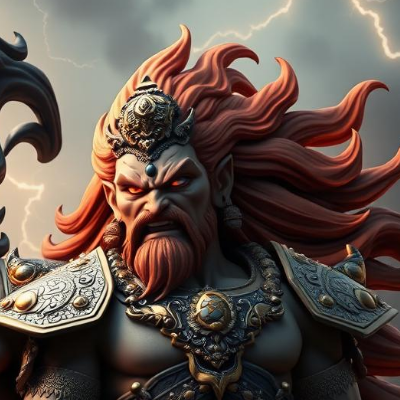
Nishumbha is a Danava prince and the younger brother of Shumbha, the Danava king who conquered the three worlds and dethroned Indra. He belongs to the Danava lineage descended from the progenitor sage Kashyapa and his wife Danu, the mother of the Danava race. Within the joint dominion he shared with Shumbha, Nishumbha served as the foremost military force — the action-oriented, combat-aggressive counterpart to his brother's commanding and strategic temper. He is distinguished in the Devi Mahatmya primarily by his weapon specialisation, his dogged persistence in battle, and by the uniquely described supernatural circumstances of his death, in which a second figure emerged from within his body as the goddess's trident split him open, making him the only demon in the text from whom such an internal figure arises during his destruction. His narrative is recorded principally in the Devi Mahatmya of the Markandeya Purana, Chapters 9 and 10, with genealogical corroboration from the Devi Bhagavata Purana and the Harivamsha. In Shakta philosophical interpretation he represents Mamata, the principle of attachment or my-ness, whose destruction alongside Shumbha's ego signifies the complete liberation of consciousness from both self-delusion and possessive clinging.
✦ The Name
The name Nishumbha does not receive a specific etymological gloss in the primary sources. It functions as a proper noun paired throughout the tradition with the name of his brother Shumbha, the two names forming a fixed dyad that appears consistently together across the Devi Mahatmya, the Devi Bhagavata Purana, and the Harivamsha. The extended form Nishumbhasura combines his name with the suffix asura to emphasise his demonic classification within the Puranic scheme.
✦ Lineage
- Father: Kashyapa — the great progenitor sage, son of Marichi and grandson of Brahma, who fathered the Danava race through his wife Danu and the Deva race through his wife Aditi; the patrilineal ancestor of Nishumbha's line.
- Mother: Danu — a daughter of the progenitor Daksha and wife of Kashyapa; the mother of the entire Danava race, which takes its collective name from her.
- Brother: Shumbha — the elder brother and king of the Danava dominion; a figure of supreme political and military ambition who conquered the three worlds and dethroned Indra; he directed the campaign against the goddess through successive generals before entering battle personally following Nishumbha's death; he was slain by the goddess Ambika with her trident after she absorbed all her warrior attendants back into herself and declared her absolute non-dual sovereignty; his narrative is recorded in the Devi Mahatmya, Chapters 7 through 10.
- Children: None recorded in any primary source.
✦ Character and Warrior Persona
The Devi Mahatmya distinguishes the two brothers in temperament and combat style with sufficient clarity to establish Nishumbha as an independent martial personality. Shumbha is presented primarily as a king and commander — the figure who receives intelligence, deliberates, sends messengers, dispatches generals, and directs the campaign from a position of sovereign authority. Nishumbha, by contrast, is presented as a warrior of immediate and intense physical aggression. He is associated in the text with the sword and shield as his characteristic weapons, and his shield is described as radiantly brilliant in its appearance. While Shumbha remained in his sovereign position sending wave after wave of generals against the goddess, Nishumbha was more directly drawn to the field of battle, characterised by an impulsive energy and a dogged, persistent combat drive that distinguished his personal style from his brother's more calculated approach.
✦ The Re-entry Episode
The Devi Mahatmya in Chapter 9 records a specific episode that illustrates Nishumbha's particular combat temperament. During the course of the great battle, the goddess struck him with sufficient force to render him momentarily unconscious. This setback, which might have prompted a withdrawal to regroup or to consult with his brother, produced in Nishumbha precisely the opposite response. Upon regaining consciousness he immediately returned to the battle with intensified and frenzied energy, plunging back into direct engagement with the goddess without pause or hesitation. This episode of re-entry after being knocked down, presented as a manifestation of singular and dogged persistence rather than strategic recalibration, is one of the specific narrative details that characterises Nishumbha as the more unreservedly physical and impulsive of the two brothers, the force to his brother's mind.
✦ The Death of Nishumbha and the Emergence of the Second Figure
Nishumbha entered the final battle alongside his brother Shumbha but engaged the goddess first, consistent with his more immediately aggressive nature. After a fierce exchange of arrows and spears, the goddess drove her trident into Nishumbha's body with decisive force. The Devi Mahatmya then records the most singular event of the entire Nishumbha episode: as the trident split Nishumbha's body open, a second figure — a distinct and powerful being described as a manifestation of his remaining life-force or an inner demon contained within him — emerged partway from the wound, from the region of his heart, and cried out to the goddess to stop. The goddess responded without alarm or hesitation. She laughed and, while simultaneously completing Nishumbha's destruction, severed the head of this emerging figure with her sword before it could fully exit the body. Both Nishumbha and the figure within him were thus destroyed in a single sustained action. This episode is unique in the Devi Mahatmya and has no parallel in the deaths of any other demon described in the text, making Nishumbha the only figure in the narrative from whose dying body a second warrior emerges and is separately dispatched.
✦ Textual Variants and Inconsistencies
The Devi Mahatmya of the Markandeya Purana is the primary and most detailed source for Nishumbha's narrative. The Devi Bhagavata Purana provides genealogical corroboration and a more expansive devotional framing of the brothers' story but does not substantially alter or contradict the Devi Mahatmya's account of Nishumbha's character or death. The Harivamsha confirms his Danava lineage. The episode of the second figure emerging from Nishumbha's body is specific to the Devi Mahatmya and is not elaborated or significantly varied across other major Puranic sources, though the commentarial tradition, particularly Bhaskararaya's Guptavati commentary, has developed its philosophical interpretation extensively.
✦ Theological Significance
In the Shakta philosophical tradition, Nishumbha is understood as a representation of Mamata, the Sanskrit term for the sense of my-ness or possessive attachment — the deep-seated identification of the self with what one regards as one's own: one's possessions, relationships, body, and accumulated identity. Where his brother Shumbha represents the false ego's claim of I-ness, Nishumbha represents its companion claim of my-ness, the two together forming the complete structure of the deluded individual self. The emergence of the second figure from within Nishumbha's body at the moment of his destruction is interpreted by Bhaskararaya and subsequent commentators as a vivid illustration of the stubbornness and tenacity of deep-seated attachment: even when the gross form of Mamata is pierced and destroyed, the inner voice of possessive clinging attempts to survive, crying out in protest at its own dissolution. The goddess's simultaneous decapitation of this emerging figure together with the completion of Nishumbha's destruction signifies that the divine power of consciousness destroys not only the manifest form of attachment but also its subtlest surviving residue in a single sovereign act.
✦ Connection to the Wider Genealogy
Through his parentage as a son of Kashyapa and Danu, Nishumbha belongs to the same broad Danava lineage that includes his brother Shumbha, Rambha, Dhenukasura, Pralambhasura, Arishtasura, Kesi, and the other Danava figures of the Puranic tradition. He stands alongside Shumbha as the second of the two most politically powerful Danavas after Mahishasura to achieve the full conquest of heaven. No children are recorded for Nishumbha in any primary source, and his line ends entirely with his death in the final battle of the Devi Mahatmya's third episode. His destruction precedes that of his brother Shumbha and serves in the narrative as the event that propels the elder brother into his own final confrontation with the goddess.
✦ References
- Primary Sources:
- Markandeya Purana, Devi Mahatmya, Chapters 9 and 10: The principal and most detailed source for Nishumbha's individual narrative; provides the account of his weapon specialisation with sword and shield, the re-entry episode following his temporary unconsciousness, the final battle, the piercing by the goddess's trident, the emergence of the second figure from his body, and the goddess's simultaneous decapitation of that figure and completion of his destruction.
- Devi Bhagavata Purana: Provides genealogical detail of Nishumbha's parentage as a son of Kashyapa and Danu and supplements the narrative with devotional and philosophical framing.
- Harivamsha: Corroborates Nishumbha's classification within the Danava lineage of Kashyapa and Danu.
- Secondary Sources:
- Coburn, Thomas B. Devi-Mahatmya: The Crystallization of the Goddess Tradition. Motilal Banarsidass, 1984: The most thorough scholarly analysis of the Devi Mahatmya's textual history and theological significance; essential for understanding the philosophical dimensions of Nishumbha's role and death within the text.
- Mani, Vettam. Puranic Encyclopaedia. Motilal Banarsidass, 1975: Provides a consolidated summary of Nishumbha's narrative drawing on multiple Puranic sources.
- Bhaskararaya. Guptavati Commentary on the Devi Mahatmya: The classical Shakta philosophical commentary that develops the interpretation of Nishumbha as Mamata and provides the most detailed reading of the second figure emerging from his body as the inner voice of deep-seated attachment refusing dissolution.