
About
Chanda — Danava General of Shumbha, Scout and Commander, Slain by Kali
Chanda · Chandasura · Parshvachara of Shumbha · The Voice of the Danava Command
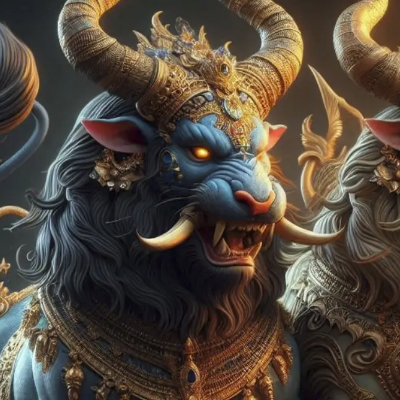
Chanda is a Danava general and Parshvachara — an attendant who moves alongside and scouts the terrain — in the service of Shumbha, the Danava king who conquered the three worlds and dethroned Indra. He belongs to the Danava lineage of Kashyapa and Danu, the primordial progenitor pair of the Danava race, and is addressed in the Devi Mahatmya as Danavendra, a chief among Danavas. Together with his brother Munda, he served as the foremost field commander and intelligence officer of Shumbha's army. He is distinguished in the tradition as the voice of the pair — the figure who first articulates their intelligence report to Shumbha and issues challenges on behalf of the Danava command. Chanda and Munda were the first to discover the goddess Ambika dwelling in the Himalayan mountains and reported her presence to Shumbha, thereby initiating the central conflict of the Devi Mahatmya's third episode. When subsequently dispatched with a vast army to capture the goddess, they became the proximate cause of the manifestation of Kali from the goddess's brow, and were decapitated by Kali in the battle that followed. Their deaths gave rise to Kali's celebrated epithet Chamunda, a contraction of their two names. The primary source for Chanda's narrative is the Devi Mahatmya of the Markandeya Purana, Chapters 5 and 7. The Skanda Purana's Prabhas Khanda provides supplementary detail regarding their prior austerities to the sun god Surya.
✦ The Name
The name Chanda derives from the Sanskrit root meaning fierce, passionate, or intensely energetic. In the esoteric and philosophical interpretation of the Shakta tradition, Chanda represents the quality of fierce argumentativeness and the aggressive force of uncontrolled passion — the tendency of the ego-driven mind to assert itself loudly and challenge whatever stands against its will. The extended form Chandasura combines his name with the suffix asura to emphasise his demonic classification. His name is paired inseparably with that of his brother Munda throughout the primary sources, and it is the combination of their two names — Chanda and Munda — that yields the epithet Chamunda, the name by which Kali came to be known following their destruction.
✦ Lineage
- Lineage class: Danava — belonging to the primordial class of beings descended from the progenitor sage Kashyapa and his wife Danu, daughter of Daksha; Chanda is addressed as Danavendra in the Devi Mahatmya, confirming his standing as a chief among Danavas; his specific placement within the listing of Danu's hundred sons is a standard Puranic grouping for commanders of the Danava class rather than an explicitly stated birth-narrative in any single primary text.
- Brother: Munda — a Danava general and Parshvachara of Shumbha, full brother and constant companion of Chanda in all episodes; characterised in the tradition as the action-oriented half of the pair, the first to charge with the army into battle; he was decapitated alongside Chanda by the goddess Kali in the battle recorded in Chapter 7 of the Devi Mahatmya.
- Affiliation: Shumbha — the Danava king who conquered the three worlds and dethroned Indra; Chanda served as one of his foremost field commanders and Parshvacharas, functioning as the voice who articulated intelligence and issued challenges on behalf of the Danava command.
- Children: None recorded in any primary source.
✦ The Austerities to Surya
The Skanda Purana's Prabhas Khanda, in its sections dealing with the Arka-Sthalas or sun-shrines, records that Chanda and Munda performed penances directed to Surya, the sun god, before entering the service of Shumbha. Through these austerities they obtained military power of a nearly invincible order. This prior acquisition of solar boons is understood in the commentarial tradition as the reason why the initial divine weapons deployed against Shumbha's forces proved insufficient to destroy them, their power having been augmented by the grace of Surya to a degree that required the specific and extraordinary manifestation of Kali to overcome. The Prabhas Khanda's account of their Surya devotion represents a supplementary devotional layer to their narrative, absent from the Devi Mahatmya itself, which does not account for the origin of their power.
✦ The Intelligence Mission and the Report to Shumbha
Chapter 5 of the Devi Mahatmya records the episode in which Chanda and Munda first encountered the goddess. Moving through the Himalayan terrain in their capacity as Parshvacharas — attendants who scout the ground and move alongside the army — they came upon the goddess Ambika dwelling in radiant beauty on the mountain. Rather than attacking her immediately, they observed her with care and returned to Shumbha to deliver a detailed report. It is Chanda who gives voice to this report, describing the goddess's appearance, her extraordinary beauty, her sovereign presence, and characterising her as a jewel of incomparable worth that rightfully belonged to the Danava king. He urged Shumbha to send for her and bring her into his possession. This intelligence report and the proposal of marriage it prompted set the entire conflict of the Devi Mahatmya's third episode into motion, making Chanda's act of reporting the goddess's presence the narrative catalyst for all that followed, including the manifestation of Kali and the ultimate destruction of Shumbha and Nishumbha themselves.
✦ The Battle and the Death of Chanda
After the death of the general Dhumralochana at the goddess's hands, Shumbha dispatched Chanda and Munda at the head of a vast army with instructions to capture the goddess by force and bring her to him. Chapter 7 of the Devi Mahatmya records what followed. As the enormous Danava forces surrounded the goddess on the mountain, she looked upon the assembled army with a fierce intensity. Her face darkened with wrath and from her furrowed brow the goddess Kali burst forth — gaunt, skeletal, terrifying in form, with a gaping mouth, sunken eyes, and a roar that filled the three worlds. Armed with sword and noose, Kali fell upon the Danava army with ferocious and unstoppable force, devouring elephants whole, trampling chariots, consuming soldiers in vast numbers. In the midst of this slaughter she seized Munda and decapitated him, then turned upon Chanda and decapitated him in the same manner. She brought the two severed heads to the goddess Ambika, presenting them as an offering.
✦ The Origin of the Epithet Chamunda
When Kali presented the severed heads of Chanda and Munda to the goddess Ambika, the Devi Mahatmya records Ambika's response as both a blessing and a naming. Pleased by the destruction of the two generals, Ambika declared that because Kali had slain Chanda and Munda, she would henceforth be celebrated throughout the world by the name Chamunda. The name is a direct contraction of the two demons' names — Chanda and Munda compressed into Chamunda — making the epithet a permanent linguistic memorial to their destruction. Chamunda subsequently became one of the most widely recognised and venerated forms of Kali across the Shaiva and Shakta traditions, appearing prominently in temple iconography, in the Tantric traditions, and in the goddess literature of South and North India alike. The two generals thus achieved an inadvertent immortality through the very act of their destruction, their names fused permanently into one of the great epithets of the divine feminine.
✦ Theological Significance
In the esoteric and philosophical reading of the Shakta tradition, Chanda represents the quality of fierce and argumentative passion — the aggressive, ego-driven insistence of a mind given over to intense desire and the compulsion to dominate and possess. His role as the voice of the pair, the one who gives eloquent and persuasive form to the demonic impulse to possess the goddess as an object of beauty and power, embodies this quality precisely: he does not see the goddess as a sovereign reality but as a jewel to be acquired and owned. His decapitation by Kali — the goddess in her most uncompromising and stripping form — is understood as the removal of this quality of fierce possessive passion from the field of consciousness, the cutting off of the voice that speaks desire's claims.
✦ Connection to the Wider Genealogy
Through his Danava classification, Chanda belongs to the same broad lineage of Kashyapa and Danu that includes Shumbha, Nishumbha, Rambha, Dhenukasura, Pralambhasura, Arishtasura, Kesi, and the other Danava figures of the Puranic tradition. He stands as a collateral member of this lineage in his capacity as a general and Parshvachara in Shumbha's service. His narrative ends entirely with his decapitation by Kali in the battle of Chapter 7, and no children or further descendants are recorded. His legacy exists not in a continuing line but in the permanent transformation of Kali's identity through the epithet Chamunda, which preserves his name and his brother's name in the tradition's devotional vocabulary.
✦ References
- Primary Sources:
- Markandeya Purana, Devi Mahatmya, Chapters 5 and 7: The principal source for Chanda's narrative; Chapter 5 records the intelligence mission and the report to Shumbha in which Chanda gives voice to the description of the goddess; Chapter 7 records the dispatch of Chanda and Munda with the vast army, the manifestation of Kali from the goddess's brow, the decimation of the Danava forces, and the decapitation of Chanda and Munda whose heads Kali presents to Ambika, prompting the bestowal of the name Chamunda.
- Skanda Purana, Prabhas Khanda, Book 7: The source for the account of Chanda and Munda's austerities directed to the sun god Surya at the Arka-Sthalas, providing the origin of their exceptional military power prior to their service under Shumbha.
- Harivamsha and Vayu Purana: Group Chanda and Munda within the standard listing of the Danava class, providing the genealogical basis for their classification as members of the Kashyapa-Danu lineage.
- Secondary Sources:
- Coburn, Thomas B. Devi-Mahatmya: The Crystallization of the Goddess Tradition. Motilal Banarsidass, 1984: Essential scholarly analysis of the Devi Mahatmya providing context for the Chanda-Munda episode and the origin of the Chamunda epithet.
- Mani, Vettam. Puranic Encyclopaedia. Motilal Banarsidass, 1975: Provides a consolidated summary of Chanda and Munda's narrative and the derivation of the Chamunda epithet.