
About
Munda — Danava General of Shumbha, Warrior Commander, Slain by Kali
Munda · Mundasura · Parshvachara of Shumbha · The Action of the Danava Command
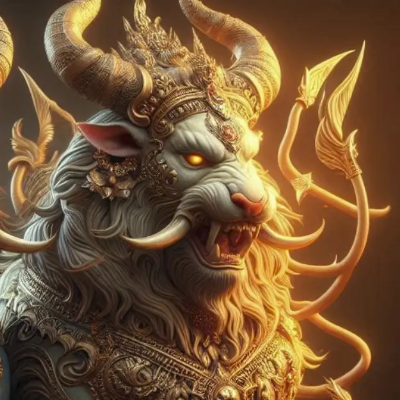
Munda is a Danava general and Parshvachara in the service of Shumbha, the Danava king who conquered the three worlds and dethroned Indra. He belongs to the Danava lineage of Kashyapa and Danu, the primordial progenitor pair of the Danava race, and is addressed in the Devi Mahatmya as a chief among Danavas. Together with his brother Chanda, he served as the foremost field commander and intelligence operative of Shumbha's army, and the two brothers function throughout the tradition as a unified dyad — two aspects of a single military and psychological force. Where Chanda is characterised as the voice of the pair, Munda is characterised as its action: the first to charge, the most immediately physically committed to the assault. He and Chanda were the first to discover the goddess Ambika in the Himalayas and reported her presence to Shumbha. When subsequently dispatched with a vast army to capture the goddess, their arrival prompted the manifestation of Kali from the goddess's brow. Munda was decapitated by Kali in the battle that followed, his head presented alongside Chanda's to the goddess Ambika as an offering, an act that gave rise to Kali's celebrated epithet Chamunda. The primary source for Munda's narrative is the Devi Mahatmya of the Markandeya Purana, Chapters 5 and 7. The Skanda Purana's Prabhas Khanda provides supplementary detail regarding his prior austerities to Surya alongside Chanda.
✦ The Name
The name Munda derives from a Sanskrit root meaning shaved, bald, or headless — a meaning that carries a grim irony in light of his death by decapitation. In the esoteric and philosophical reading of the Shakta tradition, Munda represents the quality of dullness or the absence of discriminative reasoning — the aspect of the deluded mind that acts without reflection, charging forward on the momentum of instinct and desire without the capacity for discernment. The extended form Mundasura combines his name with the suffix asura to emphasise his demonic classification. Like Chanda, his name achieves its most lasting significance as one half of the compound Chamunda, the epithet granted to Kali upon her presentation of their severed heads to the goddess Ambika.
✦ Lineage
- Lineage class: Danava — belonging to the primordial class of beings descended from the progenitor sage Kashyapa and his wife Danu, daughter of Daksha; Munda is addressed as a Danavendra in the Devi Mahatmya, confirming his standing as a chief among Danavas; his specific placement within the listing of Danu's hundred sons is a standard Puranic grouping for commanders of the Danava class rather than an explicitly stated birth-narrative in any single primary text.
- Brother: Chanda — a Danava general and Parshvachara of Shumbha, full brother and constant companion of Munda in all episodes; characterised in the tradition as the voice of the pair, the figure who gives articulate form to the demonic intelligence and issues challenges on behalf of the Danava command; he was decapitated alongside Munda by the goddess Kali in the battle recorded in Chapter 7 of the Devi Mahatmya.
- Affiliation: Shumbha — the Danava king who conquered the three worlds and dethroned Indra; Munda served as one of his foremost field commanders and Parshvacharas, characterised as the action-oriented force of the pair who led the physical charge of the Danava army.
- Children: None recorded in any primary source.
✦ The Austerities to Surya
The Skanda Purana's Prabhas Khanda records that Munda and Chanda performed austerities directed to Surya, the sun god, at the Arka-Sthalas or sun-shrines, before entering Shumbha's service. The power they obtained through these penances rendered their military capacity nearly invincible by conventional divine means, accounting for why the standard weapons of the gods proved insufficient against Shumbha's forces and why the specific and extraordinary manifestation of Kali was required to overcome them. This supplementary account from the Prabhas Khanda is absent from the Devi Mahatmya itself, which does not explain the origin of their military power, and represents a later devotional elaboration of their backstory.
✦ The Intelligence Mission
Chapter 5 of the Devi Mahatmya records that Chanda and Munda, moving through the Himalayan terrain in their capacity as Parshvacharas, came upon the goddess Ambika dwelling in luminous beauty on the mountain. They did not attack her immediately but observed her with attention and returned to Shumbha to deliver their report. In this episode Munda accompanies Chanda as the physical presence of the scouting pair — the action-oriented warrior who moves through the terrain and is present at the discovery — while it is Chanda who gives voice to the report before Shumbha. The two thus function in their complementary roles even in the intelligence episode: Munda as the active body in the field, Chanda as the articulating intelligence that translates the observation into consequential speech.
✦ The Battle and the Death of Munda
Dispatched with Chanda at the head of a vast Danava army to capture the goddess by force, Munda led the physical charge against her as the action-oriented commander of the pair. Chapter 7 of the Devi Mahatmya records that as the army closed around the goddess on the mountain, her face darkened with wrath and Kali burst forth from her furrowed brow — skeletal, terrifying, roaring with a sound that shook the worlds, and armed with sword and noose. Kali fell upon the Danava forces with a ferocity that the text describes in vivid and overwhelming terms: she devoured elephants and their riders whole, consumed chariots and their horses, trampled soldiers underfoot, and cut through the army's ranks with her sword until vast numbers of demons lay destroyed. Munda, true to his nature as the first to charge, was among those who pressed the assault most directly and was seized by Kali, who decapitated him with her sword. Chanda was decapitated in the same action. Kali then brought the two severed heads to the goddess Ambika as an offering, carrying the heads of the two commanders as the concrete proof and trophy of the battle's outcome.
✦ The Origin of the Epithet Chamunda
When Kali presented the severed heads of Munda and Chanda to the goddess Ambika, the Devi Mahatmya records Ambika's declaration that because Kali had slain Chanda and Munda, she would henceforth be celebrated throughout the world by the name Chamunda — a contraction of their two names pressed into a single divine epithet. Chamunda became one of the most widely celebrated and fearsome forms of Kali across both the Shakta and Shaiva traditions, venerated in temple iconography from the earliest classical period onward, prominent in the Tantric traditions, and the presiding deity of numerous shrines across the Indian subcontinent. Munda's name, fused with Chanda's into Chamunda, thus achieved a permanence in the tradition that outlasted his individual narrative by many centuries, his defeat at the hands of Kali becoming the etymological foundation of one of the great divine epithets of the Hindu goddess tradition.
✦ Theological Significance
In the esoteric reading of the Shakta tradition, Munda represents dullness and the absence of discriminative reasoning — the quality of a mind that acts on instinct and raw force without the capacity to distinguish between the real and the unreal, the divine and the demonic, the worthy object and the unworthy one. His role as the action of the pair, the first to charge and the most immediately physically committed, embodies this quality: he does not pause to reflect or discern but moves directly toward destruction. His decapitation by Kali — whose own terrifying form is the most uncompromising expression of the goddess's stripping away of all illusion — is understood as the removal of this undiscriminating, reflexively aggressive quality from the field of consciousness. Together with Chanda's fierce passion, Munda's dullness constitutes the paired obstruction that the manifestation of Kali is specifically summoned to dissolve.
✦ Connection to the Wider Genealogy
Through his Danava classification, Munda belongs to the same broad lineage of Kashyapa and Danu that includes Shumbha, Nishumbha, Chanda, Rambha, Dhenukasura, Pralambhasura, Arishtasura, Kesi, and the other Danava figures of the Puranic tradition. He stands as a collateral member of this lineage in his capacity as a general and Parshvachara in Shumbha's service. His narrative ends entirely with his decapitation by Kali in Chapter 7 of the Devi Mahatmya, and no children or further descendants are recorded. His enduring legacy, like that of his brother Chanda, exists not in a continuing genealogical line but in the permanent transformation of Kali's identity through the epithet Chamunda, which preserves their names fused together as one of the most celebrated designations of the divine feminine in the Hindu tradition.
✦ References
- Primary Sources:
- Markandeya Purana, Devi Mahatmya, Chapters 5 and 7: The principal source for Munda's narrative; Chapter 5 records the intelligence mission in which Munda and Chanda discover the goddess and report to Shumbha; Chapter 7 records the dispatch of the two commanders with the vast army, the manifestation of Kali, the decimation of the Danava forces, the decapitation of Munda and Chanda, and the bestowal of the name Chamunda upon Kali by the goddess Ambika.
- Skanda Purana, Prabhas Khanda, Book 7: The source for the account of Munda and Chanda's austerities directed to the sun god Surya at the Arka-Sthalas, providing the origin of their exceptional military power prior to their service under Shumbha.
- Harivamsha and Vayu Purana: Group Munda and Chanda within the standard listing of the Danava class, providing the genealogical basis for their classification as members of the Kashyapa-Danu lineage.
- Secondary Sources:
- Coburn, Thomas B. Devi-Mahatmya: The Crystallization of the Goddess Tradition. Motilal Banarsidass, 1984: Essential scholarly analysis of the Devi Mahatmya providing context for the Chanda-Munda episode, the manifestation of Kali, and the derivation and significance of the Chamunda epithet.
- Mani, Vettam. Puranic Encyclopaedia. Motilal Banarsidass, 1975: Provides a consolidated summary of Munda's narrative alongside Chanda's and notes the etymological derivation of Chamunda from their combined names.