
About
Durga — Goddess of Victory, Cosmic Power, and Divine Protection
Durga · Durgadevi · Mahishasuramardini · Chandika · Ambika · Bhagavati · Devi · Mahadevi · Adi Shakti · Katyayani · Narayani · Aparajita · Simhavahini · Saptamatrika (in collective contexts) · Vindhyavasini · Shakambhari · Shatakshi
Durga is one of the most prominent goddesses of the Hindu tradition, venerated as the supreme martial deity who annihilates demonic forces threatening cosmic order. She is understood across the major textual traditions as a manifestation — or in some accounts the primordial source — of Shakti, the divine feminine power that underlies and sustains all creation. Her most celebrated mythological role is the slaying of the buffalo-demon Mahishasura, an episode narrated with great elaboration in the Devi Mahatmya section of the Markandeya Purana, which remains the foundational scriptural text for her worship. She appears additionally in the Devi Bhagavata Purana, the Skanda Purana, the Vamana Purana, the Kalika Purana, the Varaha Purana, the Devi Upanishad, and at several points in the Mahabharata and the Harivamsa. Her identity is complex and layered: she is simultaneously an independent, sovereign goddess of the highest rank, a collective emanation of the combined powers of the male Vedic and Puranic gods, and, in Shakta theological frameworks, the ultimate ground of all being.
✦ The Name
The name Durga is most commonly interpreted as meaning "she who is difficult to reach" or "she who is difficult to overcome," derived from the Sanskrit root durg, signifying a fort, an impassable place, or a condition of difficulty and inaccessibility. The name thus encodes both her role as protector — a fortress against evil — and her transcendence — a deity beyond ordinary comprehension or approach.
The Devi Bhagavata Purana offers an additional etymological explanation embedded in its narrative: the name Durga was given to the goddess after she destroyed the demon Durgama (also called Durgamasura in some recensions), the demon whose name itself means "difficult to traverse." By killing him she became known as Durga, the one who conquered that which was unconquerable. The Skanda Purana preserves a similar derivation.
Her epithet Mahishasuramardini means "she who crushed Mahishasura," Mahisha being the Sanskrit word for buffalo and Asura denoting a demon. Chandika and Chandi carry the sense of "the fierce one" or "the wrathful," emphasising her destructive, battle-ready aspect. Ambika means "the mother" and is used across several Puranas to denote her nurturing and creatrix dimensions. Bhagavati is an honorific meaning "the auspicious one possessed of all divine qualities." Katyayani, one of the nine Navadurga forms, carries the patronymic of the sage Katyayana and is associated with the episode in which she was born to or was worshipped by that sage. Aparajita means "the unconquered one." Simhavahini means "she whose vehicle is the lion." Vindhyavasini means "she who dwells in the Vindhya mountains." Shakambhari means "she who bears vegetation" and Shatakshi means "the hundred-eyed," both names associated with the episode of the demon Durgama in the Devi Bhagavata Purana.
✦ Lineage
- Origin (primary account — Devi Mahatmya): Durga is not born of two parents in the conventional genealogical sense. The Devi Mahatmya describes her arising from the combined divine energies (tejas) of all the principal gods — including Brahma, Vishnu, Shiva, Indra, Yama, Varuna, Agni, Vayu, and others — when those gods were rendered powerless by the demon Mahishasura. Each god contributed a portion of his radiance, and from that confluence of powers the goddess emerged as a complete, sovereign being, more powerful than any of her contributors individually.
- Origin (Shakta theological account — Devi Bhagavata Purana): In the Devi Bhagavata Purana, Durga — identified here with Mahadevi or Adi Shakti — is treated not as a derived being but as the primordial reality from whom Brahma, Vishnu, and Shiva themselves originate. In this framework she has no creator and no parents; she is svayambhu, self-existent.
- Origin (Vamana Purana and regional accounts): The Vamana Purana contains a variant in which the goddess Durga is identified with Parvati, the daughter of Himavat (the personification of the Himalaya mountains, understood as a divine king of mountains) and his consort Mena. In this account she is the same deity as the mountain goddess who became the wife of Shiva, and she assumed the form or name Durga in her martial aspect.
- Relationship to Shiva: In the Shaiva-Shakta synthesis that characterises much of the Puranic literature, Durga is identified with Parvati, the consort of Shiva, the great ascetic and destroyer god. In this understanding she is simultaneously an independent warrior goddess and the Shakti — the dynamic power — of Shiva. The two are understood as inseparable, the masculine and feminine poles of ultimate reality.
- Relationship to Kaushiki and Kali: The Devi Mahatmya narrates that when the gods prayed to Parvati near the Himalayas regarding the demons Shumbha and Nishumbha, a luminous goddess named Kaushiki emerged from Parvati's outer sheath or body-covering (kosha). After this emergence, the residual form of Parvati became dark and is identified as Kalika or Kali. Kaushiki then undertook the mission against Shumbha and Nishumbha. In the Devi Mahatmya's overarching theological framing, Kaushiki, Kali, and the goddess who slew Mahishasura are all understood as aspects or manifestations of the one supreme Chandika-Durga, even though they are distinct figures within the narrative.
- Relationship to Vishnu: The Mahabharata contains passages in which Durga is addressed as a sister of Vishnu, the great preserver god. This sibling relationship is asserted in some Vaishnava-inflected accounts and in certain passages of the Harivamsa, though it is not maintained in the Shakta Puranas, where she is the supreme being from whom Vishnu himself is derivative.
- Children (in some regional and Puranic traditions): In the traditions of Bengal and certain Puranas, Durga is presented as the mother of four children: Lakshmi (goddess of wealth and fortune), Sarasvati (goddess of learning and arts), Kartikeya (also called Skanda or Murugan, the divine commander of the gods' armies, who destroyed the demon Tarakasura), and Ganesha (the elephant-headed deity, remover of obstacles and lord of beginnings). This family grouping is central to the Bengali Durga Puja festival and is reflected in the iconographic tradition. However, it is a devotional and iconographic convention that developed strongly in medieval and regional traditions; the Devi Mahatmya itself does not present Durga in a maternal role of this kind.
- Navadurga (nine forms): The tradition recognises nine principal forms of Durga collectively called the Navadurga: Shailaputri (daughter of the mountain, identified with Parvati), Brahmacharini (the ascetic form), Chandraghanta (wearing a crescent bell), Kushmanda (the cosmic egg-creator), Skandamata (mother of Skanda), Katyayani (born of the sage Katyayana's penance), Kalaratri (the dark night of destruction), Mahagauri (the supremely pure or white), and Siddhidatri (bestower of supernatural accomplishments). These forms are elaborated primarily in the Markandeya Purana, the Skanda Purana, and associated devotional literature.
✦ The Slaying of Mahishasura
The central narrative of Durga's mythology is the destruction of Mahishasura, the buffalo-demon, as recounted in the Devi Mahatmya, which forms chapters 81 through 93 of the Markandeya Purana. Mahishasura was a demon of extraordinary power who had performed severe austerities and received from Brahma — the creator god — a boon of near-invincibility: he could not be killed by any male being, god or mortal. Armed with this protection, Mahishasura conquered the three worlds, expelled the gods from heaven, and usurped the throne of Indra, the king of the gods.
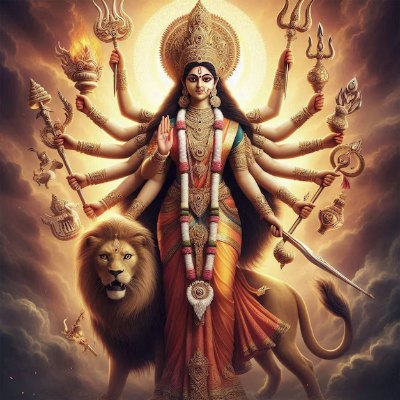
The gods, humiliated and powerless, assembled before Brahma and then proceeded together to Vishnu and Shiva to seek a remedy. The combined fury and radiance of all the assembled gods then poured forth from each of their bodies as blazing light. This light converged and coalesced into a single luminous form — a goddess of surpassing beauty and terrifying power. The gods each contributed weapons and ornaments to equip her: Shiva gave his trident, Vishnu his discus (the Sudarshana Chakra), Varuna (god of waters) his noose, Agni (god of fire) his spear, Vayu (god of wind) his bow and arrows, Indra his thunderbolt (vajra) and a bell from his elephant Airavata, Yama (god of death) his staff, Brahma his water-pot and rosary, the sun god spread his rays across her body's pores, and the ocean garments and jewels. The Himalaya provided the lion as her vehicle.
Thus fully armed and mounted on the lion, the goddess confronted Mahishasura and his vast demon army. The battle was immense and prolonged. Mahishasura, able to change his form at will, shifted between the shapes of a buffalo, a lion, a man, an elephant, and other creatures to evade and attack her. The goddess systematically destroyed his armies and his general commanders. Finally, she pinned Mahishasura under her foot, pierced him with her trident, and severed his head with her sword as he attempted once more to change form. The slaying restored cosmic order and returned the heavens to the gods. This episode is the source of Durga's most celebrated epithet, Mahishasuramardini. The Vamana Purana and the Kalika Purana contain variant narrations of the same battle with some differences in detail, but the core narrative is consistent across all versions.
Within the Devi Mahatmya's overarching theological framework, Kaushiki, Kali, the Matrikas, and the goddess who slew Mahishasura are all presented as aspects or manifestations of the one supreme Chandika-Devi. The narrative thus operates on two levels simultaneously: at the level of the story, distinct goddesses perform distinct actions; at the level of theology, all of these forms are one. This dual structure is a defining characteristic of the Devi Mahatmya's literary and doctrinal method.
✦ The Episode of Durgamasura
The Devi Bhagavata Purana contains an episode in which a demon named Durgama (or Durgamasura) stole the four Vedas — the sacred scriptures of the Hindu tradition, understood as the repository of all ritual knowledge — from Brahma, causing the gods and human sages to lose the capacity to perform the sacrifices and rituals upon which cosmic order depended. The world fell into drought, famine, and disorder. The gods prayed intensely to the supreme goddess, who responded by manifesting in a form with a thousand arms, known here as Shatakshi (the hundred-eyed) or Shakambhari (the bearer of vegetation), and she restored the Vedas by defeating and slaying Durgama. The Devi Bhagavata Purana uses this episode to explain the name Durga as deriving from her conquest of Durgama.
✦ Durga in the Mahabharata and Harivamsa
The Mahabharata contains several passages in which Durga appears or is invoked. In the Virata Parva, the hero Arjuna — the third of the five Pandava princes, son of Pandu and Kunti, and a central protagonist of the Kurukshetra war — worships her before battle, and she appears to grant him victory. In the Bhishma Parva there is a hymn attributed to Yudhishthira — the eldest Pandava and rightful king of the Kuru line — in which Durga is praised as the source of victory, the remover of difficulties, and the supreme feminine power. The Mahabharata addresses her by numerous epithets in these passages and identifies her as having been born among the cowherds (Gopas) in one account.
The Harivamsa, a supplement to the Mahabharata, contains the episode of the infant goddess substituted for the newborn Krishna at the moment of his birth. Vasudeva — a chieftain of the Yadava clan and father of Krishna — secretly transported the infant Krishna from Mathura to Gokula and brought back a female child born simultaneously to Nanda and Yashoda there. When the demon king Kamsa — Vasudeva's brother-in-law and the tyrannical ruler of Mathura who had been warned that a child of Devaki would cause his death — seized the infant girl and attempted to dash her against a stone, the child slipped from his grasp, rose into the sky, and revealed herself as the goddess, proclaiming his doom before vanishing. This episode establishes a narrative link between Durga and the Krishna mythology, though it has not generated a tradition treating her as biologically connected to the Yadava genealogy.
✦ Textual Variants and Inconsistencies
Origin: The Devi Mahatmya presents Durga as emergent from the combined tejas of the male gods, making her in some sense their collective creation. The Devi Bhagavata Purana reverses this entirely, asserting that those same male gods are themselves her creations. These two positions are theologically irreconcilable and reflect the difference between a text produced within a tradition that treats the male gods as primary and one produced within a fully Shakta tradition that asserts the feminine divine as supreme.
Identity with Parvati: The Shaiva Puranas — particularly the Shiva Purana and the Linga Purana — identify Durga with Parvati, the daughter of Himavat and Mena and the wife of Shiva, treating her as one form of that goddess. The Shakta texts treat Durga as the supreme or original form and Parvati as one of her manifestations. The Devi Mahatmya itself complicates this by making Kaushiki emerge from Parvati's body, which simultaneously distinguishes the two and implies their ultimate non-difference.
The agent in the Shumbha-Nishumbha episode: A careful reading of the Devi Mahatmya shows that the specific narrative agent who slays Shumbha and Nishumbha is Kaushiki, an emanation from Parvati's body, rather than the same goddess who slew Mahishasura. The text's own theological framing, however, insists these are all one. Later devotional and popular tradition has tended to collapse the distinction and refer to Durga as the slayer in both episodes. This is a legitimate theological position within the tradition but represents a reading at the level of unified divine identity rather than at the level of the narrative's own dramatis personae.
Relationship to Vishnu: The identification of Durga as Vishnu's sister, present in some Mahabharata passages, is not accepted in the Shakta Puranas, where she is the supreme being from whom Vishnu is derivative.
The maternal role: The grouping of Durga with Lakshmi, Sarasvati, Ganesha, and Kartikeya as a family unit is central to Bengali devotional iconography but is not established in the same form in the Devi Mahatmya or the earliest Puranic layers. It develops more fully in medieval regional traditions and is reflected in the Kalika Purana and associated devotional literature.
✦ Theological and Philosophical Significance
In Shakta theology, Durga is identified with Mahadevi, the supreme reality who underlies all existence. The Devi Mahatmya presents the goddess not merely as a powerful deity but as the cosmic power (Shakti) without whom the male gods are inert — a doctrine it articulates through the narrative of their helplessness before Mahishasura and their dependence on the goddess to restore order. The philosophical position developed most fully in the Devi Bhagavata Purana takes this further, identifying the goddess with Brahman — the ultimate impersonal ground of being described in Upanishadic philosophy — and asserting that the personal form of the goddess is simultaneously the transcendent absolute and the dynamic world-power.
The Devi Upanishad, a minor Upanishad belonging to the Atharva Veda tradition, records the goddess declaring her identity with Brahman and the five elements, that she pervades all creation, and that she encompasses both the manifest and unmanifest dimensions of reality. This text is one of the bases for the Shakta non-dualist philosophical school.
At a more accessible theological level, Durga functions as the protector of dharma — the moral and cosmic order — and the destroyer of forces symbolised by the demons. The buffalo Mahishasura is understood in commentarial traditions as a symbol of ignorance and animal passion, and Durga's victory over him represents the triumph of divine wisdom and cosmic righteousness over the forces of darkness and disorder. The declaration by Kaushiki — that all the goddesses who fought alongside her were projections of her own singular power — is understood as the Devi Mahatmya's most concentrated statement of Shakta non-dualism within a narrative frame.
✦ Iconography and Worship
The standard iconographic form of Durga depicts her as a beautiful woman with multiple arms — typically eight or ten, though some forms have eighteen — riding a lion or tiger. She holds in her various hands the weapons presented to her by the gods: trident, discus, sword, bow, arrow, thunderbolt, spear, shield, and noose are among the most commonly depicted. One hand is typically held in the gesture of granting boons (varada mudra) and another in the gesture of protection (abhaya mudra). In the Mahishasuramardini form she is shown with her foot or spear upon the prostrate or decapitated buffalo, with the demon's human form emerging from the severed neck.
The primary festival of Durga worship is Durga Puja, observed most elaborately in West Bengal and other eastern states, during the autumn month of Ashvin (September-October) over nine nights — known as Navratri. The ten-day festival culminates on Vijayadashami (the tenth day of victory), which commemorates her defeat of Mahishasura. During this period the Devi Mahatmya is recited in its entirety as the central ritual text. Major temple seats (Shakti Peethas) associated with Durga include the Vaishno Devi shrine in Jammu, the Vindhyavasini temple at Vindhyachal, and the Kamakhya temple in Assam. The Shakti Peetha tradition holds that these sites mark the places where portions of the body of Sati — understood as an earlier form or incarnation of Parvati-Durga — fell to earth after her death, making them sacred ground permeated by divine feminine presence.
✦ Connection to the Wider Genealogy
Durga occupies a pivotal position in the divine genealogy of the Hindu tradition by virtue of her simultaneous relationships with multiple lineages. As an identified form of Parvati, she belongs to the family of Himavat (the Himalaya, understood as a divine king of mountains) and his wife Mena, making her the sister of the river goddess Ganga in some Puranic genealogies. As the consort of Shiva, she is linked to the lineage of Shiva himself, who in the Shaiva Puranas is described variously as self-created or as arising from Brahma, depending on the text.
As the source from whom Kaushiki emerged, Durga-Parvati stands in a generative relationship to that goddess, who is understood as her own emanation rather than a separate divine lineage. As the source from whom Kali arose — whether as the residual dark form after Kaushiki's emergence or as the projection of Kaushiki's own wrath — she connects genealogically and theologically to the Kali tradition as well.
As the mother — in the medieval devotional and iconographic tradition — of Ganesha (lord of beginnings and remover of obstacles, son of Shiva and Parvati), Kartikeya (the six-headed war god and commander of the divine army, whose worship is particularly prominent in South India under the name Murugan), Lakshmi (goddess of wealth and fortune, and in the dominant Vaishnava tradition the consort of Vishnu), and Sarasvati (goddess of learning, speech, and the arts), Durga functions as a genealogical nexus connecting several of the most important divine lineages of the tradition.
The identification of Durga as the infant goddess substituted for the newborn Krishna places her in a narrative relationship with Vasudeva — a chieftain of the Yadava clan and father of Krishna — and Devaki, his wife, and through Krishna with the entire Vrishni-Yadava genealogy central to the Mahabharata. This connection, while narratively specific, is understood as a cosmic event rather than a biological kinship and has not generated a sustained tradition of treating Durga as part of the Yadava family tree.
✦ References
- Primary Sources
- Markandeya Purana, chapters 81–93 (Devi Mahatmya / Durga Saptashati / Chandi): The foundational scriptural source for the Mahishasura-vadha, the emergence of Kaushiki from Parvati, the Shumbha-Nishumbha episode, the Raktabija battle, the production of Kali and the Matrikas, and the theological identification of all these forms as one supreme Chandika-Devi.
- Devi Bhagavata Purana (all twelve Skandhas, particularly Skandhas 1, 3, 5, and 7): The major Shakta Mahapurana that repositions Durga-Mahadevi as the supreme creator anterior to the male gods. Contains the Durgamasura episode and the fullest Shakta theological articulation of her nature as Brahman.
- Mahabharata, Virata Parva and Bhishma Parva (Durgastava hymns): Contains hymns to Durga attributed to Arjuna and Yudhishthira respectively, identifying her as the granter of victory and supreme feminine power; also contains reference to her birth among the cowherds and her identification as a sister of Vishnu.
- Harivamsa (supplement to the Mahabharata), Vishnu Parva: Contains the episode of the infant goddess substituted for the newborn Krishna and her proclamation of Kamsa's doom.
- Vamana Purana: Contains a version of the Mahishasura episode with variant details and contributes to the identification of Durga with Parvati as daughter of Himavat.
- Kalika Purana: A major Shakta text of the eastern tradition that elaborates Durga's iconography, worship, and relationship to the tantric goddess tradition; contributes to the medieval Bengali devotional framework including the family grouping with Lakshmi, Sarasvati, Ganesha, and Kartikeya.
- Skanda Purana (various Khandas): Contains elaborations of the Navadurga forms, variant battle episodes, and accounts of Durga's major sacred sites and epithets.
- Shiva Purana and Linga Purana: Shaiva Puranas that identify Durga with Parvati as a form or Shakti of Shiva, contributing to the Shaiva-Shakta synthetic understanding of the goddess.
- Devi Upanishad (Atharva Veda tradition): A minor Upanishad in which the goddess declares her identity with Brahman and the five elements; the primary Upanishadic text for Shakta non-dualist philosophy.
- Varaha Purana: Contains passages relevant to Durga's epithets and narrative episodes within the divine feminine tradition.
- Modern Reference Works
- Vettam Mani, Puranic Encyclopaedia (Motilal Banarsidass, 1975): Provides consolidated entries on Durga, Mahishasura, Kaushiki, the Matrikas, and related figures across the major Puranic sources; useful for cross-referencing textual variants.
- Thomas Coburn, Devi-Mahatmya: The Crystallization of the Goddess Tradition (Motilal Banarsidass, 1984): The definitive scholarly study of the Devi Mahatmya as a text, its composition, its theological claims including the Kaushiki emergence episode, and its place in the development of the goddess tradition.
- Thomas Coburn, Encountering the Goddess: A Translation of the Devi-Mahatmya and a Study of Its Interpretation (SUNY Press, 1991): Provides close translation and analysis of the Devi Mahatmya with particular attention to the relationship between Parvati, Kaushiki, and Kali in the Shumbha-Nishumbha narrative.
- David Kinsley, Hindu Goddesses: Visions of the Divine Feminine in the Hindu Religious Tradition (University of California Press, 1986): Provides comparative analysis of Durga's iconography, mythology, and theological identity across the major textual and regional traditions.
- Cheever Mackenzie Brown, The Triumph of the Goddess: The Canonical Models and Theological Visions of the Devi-Bhagavata Purana (SUNY Press, 1990): Analyses the Devi Bhagavata Purana's theological repositioning of Durga as supreme reality and its differences from the Markandeya Purana's account.
- Wendy Doniger O'Flaherty, Hindu Myths (Penguin Classics, 1975): Provides translated excerpts and scholarly analysis of the Mahishasura, Raktabija, and Kaushiki episodes and their theological implications.