
About
Rukmaratha, Rukmabahu, Rukmakesha, Rukmanetra — Princes of Vidarbha
Rukmaratha · Rukmabahu · Rukmakesha · Rukmanetra · Sons of Bhishmaka · Bhoja princes
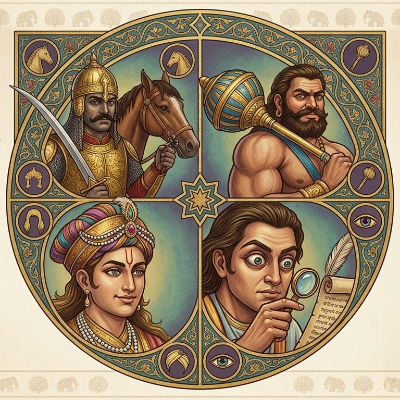
Rukmaratha, Rukmabahu, Rukmakesha, and Rukmanetra are the four younger sons of Bhishmaka, king of Vidarbha — a kingdom in the Deccan region of the Indian subcontinent with its capital at the city of Kundina — and his queen Shuddhamati. They are the younger brothers of Rukmi, the eldest son and crown prince of Vidarbha, and the elder brothers of Rukmini, the youngest child of Bhishmaka, who is identified in the Bhagavata Purana as an incarnation of the goddess Lakshmi and who becomes the principal consort of Krishna, the eighth avatar of Vishnu. These four princes appear in the Puranic tradition almost exclusively as names within genealogical lists; the primary texts — chiefly the Bhagavata Purana, the Vishnu Purana, and the Harivamsa — record their names as part of Bhishmaka's lineage but do not assign them individual narrative episodes, speaking roles, or independent characterisation. Their profile is accordingly brief, reflecting the limited textual base honestly rather than supplementing it with uncertain material.
✦ The Names
All four names share the same Sanskrit root as those of their elder brother Rukmi and their sister Rukmini — the root rukma, meaning gold or that which shines with a golden radiance. This consistent gold-root naming across all six children of Bhishmaka suggests a deliberate dynastic or ceremonial naming convention within the Vidarbha royal house of the Bhoja line. The second element of each name identifies a distinct bodily or personal attribute: Rukmaratha combines the gold-root with ratha, meaning chariot, yielding the sense of one whose chariot is golden or who is golden upon the chariot; Rukmabahu combines it with bahu, meaning arm, giving the sense of the golden-armed; Rukmakesha combines it with kesha, meaning hair, giving the sense of the golden-haired; and Rukmanetra combines it with netra, meaning eye, giving the sense of the golden-eyed. The texts do not elaborate on whether these names reflect physical traits, auspicious qualities assigned at birth, or purely conventional dynastic naming. It should be noted that the name Rukmaratha is shared with a son of Rukmi himself — a figure of the next generation who appears in the Bhagavata Purana's account of the dice game at Bhojakata; that younger Rukmaratha is a distinct person from Bhishmaka's second son of the same name.
✦ Lineage
- Father — Bhishmaka: King of Vidarbha and head of the Bhoja dynasty, a branch of the wider Yadava lineage. Described across the Puranic texts as a pious and personally devout ruler who held Krishna in high regard.
- Mother — Shuddhamati: Queen of Vidarbha, also rendered Sudhimati in some recensions. Mother of all six children of Bhishmaka.
- Elder brother — Rukmi: The eldest son and crown prince of Vidarbha, a powerful warrior and an implacable opponent of Krishna. Rukmi's insistence on marrying his sister Rukmini to Shishupala, king of Chedi, rather than to Krishna forms the central conflict of the Rukmini narrative in the Bhagavata Purana and related texts. After his defeat and humiliation at Krishna's hands following Rukmini's elopement, Rukmi founded the city of Bhojakata in self-imposed exile and was eventually killed by Balarama — Krishna's elder brother — during a dice game at Bhojakata following the wedding of Rukmi's daughter to Pradyumna, son of Krishna and Rukmini.
- Younger sister — Rukmini: The youngest child of Bhishmaka, identified in the Bhagavata Purana as an incarnation of the goddess Lakshmi. Deeply devoted to Krishna from hearing of his virtues, she sent him a letter through a brahmin messenger imploring him to carry her away before her arranged marriage to Shishupala could take place. Krishna abducted her from a temple procession at Kundina, and she became his foremost wife at Dvaraka.
✦ Textual Basis and Limits
The four princes are named together as a group in the genealogical passages of the Bhagavata Purana and the Vishnu Purana that enumerate Bhishmaka's sons in the course of introducing the Rukmini episode. The Harivamsa similarly lists them by name within its account of the same lineage. None of the three primary texts assigns any of the four brothers a speaking part, an individual action, a military role in the conflict surrounding Rukmini's elopement, or any narrative episode of their own. They are not described as supporting Rukmi in his pursuit of Krishna after the abduction, nor as opposing him; they are simply not present as agents in the narrative. No marriages, children, or further genealogical lines are attributed to them in any of the primary Puranic or epic sources. Any statement beyond what is recorded here — including speculation about their roles at Kundina during the marriage festival or their fates after the events of the main narrative — would go beyond what the texts support.
✦ Connection to the Wider Genealogy
Through their father Bhishmaka's membership of the Bhoja branch of the Yadava lineage, the four princes share a distant common ancestry with Krishna himself, who belongs to the Vrishni branch of the same broad Yadava descent group. Through their sister Rukmini's union with Krishna, they stand as maternal uncles of Pradyumna — the son of Krishna and Rukmini, identified in certain Puranic texts as an incarnation of the god of love, Kama — and great-maternal-uncles of Aniruddha, Pradyumna's son and a grandson of Krishna, who is a significant figure in the later books of the Bhagavata Purana. These genealogical connections place the four brothers within one of the most significant kinship networks of the Puranic tradition, even though the texts do not develop their individual identities beyond the listing of their names.
✦ References
Primary Sources
- Bhagavata Purana, Skandha 10, Chapters 52–54: Introduces Bhishmaka's sons by name in the genealogical framing of the Rukmini elopement narrative; the four younger brothers are listed alongside Rukmi and Rukmini without individual narrative elaboration.
- Vishnu Purana, Book 5: Provides a parallel genealogical listing of Bhishmaka's children in the context of the same episode, naming the four brothers as part of the Vidarbha royal family.
- Harivamsa, Vishnu Parva: Names the brothers within its account of the Bhishmaka lineage and the Rukmini narrative without assigning them individual roles or episodes.
Modern Reference Works
- Mani, Vettam — Puranic Encyclopaedia (1975): Lists the four brothers by name within the entry on Bhishmaka's lineage and confirms their status as genealogical names without independent narrative development in the primary sources.
- Wisdomlib.org — definition entries for Rukmaratha, Rukmabahu, Rukmakesha, Rukmanetra: Provides brief individual entries for each name, confirming their identification as sons of Bhishmaka and brothers of Rukmi and Rukmini, with references to the relevant Puranic passages.