
About
Bali — Son of Kritavarma and Husband of Charumati
Bali · Bali son of Kritavarma · Krtavarmasuta · Satvata Yadava
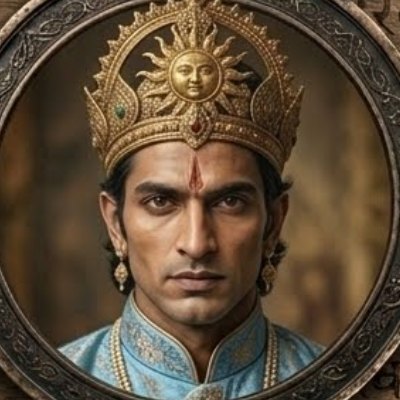
Bali is the son of Kritavarma, a Yadava chief of the Satvata branch of the wider Yadava clan grouping, and the husband of Charumati, the only named daughter of Krishna — the eighth avatar of Vishnu and king of Dvaraka — and his principal wife Rukmini, who is identified in the Bhagavata Purana as an incarnation of the goddess Lakshmi. Bali is identified by name and patronymic in Bhagavata Purana, Skandha 10, Chapter 61, Verse 24, which records the marriage of Charumati to krtavarma-sutah — the son of Kritavarma — named Bali. This single verse constitutes the entirety of his direct attestation in the primary sources. Beyond his identification, his parentage, and his marriage to Charumati, the primary texts assign him no individual narrative, characterisation, military role, or genealogical continuation. This profile is accordingly brief, reflecting that narrow textual base honestly.
✦ The Name
The name Bali derives from the Sanskrit root bala, meaning strength or power, and carries the general sense of the strong one or the mighty one. It is a name borne by several distinct figures across the Hindu scriptural tradition — most prominently by the celebrated demon king Mahabali, grandson of Prahlada, who appears in the Vamana avatar episode of the Bhagavata Purana and the Vishnu Purana, and by the Vanara king Bali, son of Indra and elder brother of Sugriva, who is a major figure in the Ramayana. The Bali who is the son of Kritavarma and husband of Charumati is entirely distinct from both of these figures; the shared name reflects the name's broad currency in the Sanskrit tradition rather than any genealogical or narrative connection between the bearers.
✦ Lineage
- Father — Kritavarma: A Yadava chief of the Satvata branch of the Yadava clan, and a figure of considerable significance in both the Mahabharata and the Bhagavata Purana. During the Kurukshetra war Kritavarma fought on the side of the Kauravas, commanding a force supplied by him to Duryodhana while Krishna himself sided with the Pandavas — a division within the Yadava confederation that the Mahabharata records without elaborating on its internal political causes at length. Kritavarma is one of only three survivors on the Kaurava side at the war's conclusion, alongside Ashvatthama and Kripa. He appears again in the Bhagavata Purana's account of the destruction of the Yadava clan at Prabhasa, where he is named among the Yadava chiefs present at the fatal gathering, and is implicated in the internecine violence that destroys the clan. His mother's name is not recorded in the primary sources consulted for this profile.
- Wife — Charumati: The only named daughter of Krishna and Rukmini, identified in the Bhagavata Purana's genealogical passage in Skandha 10, Chapter 61. Through this marriage Bali becomes the son-in-law of Krishna, the eighth avatar of Vishnu, and of Rukmini, an incarnation of the goddess Lakshmi. He is thus also the son-in-law of the Bhoja line of Vidarbha through Rukmini's own parentage as the daughter of Bhishmaka, king of Vidarbha.
✦ Textual Basis and Limits
Bali son of Kritavarma is attested solely in the genealogical verse of Bhagavata Purana 10.61.24. He is not mentioned by name in the Mahabharata, the Harivamsa, the Vishnu Purana, or any other primary source consulted, nor does he appear as an agent in any narrative episode in those texts. His father Kritavarma is a developed figure across multiple texts, but the son receives no individual elaboration beyond the single verse that records his marriage to Charumati. His mother's identity, any children born of the union with Charumati, and any role he may have played in the events surrounding the destruction of the Yadavas at Prabhasa are not recorded in any primary source consulted. Any statement beyond what is given here would exceed what the evidence supports.
✦ Connection to the Wider Genealogy
Through his father Kritavarma, Bali belongs to the Satvata branch of the Yadava lineage — a distinct sub-lineage from the Vrishni branch to which Krishna himself belongs, though both share the common Yadava ancestry descending from the ancient king Yadu. Through his marriage to Charumati, Bali is connected to the Vrishni branch directly, becoming the son-in-law of Krishna and Rukmini. His marriage to Charumati thus represents an intra-Yadava alliance joining the Satvata and Vrishni branches through the daughter of Krishna, placing Bali within the dense genealogical network enumerated in Bhagavata Purana Chapter 61 — a network that also includes the marriages of Pradyumna to Rukmavati of the Vidarbha Bhoja line and of Samba to Lakshmana the daughter of Duryodhana of the Kuru line. Bali's own individual presence within this network, however, remains confined to a single verse.
✦ References
Primary Sources
- Bhagavata Purana, Skandha 10, Chapter 61, Verse 24: The sole primary source in which Bali son of Kritavarma is named; records his marriage to Charumati, daughter of Krishna and Rukmini, through the patronymic compound krtavarma-sutah and the given name Bali.
- Mahabharata, Drona Parva and Sauptika Parva: The primary sources for the career of his father Kritavarma — his role on the Kaurava side at Kurukshetra and his presence among the three survivors of that war — providing essential context for Bali's paternal lineage, though Bali himself does not appear in these passages.
- Bhagavata Purana, Skandha 11: Records Kritavarma's presence at the destruction of the Yadava clan at Prabhasa, again providing context for the paternal line without mentioning Bali individually.
Modern Reference Works
- Mani, Vettam — Puranic Encyclopaedia (1975): Identifies Bali as the son of Kritavarma and husband of Charumati within the entry on Charumati, citing Bhagavata Purana 10.61.24; the entry on Kritavarma provides the fuller account of the father's career across the Mahabharata and the Bhagavata Purana.
- Wisdomlib.org — definition entries for Bali and Kritavarma: Confirms the patronymic identification and the marriage to Charumati, and provides cross-references to the Kritavarma entries that establish the paternal lineage and its significance in the wider Puranic and epic tradition.