
About
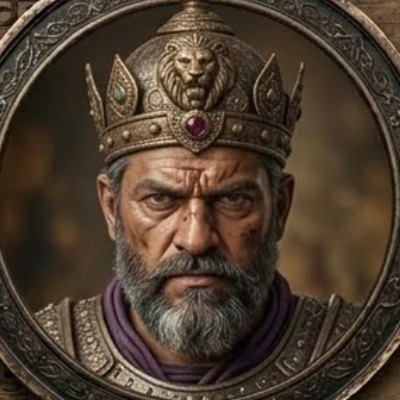
Shatadhanva — Yadava Warrior of the Andhaka Line, Slayer of Satrajit
Shatadhanva · Satadhanva · Shadhanva · Shatadhanvan
Shatadhanva is a Yadava warrior of the Andhaka branch of the Satvata line, second son of Hridika and younger brother of Kritavarma. He is best known in the Puranic and epic tradition for the murder of Satrajit — the Yadava king who possessed the legendary Syamantaka jewel — and for his subsequent flight from and death at the hands of Krishna. His episode is among the more fully narrated in the Harivamsha, the Vishnu Purana, and the Bhagavata Purana, though the three accounts differ in notable particulars. His lineage places him in the seventh generation of descent from Bhajamana, through Viduratha, Rajadhideva, Shami, Pratiksatra, Svayambhoja, and Hridika. He appears in the Harivamsha (Harivamsha Parva, chapters 38–39), the Vishnu Purana (IV.13), the Bhagavata Purana (X.56–57), and the Mahabharata.
✦ The Name
The name Shatadhanva is a Sanskrit compound: shata (a hundred) and dhanva or dhanvan (bow, or one who wields a bow). The compound thus means "he of a hundred bows" or "one whose bow is worth a hundred" — an epithet conveying exceptional martial prowess. The Harivamsha refers to him as a highly powerful Bhoja warrior, which reflects the dual Andhaka-Bhoja clan identity associated with his family. The spelling variant Satadhanva, found in several English translations, represents the same name with the aspirate reduced.
✦ Lineage
- Father: Hridika — son of Svayambhoja, of the Andhaka branch of the Satvata line; described across multiple Puranas as a votary of Krishna and the father of Kritavarma and nine other sons.
- Elder brother: Kritavarma — the eldest son of Hridika, a celebrated Yadava warrior who led the Narayani Sena on the Kaurava side at the Kurukshetra War and was one of only three survivors of the entire Kaurava army.
- Other brothers (Harivamsha 1.38.5–6): Bhishak, Vaitarana, Sudanta, and Vidanta — four brothers recorded as born through the boon of the celestial sage Chyavana — and additional brothers whose names the Harivamsha does not individually specify in the genealogical list beyond these six sons named alongside Kritavarma and Shatadhanva.
✦ The Syamantaka Episode
The Syamantaka jewel was a divine gem of extraordinary brilliance originally gifted by the sun-god Surya to the Yadava king Satrajit. The jewel was said to produce vast wealth daily and to protect its virtuous owner from all misfortune. Satrajit installed it in his home at Dvaraka and refused to yield it even when Krishna requested he give it to king Ugrasena for the common good. After a series of events involving the jewel's temporary loss and recovery through a contest with Jambavan — the great bear-king — Satrajit, out of remorse for having falsely accused Krishna of theft, gave both the jewel and his daughter Satyabhama in marriage to Krishna. Krishna accepted the daughter but returned the jewel to Satrajit.
Among the Yadavas who had sought to marry Satyabhama before her union with Krishna were Akrura, Kritavarma, and Shatadhanva. Their suit having been passed over in favour of Krishna, the three harboured resentment. When Krishna and Balarama left Dvaraka on the occasion of their visit to Varanavata — news having reached them of the supposed death of the Pandavas in the house of lac — the conspirators saw their opportunity. According to the Harivamsha (1.39.3), Shatadhanva killed Satrajit in his sleep at dead of night and took the Syamantaka, delivering it thereafter to Akrura. The Harivamsha specifies that Akrura accepted the jewel but made Shatadhanva promise never to reveal where it was kept, and assured him that the Yadavas of Dvaraka were under Akrura's sway and that he would protect Shatadhanva if Krishna came after him.
The murdered king's daughter, Satyabhama, drove her chariot to find Krishna at Varanavata and reported her father's killing. Krishna and Balarama at once returned toward Dvaraka. Learning of their approach, Shatadhanva fled on horseback. A pursuit ensued across a vast distance — the Harivamsha records more than a hundred yojanas covered on a single mare. When the horse died of exhaustion at the outskirts of Mithila, Shatadhanva continued on foot. Krishna, leaving Balarama behind with the chariot, pursued Shatadhanva alone on foot and killed him near Mithila. He searched Shatadhanva's body and possessions but found no trace of the Syamantaka. When Krishna returned and reported this to Balarama, Balarama refused to believe him, broke into anger, denounced Krishna as unworthy of brotherhood, and departed for the city of Mithila, where he remained as a guest of king Janaka for a considerable period.
The jewel was eventually discovered to be in Akrura's possession. Akrura had been using its power — the gem was said to yield eight bharas of gold daily — to fund large-scale religious sacrifices. Krishna eventually summoned Akrura and, after the latter confirmed the gem's whereabouts before the assembled Yadavas, permitted him to retain it on the condition that it remain within Dvaraka.
✦ Textual Variants and Inconsistencies
Three significant textual variants affect the Shatadhanva episode across the primary sources.
The conspiracy: The Harivamsha (1.39.1–5) presents the murder as primarily Shatadhanva's act, motivated by his own desire for the jewel and his rejection as a suitor for Satyabhama, with Akrura as the passive recipient of the stolen gem rather than an active instigator. The Bhagavata Purana (X.56–57) presents all three — Kritavarma, Akrura, and Shatadhanva — as co-conspirators who together planned and carried out the murder. The Vishnu Purana broadly follows the Harivamsha in making Shatadhanva the active killer, with Akrura as the custodian of the gem. The Bhagavata Purana thus implicates Kritavarma more deeply in the initial conspiracy, while the Harivamsha confines Kritavarma's involvement to the background resentment and focuses the criminal act on Shatadhanva alone.
Akrura's role: The Harivamsha (1.39.13) contains a notably damning detail: that when the pursuit of Shatadhanva was underway and Shatadhanva looked to Akrura for the promised support, Akrura — despite being capable of intervening — did nothing and abandoned him out of wickedness. This detail, which makes Akrura's treachery toward his own confederate explicit, is not foregrounded in the same way in the Bhagavata Purana, which focuses instead on the broader resolution of the jewel's custody.
Shatadhanva's designation: The Harivamsha (1.39.11) refers to Shatadhanva as "the highly powerful Bhoja king," and Satyabhama's message to Krishna as reported in the same text also calls him "of the Bhoja race." This is consistent with the broader ambiguity in the primary sources concerning the Andhaka-Bhoja dual identity of Hridika's family. Shatadhanva is thus designated both as an Andhaka — through his genealogical descent — and as a Bhoja, in the same manner as his brother Kritavarma.
✦ Connection to the Wider Genealogy
Shatadhanva is the second son of Hridika and the younger brother of Kritavarma, placing him within the same household that produced the most prominent Andhaka warrior of the Kurukshetra War era. Unlike Kritavarma, who survived the war and died only in the internecine destruction of the Yadavas at Prabhasa, Shatadhanva was killed by Krishna well before the war. No children of Shatadhanva are recorded in any primary source consulted. His death near Mithila — and the consequent estrangement of Balarama from Krishna — forms one of the narrative connective threads in the Harivamsha linking the Syamantaka episode to Balarama's extended sojourn at Mithila, where he is described as having taught mace-fighting to Duryodhana.
✦ References
- Harivamsha, Harivamsha Parva, 1.38.5–6: Names Shatadhanva as the second son of Hridika in the genealogical succession list of the Bhajamana line.
- Harivamsha, Harivamsha Parva, 1.39.1–23: The fullest primary account of the Syamantaka episode as it concerns Shatadhanva: his killing of Satrajit, his delivery of the jewel to Akrura, the pursuit by Krishna and Balarama, Akrura's abandonment of Shatadhanva during the chase, Krishna's killing of Shatadhanva near Mithila, and Balarama's angry departure for Mithila.
- Vishnu Purana, IV.13: Narrates the Syamantaka episode with Shatadhanva as the killer of Satrajit; broadly consistent with the Harivamsha in assigning the primary criminal act to Shatadhanva rather than treating the three as equal co-conspirators.
- Bhagavata Purana, X.56–57: Presents Kritavarma, Akrura, and Shatadhanva as joint conspirators; records Krishna's killing of Shatadhanva and the subsequent recovery of the jewel from Akrura.
- Mahabharata, Adi Parva, Chapter 63, verse 105: Names Shatadhanva as a son of Hridika alongside Kritavarma.
- Wikipedia, s.v. Syamantaka and Satrajit: Secondary sources summarising the episode across primary accounts and noting the differing degrees of culpability assigned to the three conspirators.
- Wisdomlib, s.v. Hridika (Purana Index, Cologne Digital Sanskrit Dictionaries): Modern reference confirming Shatadhanva as the second son of Hridika with cross-Puranic attestation.