
About
The Other Sons of Hridika — Brothers of Kritavarma in the Andhaka Line
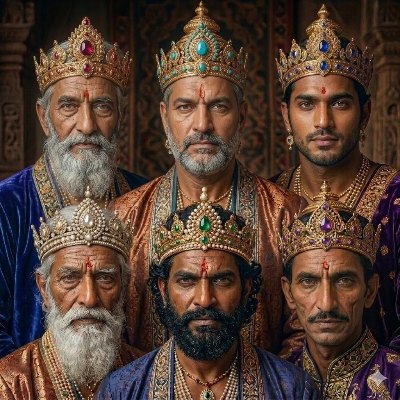
Bhishak · Vaitarana · Sudanta · Vidanta · Devabahu · Devamidha · Kamada · Kamadantika (daughters)
The sons of Hridika beyond Kritavarma and Shatadhanva are recorded collectively across the Harivamsha, the Bhagavata Purana, the Brahmanda Purana, the Vishnu Purana, and the Vayu Purana. Hridika was the son of Svayambhoja of the Andhaka branch of the Satvata line, and his household produced the most historically prominent family of the Andhaka clan in the period of the Kurukshetra War. The Bhagavata Purana (IX.24.26–27) states that Hridika had ten sons in total, of whom Kritavarma was the eldest. The individual names of all ten, however, are not preserved in any single primary source. The Harivamsha names six sons and two daughters. The Bhagavata Purana and Brahmanda Purana together contribute one additional name. The Vishnu Purana and Brahma Purana introduce a further name that creates a genealogical inconsistency noted by the commentarial tradition. The profile below presents what the primary sources actually record, source by source, with the variants clearly identified.
✦ Sons Named in the Harivamsha
The Harivamsha (1.38.5–6) is the most detailed primary source for Hridika's sons. After naming Kritavarma as eldest and Shatadhanva as second, the text states that four further sons were born through the grace of the celestial sage Chyavana. These four are:
- Bhishak — the name derives from the Sanskrit bhishaj, meaning physician or healer. No individual narrative attaches to this figure in any source; he is named solely in this genealogical verse. The variant form Bhishaj appears in the Purana Index's full-text search in the context of the Hridika lineage, likely representing the same individual.
- Vaitarana — the name is formed from vaitarana, a term denoting the river of the dead in Hindu cosmology, or alternatively from vi-tarana, meaning crossing over or surpassing. No individual narrative is attached to this figure in any source.
- Sudanta — from su (good, well) and danta (tooth, tamed), meaning one with fine teeth or one who is well-tamed or disciplined. No individual narrative is attached to this figure in any source.
- Vidanta — from vi (without, beyond) and danta (tooth, tamed), forming a name that may signify one who is beyond ordinary restraint, or a contrast companion to Sudanta. No individual narrative is attached to this figure in any source.
The Harivamsha thus names six sons of Hridika in total — Kritavarma, Shatadhanva, and these four — and does not account for the full complement of ten that the Bhagavata Purana indicates. The same verse (1.38.6) also records two daughters: Kamada and Kamadantika.
The detail that Bhishak, Vaitarana, Sudanta, and Vidanta were born specifically through the grace of Chyavana — the son of the great sage Bhrigu — is notable. Chyavana appears elsewhere in the Puranic tradition as a sage closely associated with the Yadava kings, and the invocation of his boon as the cause of these births indicates that Hridika's household enjoyed a particular religious relationship with the Bhrigu lineage. Whether this reflects a historical connection between the Andhaka clan and the Bhrigu family, or whether it is a conventional narrative device accounting for the separate births of these sons, cannot be determined from the primary sources alone.
✦ Son Named in the Bhagavata Purana and Brahmanda Purana
- Devabahu — named in the Bhagavata Purana (IX.24.27) and the Brahmanda Purana (III.71.141) as a son of Hridika. A Sanskrit compound meaning "he of godlike arms" or "whose arms are like those of a god," the name reflects the conventional Yadava martial epithetic tradition. The Bhagavata Purana records that Devabahu's son was Kambalabarhisa, extending the family's genealogical record by one further generation. Devabahu is not named in the Harivamsha's list and is not the subject of any narrative episode in any primary source consulted.
✦ Devamidha — A Problematic Attribution
The Vishnu Purana (IV.14.23–24) and the Brahma Purana record a son of Hridika named Devamidha, who is in turn described as the father of Shurasena — the prominent Yadava king who was the father of Vasudeva and thus the grandfather of Krishna. This placement creates a direct and significant genealogical inconsistency with the Harivamsha, which does not include Devamidha among Hridika's sons at all.
The Purana Index (Cologne Digital Sanskrit Dictionaries) records this Devamidha under entry 1c, identifying him as a son of Hridika who was also known as Shura and who fathered Shurasena. Wilson's commentary on the Vishnu Purana (IV.14, footnote 16) notes the difficulty explicitly: the Vayu Purana, Padma Purana, Agni Purana, and Matsya Purana all record a different genealogical series for the ancestry of Vasudeva, and the first three of these sources leave it doubtful whether the Shurasena who was Vasudeva's father was a son of Bhajamana's branch or an entirely different line. The Brahma Purana has Shurasena as a son of Devamidha but does not specify Devamidha among the sons of Hridika. Wilson concludes that the Bhagavata Purana's account, which places Shurasena in the Vrishni branch of the Yadavas rather than the Andhaka-Bhajamana branch, is probably the correct genealogy for the father of Vasudeva.
The effect of this inconsistency on the present lineage is substantial: if the Vishnu Purana's placement of Devamidha as a son of Hridika were accepted, it would make Shurasena (father of Vasudeva, father of Krishna) a first cousin of Kritavarma — a genealogical proximity not supported by the Harivamsha or the Bhagavata Purana's own account of the Vrishni succession. The majority of scholarship and the Bhagavata Purana itself place Shurasena in a distinct line, and the Devamidha entry in the Vishnu Purana most likely represents a textual conflation between the Andhaka and Vrishni branches, possibly introduced in transmission.
✦ The Unaccounted Sons
The Bhagavata Purana states that Hridika had ten sons, of whom Kritavarma was the eldest. The named sons across all primary sources — Kritavarma, Shatadhanva, Bhishak, Vaitarana, Sudanta, Vidanta, and Devabahu — account for seven individually named sons. Even setting aside the problematic Devamidha attribution, the names of three further sons of Hridika are not preserved in any primary source that has been consulted. The tradition records the total of ten as a fact but does not supply all ten names in any extant text. The Wisdomlib full-text index for the Hridika entry lists several terms associated with the Hridika context across nineteen books and stories — including Devanta, Naranta, Dhiyanta, Nakavan, Vanarha, Shvetarata, Kanakodbhava, Adhidanta, Kaniyaka, Karambhaka, Vanajata, Bhishana, and Devarha — but these appear to be secondary descriptive terms, compound names, or epithets occurring in the broader Hridika textual cluster rather than individually verified sons bearing those names in the genealogical list.
✦ The Daughters of Hridika
The Harivamsha (1.38.6) records two daughters of Hridika alongside the four sons born through Chyavana's grace: Kamada and Kamadantika. Kamada means "she who grants desires," from kama (desire) and da (giver). Kamadantika is a compound of the same root with antika, meaning near or resembling, suggesting one who closely resembles or is akin to the wish-granter. No marriage alliances or narrative episodes involving either daughter are recorded in any primary source consulted.
✦ Shared Lineage and Clan Context
All of the named sons share the same patrilineal descent from Hridika, son of Svayambhoja, and are thus members of the seventh generation of the Bhajamana dynastic line — itself a branch of the Andhaka clan of the Satvata-Yadava lineage. As brothers of Kritavarma, they belong to the same household that the Mahabharata designates interchangeably as Andhaka and Bhoja of Mrittikavati, the dual clan identity that characterises this branch of the family. None of the eight additional sons named in the sources — Bhishak, Vaitarana, Sudanta, Vidanta, Devabahu, and the unattributed three — play any individually attested role in the Kurukshetra War or in any other major narrative episode, and their genealogical descendants are not traced in the Puranic literature beyond the single case of Devabahu, whose son Kambalabarhisa is noted in the Bhagavata Purana.
✦ References
- Harivamsha, Harivamsha Parva, 1.38.5–6: Primary source for Bhishak, Vaitarana, Sudanta, and Vidanta, naming them as sons of Hridika born by the grace of the sage Chyavana; also names daughters Kamada and Kamadantika. Records six sons in total without claiming a total of ten.
- Bhagavata Purana, IX.24.26–27: States that Hridika had ten sons of whom Kritavarma was the eldest; names Devabahu among the sons and records that Devabahu's son was Kambalabarhisa.
- Brahmanda Purana, III.71.141: Confirms Devabahu as a son of Hridika.
- Vishnu Purana, IV.14.23–24: Names Devamidha as a son of Hridika and father of Shurasena; Wilson's footnote 16 flags the cross-Puranic inconsistency of this placement and its incompatibility with the Vrishni-branch genealogy of Vasudeva.
- Vishnu Purana, IV.14, footnote 16 (H. H. Wilson translation, 1840): Secondary commentary noting that the Vayu, Padma, Agni, and Matsya Puranas give conflicting genealogical series for Vasudeva's ancestry, and that the Bhagavata Purana's account is likely the correct placement for Shurasena.
- Cologne Digital Sanskrit Dictionaries, Purana Index, s.v. Hridika and Devabahu: Modern reference consolidating cross-Puranic attestations of Hridika's sons and naming Devabahu as son of Hridika and father of Kambalabarhisa.
- Cologne Digital Sanskrit Dictionaries, Purana Index, s.v. Devamidha (entry 1c): Records Devamidha as a son of Hridika in the Vishnu Purana account, noting the alias Shura and his role as father of Shurasena.
- Wisdomlib, s.v. Hridika (full-text index): Secondary reference noting the range of terms appearing in the Hridika textual cluster across nineteen books.