
About
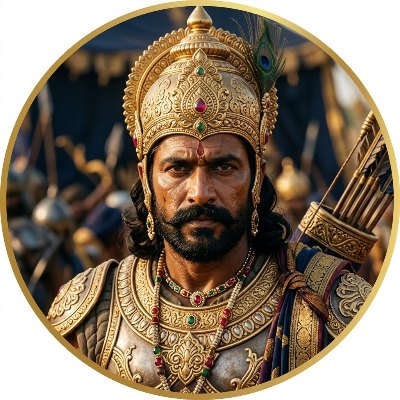
Satyaki (Yuyudhana) — Vrishni Warrior, Disciple of Arjuna, and Commander at Kurukshetra
Yuyudhana · Satyaki · Shineya · Satvata-Pungava
Yuyudhana, universally known by his patronymic Satyaki — meaning "son of Satyaka" — was one of the most distinguished warriors of the Vrishni Yadava clan and a central figure in the Mahabharata. He belonged to the sixth generation from the ancestor Satvata, through the line Satvata — Vrishni I — Anamitra — Shini — Satyaka — Yuyudhana. A kinsman and devoted ally of Krishna, Satyaki chose to fight alongside the Pandavas at the Kurukshetra War and served as one of the seven commanders of the Pandava coalition, leading an akshauhini, or full army division. Renowned as a master archer trained under Arjuna, he survived all eighteen days of the war. He appears extensively throughout the Mahabharata, particularly in the Udyoga, Bhishma, Drona, and Mausala Parvas, and receives incidental genealogical mention in the Harivamsa and the Vishnu Purana.
✦ The Names and Epithets
Yuyudhana is the birth name, derived from the Sanskrit root yudh (to fight) with the desiderative prefix, yielding a sense of "one eager or anxious to fight." Satyaki is a patronymic formed from his father's name Satyaka, meaning "son of Satyaka." Shineya is a lineage name meaning "descendant of Shini," referring to his paternal grandfather Shini of the Vrishni line; this epithet is used frequently in the Mahabharata alongside Satyaki. The title Satvata-Pungava, meaning "bull of the Satvata clan" or "foremost among the Satvatas," is an honorific applied to him in recognition of his prowess, identifying him as the pre-eminent warrior of his lineage grouping.
✦ Lineage
- Patriline: Satvata — Vrishni I — Anamitra — Shini — Satyaka — Yuyudhana (Satyaki)
- Father: Satyaka, son of Shini of the Vrishni-Satvata line; a Yadava chieftain of Dvaraka
- Paternal grandfather: Shini, son of Anamitra; the Mahabharata records an ancestral feud between the Shini line and the family of Somadatta of the Kuru-allied Bahlika clan, a feud that directly shaped the enmity between Satyaki and Bhurishravas at Kurukshetra
- Sons: Ten sons who fought at Kurukshetra and were killed in battle; the Mahabharata records their deaths collectively on the twelfth day of the war at the hands of Karna. A younger son named Asanga survived the main war but perished in the subsequent Mausala fratricide at Prabhasa Tirtha.
- Grandson: Yugandhara, son of Asanga; the sole surviving male heir of Satyaki's line, who was installed by Arjuna as ruler of the territory near the Sarasvati river, in the region called Martikavata, following the evacuation of the Yadava survivors from Dvaraka after the Mausala catastrophe
Note on textual variant: Some recensions of the Puranic genealogies describe Satyaki as a grandson of Satyaka rather than a direct son, positing an intervening generation. The lineage followed here — Satyaka as the direct father of Satyaki — reflects the reading consistent with the established genealogical tree and is supported by the predominant usage of the Mahabharata itself, which regularly applies the patronymic "son of Satyaka" to Yuyudhana.
✦ Discipleship under Arjuna
Although Satyaki was a kinsman of Krishna and a member of the Yadava warrior order in his own right, he chose Arjuna — the third Pandava prince, son of King Pandu and the divine Kunti, regarded as the foremost archer of his age — as his personal teacher in the arts of warfare and the use of divine weapons. The Mahabharata records that Satyaki received instruction from Arjuna in the techniques of archery and in the knowledge and invocation of the divine astras, the supernatural weapons of the epic tradition. This discipleship created a bond of devotion between Satyaki and Arjuna that ran alongside and reinforced his pre-existing loyalty to Krishna, and it shaped the battlefield conduct of all three during the Kurukshetra War.
✦ The War Council and the Peace Embassy
In the period before the war, when Krishna undertook a diplomatic mission to Hastinapura as an emissary of the Pandavas seeking a negotiated settlement, Satyaki accompanied him as a close attendant and personal guard. The Udyoga Parva of the Mahabharata records that during this mission, when the Kaurava prince Duryodhana — the eldest son of the blind king Dhritarashtra — attempted to have Krishna seized by force, Satyaki was present and prepared to resist. The episode underscores the role Satyaki played as a trusted protector of Krishna beyond the battlefield.
✦ The Fourteenth Day: The Penetration of the Kaurava Array and the Duel with Bhurishravas
The most celebrated episode in Satyaki's biography occurs on the fourteenth day of the Kurukshetra War, recorded in the Drona Parva. On that day, Arjuna had sworn a vow to kill Jayadratha — the king of Sindhu and brother-in-law of the Kauravas, whose action had contributed to the death of Arjuna's son Abhimanyu on the thirteenth day — before sunset or else die by his own fire. Arjuna drove deep into the Kaurava formation led by the supreme commander Drona, a Brahmin warrior-teacher of unparalleled skill. Concerned for Arjuna's safety when news of his progress was interrupted, Krishna asked Satyaki to follow and reinforce him.
Satyaki, though already fatigued from earlier fighting, drove his chariot through the entire Kaurava army, defeating or bypassing the successive commanders placed to block him, including Kritavarma — the Yadava nobleman who had allied with the Kauravas — and then Drona himself. He reached Arjuna's position having sustained considerable strain. It was during this advance or shortly after his arrival that his confrontation with Bhurishravas took place. Bhurishravas was the son of Somadatta of the Bahlika clan, and between the Somadatta line and Satyaki's grandfather Shini there existed a long-standing ancestral feud: it was recorded that Shini and Somadatta had previously fought each other, and that Bhurishravas had sworn to avenge his father. On the fourteenth day this enmity reached its resolution.
The Drona Parva narrates that Bhurishravas overpowered the exhausted Satyaki, seized him by the hair, and dragged him along the ground with the intention of executing him. Satyaki was on the verge of being killed when Arjuna, at the direction of Krishna who pointed out what was happening, intervened by severing one of Bhurishravas's arms with an arrow from a distance. This act was immediately contested as a violation of the accepted norms of single combat, since Bhurishravas had not been fighting Arjuna at that moment. Arjuna defended his action by arguing that the protection of his disciple and the prevention of an unjust killing outweighed the formal constraint. While the debate continued, Satyaki recovered and struck off the head of the now-helpless Bhurishravas — an act that was itself criticised within the text as a breach of conduct against an unarmed man who had resolved to fast unto death. The Mahabharata presents these transgressions with moral commentary rather than suppressing them, and the episode stands as one of the war's prominent illustrations of the erosion of dharmic rules under the pressures of combat.
✦ The Deaths of His Ten Sons
The Drona Parva records that Satyaki's ten sons — who fought collectively as part of the Pandava forces — were killed on the twelfth day of the war by Karna, the son of the sun-god Surya and a foundling raised in a charioteer's family, who had been declared the commander of the Kaurava vanguard on that day. The ten sons are described as attacking Karna in defence of Arjuna's position and being slain in rapid succession. The Mahabharata does not give the individual names of all ten sons in a complete enumerated list in most recensions, recording their fate collectively rather than individually. Satyaki himself survived.
✦ Survival and the Post-War Period
Satyaki was among the very small number of warriors on the Pandava side to survive all eighteen days of the Kurukshetra War. The Mahabharata, in its accounting of survivors at the end of the Sauptika Parva, lists him alongside figures such as the Pandavas themselves, Krishna, and Kritavarma on the opposing side as among those who remained alive at the war's conclusion. After the war, Satyaki returned to Dvaraka and resumed his place within the Yadava political community.
✦ The Mausala Fratricide and Death
Thirty-six years after the Kurukshetra War, a curse pronounced by certain sages — provoked by a deceptive act performed by young Yadava men in which a boy was disguised as a pregnant woman and presented to the sages for sport — took effect at Prabhasa Tirtha on the seacoast. The Mausala Parva records that the curse caused iron clubs to grow from a species of grass called eraka, and that when the Yadavas gathered at Prabhasa and consumed wine in large quantities, a brawl broke out among them that escalated into a full massacre in which clan members killed each other with the iron clubs formed from the cursed grass.
The Mausala Parva specifically records that Satyaki — in a state of intoxication — publicly denounced Kritavarma, the Yadava who had fought on the Kaurava side and who had participated in the night massacre of the sleeping Pandava camp on the eighteenth night of the war. Satyaki's denunciation of Kritavarma for this act of killing defenceless sleeping men provoked a violent altercation, during which Satyaki killed Kritavarma. This act triggered the wider chaotic violence among the assembled Yadavas. Satyaki was subsequently surrounded and killed in the general melee that ensued. The episode marks the end of the Vrishni and Yadava political order at Dvaraka.
✦ The Surviving Line: Asanga and Yugandhara
Among Satyaki's sons, one named Asanga survived the eighteen days of the Kurukshetra War but perished in the Mausala fratricide at Prabhasa. Asanga's son Yugandhara survived the entire sequence of catastrophes — the war, the Mausala massacre, and the submersion of Dvaraka. The Ashramavasika Parva of the Mahabharata records that Arjuna, having been entrusted by Krishna with the care of the surviving Yadava women, children, and dependants, evacuated them from Dvaraka as the sea reclaimed the city. In the course of this evacuation and the subsequent resettlement, Yugandhara was established as the ruler of a territory in the region of the Sarasvati river, identified in the text as Martikavata. This installation preserved the continuity of Satyaki's lineage through the otherwise catastrophic end of the Vrishni-Yadava world.
✦ Textual Variants
As noted under the lineage section, some Puranic recensions describe Satyaki as a grandson of Satyaka rather than a son, inserting an additional generation. The Mahabharata's own usage of the patronymic "son of Satyaka" strongly supports the direct father-son relationship followed in this profile. The Harivamsa and the Vishnu Purana genealogies of the Vrishni line also show minor variations in the generations above Satyaka; these do not affect the internal coherence of Satyaki's own lineage as given here.
✦ Theological and Moral Significance
Satyaki functions in the Mahabharata as a figure who illuminates the moral complexity of the war. His conduct in the Bhurishravas episode — fighting to reach his teacher Arjuna, being overpowered, then being saved by an intervention that violated single-combat norms, and then striking the killing blow against an incapacitated man — places him at the centre of the text's sustained exploration of the breakdown of dharmic constraints under the conditions of total war. The Mahabharata does not present these transgressions as heroic simpliciter; characters within the text express concern and reproach. Satyaki's later death at Prabhasa, triggered by his own act of violence against Kritavarma in a drunken brawl, carries an implicit continuity with the ethical transgressions of the war years. At the same time his loyalty to Arjuna, his courage in driving through the entire Kaurava army alone, and his devotion to Krishna are consistently affirmed as genuine virtues.
✦ Connection to the Wider Genealogy
Satyaki stands in the sixth generation from Satvata, the founding ancestor of the Satvata Yadava clan. His grandfather Shini was a kinsman of the Vrishni line that also produced Vasudeva — the father of Krishna — making Satyaki and Krishna members of the same extended clan. Through Satyaki's father Satyaka's daughter, who married Pradyumna the son of Krishna and Rukmini, Satyaki was connected by collateral affinity to the immediate royal family of Dvaraka; Satyaki's sister, in effect, was the mother of Aniruddha, a prince of the Yadava house. Satyaki's own surviving line through Asanga and Yugandhara represents one of the very few threads of Yadava lineage to persist beyond the end of the Mausala catastrophe and the disappearance of Krishna from the world.
✦ References
Primary Sources
- Mahabharata, Udyoga Parva — records Satyaki's presence with Krishna during the peace embassy to Hastinapura; uses the patronymics Satyaki and Shineya; establishes his loyalty and role as Krishna's companion
- Mahabharata, Bhishma Parva — places Satyaki as one of the seven akshauhini commanders of the Pandava coalition; records his participation in the early days of the Kurukshetra War
- Mahabharata, Drona Parva — the primary source for Satyaki's penetration of the Kaurava formation on Day 14; the detailed account of the duel with Bhurishravas and its moral aftermath; the killing of Satyaki's ten sons by Karna on Day 12
- Mahabharata, Sauptika Parva — lists Satyaki among the survivors at the war's end
- Mahabharata, Mausala Parva — the principal source for Satyaki's death in the Prabhasa fratricide; records his denunciation of Kritavarma, the killing, and his own death in the ensuing melee; records the fate of Asanga
- Mahabharata, Ashramavasika Parva — records Arjuna's evacuation of Dvaraka survivors and the installation of Yugandhara at Martikavata near the Sarasvati river
- Harivamsa (Harivamsa Parva, Vrishni genealogy sections) — provides the genealogical framework placing Satyaki within the Shini-Vrishni line; records the daughter of Satyaka married to Pradyumna
- Vishnu Purana (Book IV, Yadava genealogy) — parallel Vrishni genealogy corroborating Satyaki's lineage placement with minor variants
Secondary and Reference Works
- Vettam Mani, Puranic Encyclopaedia (entries on Satyaki, Yuyudhana, Shineya, Bhurishravas) — comprehensive cross-referencing of Puranic and epic passages relating to Satyaki's epithets, genealogy, and narrative episodes
- Wisdomlib (online Puranic database, entries for Satyaki and Yuyudhana) — collates verse citations across the Mahabharata and Harivamsa relevant to the name, lineage, and episodes discussed in this profile