
About
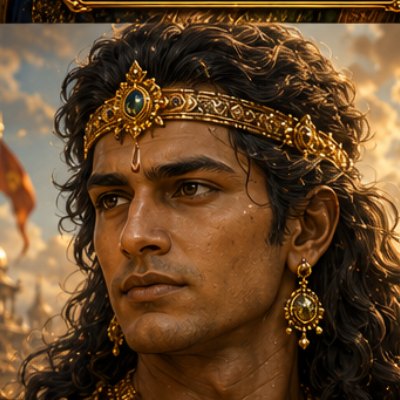
Satrajit — Yadava Nobleman of Dvaraka, Devotee of the Sun, Keeper of the Syamantaka Gem
Satrajit · Satrajita · Satraji
Satrajit is a prominent Yadava nobleman of the Vrishni clan, son of Nighna who was son of Anamitra, himself son of Vrishni the son of Satvata. Satrajit is principally known across the Puranic tradition for his intense devotion to the sun god Surya, through which he obtained the legendary Syamantaka gem — a jewel of extraordinary power described as yielding eight measures of gold daily for a pure keeper and bringing only calamity to the impure. The narrative of the Syamantaka gem, unfolding across the Vishnu Purana, the Bhagavata Purana, the Harivamsha, the Matsya Purana, the Vayu Purana, the Brahmanda Purana, and the Padma Purana, is regarded as one of the most extensively attested Krishna-related narratives in the entire Puranic corpus. Satrajit is also the father of Satyabhama, one of the principal wives of Krishna, and it is through his connection to Krishna that his sub-line of the Vrishni tree carries lasting genealogical and narrative significance.
✦ The Name
The name Satrajit is a Sanskrit compound of satra — a Vedic sacrificial session of extended duration, associated with great merit — and jit, meaning conqueror or victor. The name therefore carries the meaning one who has conquered through sacrifice, or victor of the sacrificial session, a title of religious and martial distinction appropriate to a Kshatriya nobleman noted for his devotion. An alternate form, Satrajita, is the fully declined nominative and appears in this form in several Puranic texts including the Bhagavata Purana.
✦ Lineage
- Father: Nighna — prince of the Vrishni clan, son of Anamitra son of Vrishni son of Satvata
- Brother: Prasena — brother of Satrajit, who received the Syamantaka gem from Satrajit and was killed by a lion while hunting; his death set in motion the central events of the Syamantaka narrative
- Daughters: Satyabhama — the eldest and most renowned of Satrajit's daughters, later given in marriage to Krishna; she is identified in the Bhagavata Purana and other texts as an avatara of Bhudevi, the earth goddess, and bore Krishna ten sons; Bratini and Prasvapini — two further daughters of Satrajit, also given to Krishna, recorded in the Harivamsha tradition
- Son-in-law: Krishna — son of Vasudeva, the pre-eminent figure of the Vrishni clan; he married Satyabhama following the resolution of the Syamantaka episode
✦ The Syamantaka Gem: Acquisition from Surya
Satrajit was a devoted worshipper of Surya, the sun god. One day, while engaged in prayers on the shore of the ocean, Surya appeared before him in bodily form. The brilliance of the solar deity was such that Satrajit could not see him clearly and asked him to appear less dazzling. When the sun god removed the Syamantaka gem from around his own neck, Satrajit was able to perceive his form — and saw that without the gem Surya appeared in the manner of an ordinary figure, with reddish eyes. Surya, pleased with Satrajit's devotion, asked him to name a wish, and Satrajit requested the Syamantaka itself. Surya granted the request and bestowed the gem upon him. The Vishnu Purana, Bhagavata Purana, and Harivamsha all record this episode, with minor variations in detail.
The gem's properties are described consistently across the major sources. When kept by one who is pure in conduct, it yielded eight measures of gold — given as approximately eight bhara, or close to one hundred and seventy pounds — daily. It could also protect the region in which it was housed from disease, drought, wild animals, and misfortune. When worn by one who was impure or sinful, however, the gem brought calamity and death to its wearer. When Satrajit returned to Dvaraka with the jewel shining around his neck, the citizens mistook him for the sun god himself, so brilliant was its radiance.
Krishna, on encountering Satrajit, suggested that a gem of such power and benefit ought to be presented to the Yadava king Ugrasena, the lord of their confederacy, for the welfare of the whole clan. Satrajit, unwilling to part with the jewel, refused. He kept it in his household, where it continued to produce gold daily and to ward off misfortune.
✦ The Loss of the Gem and the False Accusation of Krishna
Satrajit eventually gave the Syamantaka to his brother Prasena. The Vishnu Purana notes that Satrajit did this precisely because he feared Krishna would request it; by putting the gem in Prasena's hands, he placed it beyond the reach of any claim Krishna might make. Prasena, however, was not of the moral purity the gem required of its wearer. He mounted his horse and rode into the forest to hunt, wearing the jewel around his neck. A lion killed him, took the gem, and retreated towards its mountain cave. Before reaching it, the lion was itself killed by Jambavan — the celebrated bear king, described elsewhere in the tradition as the same Jambavan who had served Rama in the Tretayuga — who took the gem and gave it to his young son Sukumara as a plaything.
Prasena did not return. Satrajit, finding his brother missing along with the gem, immediately suspected Krishna, reasoning that Krishna had coveted the jewel from the beginning and must have killed Prasena to obtain it. This accusation spread through the Yadava community and reached the population of Dvaraka. Hearing this calumny against him, Krishna resolved to investigate personally. He led a party of citizens into the forest, found Prasena's body alongside his slain horse, and nearby found the body of the lion that had killed Prasena — with marks on it showing it had in turn been killed by a bear. Following the bear's tracks, Krishna located Jambavan's cave. He sent his companions to wait outside and entered alone.
✦ Krishna's Recovery of the Gem and Marriage to Satyabhama
Inside the cave, Krishna found Jambavan's nurse rocking Sukumara in a swing, with the Syamantaka gem hung above the child as a toy. As Krishna moved to take the gem, the child cried out and Jambavan came forward to defend it. A ferocious battle between the two ensued. The Vishnu Purana records the combat as lasting twenty-one days; the Bhagavata Purana gives twenty-eight days. Krishna's companions outside the cave, after many days without any sign of him, concluded he was dead and returned to Dvaraka in mourning. Eventually Jambavan, his body weakened by the prolonged contest, recognised in Krishna the form of Rama whom he had served in a former age. He surrendered, acknowledged Krishna's supremacy, returned the Syamantaka gem, and offered his daughter Jambavati in marriage as a further gift. Krishna accepted both.
Krishna returned to Dvaraka with Jambavati and the gem. In a public assembly of the Yadavas he presented the Syamantaka to Satrajit, thereby vindicating himself completely of any part in Prasena's death. Satrajit, overwhelmed with shame at the false accusation he had spread, offered the gem back to Krishna together with his daughter Satyabhama in marriage as an act of restitution. Krishna accepted Satyabhama but declined to take back the Syamantaka, returning it to Satrajit as its rightful owner.
✦ The Murder of Satrajit and Final Disposition of the Gem
The Bhagavata Purana (Canto 10, chapter 57) and the Vishnu Purana both record the subsequent murder of Satrajit. Akrura and Kritavarma — two prominent Yadava figures, both of whom had desired Satyabhama in marriage and resented her being given to Krishna — incited a third nobleman, Shatadhanvan, to seize the Syamantaka gem by force. Taking advantage of an absence of Krishna from Dvaraka — the occasion being Krishna's departure to Hastinapura upon hearing the false report that the Pandavas had perished in the house of lac — the wicked Shatadhanvan entered Satrajit's chamber at night and murdered him in his sleep solely out of greed for the gem.
Satyabhama, devastated by her father's death, preserved his body in oil and hastened to Hastinapura to inform Krishna. Krishna and Balarama immediately returned to Dvaraka. Shatadhanvan, hearing of their return, deposited the Syamantaka with Akrura and fled on a horse of extraordinary speed. Krishna pursued and killed him, but recovered no gem on his person. Balarama refused to believe the gem was not found and temporarily withdrew from Dvaraka in anger. Krishna later located the gem in the keeping of Akrura, who had been performing great sacrifices with gold produced by the jewel. In a public assembly of all the Yadavas, the gem was produced, displayed, and returned to Akrura's custody. Through this public disclosure Krishna was finally and completely exonerated of all suspicion in connection with the Syamantaka, and he himself performed the funeral rites of Satrajit.
✦ Textual Variants
The Vishnu Purana and the Bhagavata Purana agree on the overall structure of the Syamantaka narrative but differ in certain details. The duration of the battle between Krishna and Jambavan is given as twenty-one days in the Vishnu Purana and twenty-eight days in the Bhagavata Purana. The Padma Purana gives a broadly similar account. The Matsya Purana records Satrajit as having ten wives, all daughters of the Kekaya king, and credits him with a hundred sons born of these wives, though this aspect of his family is not mentioned in the Bhagavata or Vishnu accounts. The Harivamsha records three daughters of Satrajit — Satyabhama, Bratini, and Prasvapini — all given to Krishna, while the Bhagavata Purana in its main narrative of the Syamantaka episode mentions only Satyabhama in direct connection with these events. The Vayu Purana and Brahmanda Purana also contain versions of the Syamantaka narrative confirming the core episode. H. H. Wilson's footnotes to Vishnu Purana IV.13 note that the story occurs in the Bhagavata, Vayu, Matsya, Brahma, and Harivamsha and may be considered common to the whole Puranic series.
✦ Theological Significance
The Syamantaka narrative is explicitly framed in the Bhagavata Purana (Canto 10, chapter 57) as having its own theological merit: the text states that those who recite or hear this account are cleansed of ill repute and attain peace. The narrative as a whole is structured as a demonstration of Krishna's capacity to bear false accusation, pursue truth through personal effort, and restore right order without vindictiveness — returning the gem to its proper owners at each stage rather than retaining it for himself, even when it was repeatedly offered to him. Satrajit functions within this narrative as a figure whose shortcomings — greed, hasty accusation, inability to surrender attachment to the gem — are ultimately redeemed through his acknowledgement of wrongdoing. His murder, and Krishna's subsequent performance of his father-in-law's funeral rites, further illustrates the Puranic theme of dharmic obligation persisting through personal grief and conflict.
✦ Connection to the Wider Genealogy
Satrajit stands in the line Satvata → Vrishni → Anamitra → Nighna → Satrajit. Through his daughter Satyabhama's marriage to Krishna, his sub-branch of the Vrishni tree is directly connected to the household of Krishna, the central figure of the Vrishni clan. Satrajit's brother Prasena, also son of Nighna, dies without issue in the sources. The gem itself, after Satrajit's death, passes to Akrura — a figure belonging to the separate Shvaphalka sub-line of the Vrishni genealogy, making the Syamantaka's final disposition a point of connection between these two branches of the tree.
✦ References
Primary Sources
- Bhagavata Purana, Canto 10, chapters 56–57 — The fullest sustained account of the Syamantaka narrative, the acquisition of the gem, the false accusation of Krishna, the battle with Jambavan, the marriage to Satyabhama, and the murder of Satrajit with subsequent recovery of the gem from Akrura; also records Satrajit's genealogical position at IX.24.13.
- Vishnu Purana, Book IV, chapter 13 — Names Satrajit as son of Nighna son of Anamitra; provides a full account of the Syamantaka narrative including the gem's properties, Prasena's death, the battle with Jambavan (twenty-one days), and the final assembly; Wilson's footnotes confirm the story's attestation across the Puranic corpus.
- Harivamsha, Harivamsha Parva, chapter 38 — Records the Syamantaka narrative and names Satrajit as son of Nighna; records the three daughters Satyabhama, Bratini, and Prasvapini as given to Krishna.
- Matsya Purana, Dynasty of Vrishni section and chapter 45 — Confirms Satrajit as son of Nighna; records his ten wives as daughters of the Kekaya king and his hundred sons; gives the Syamantaka narrative.
- Vayu Purana, 96.20–35 — Records Satrajit's genealogical position and aspects of the Syamantaka narrative.
- Brahmanda Purana, III.71.21–52 — Contains the Syamantaka narrative with Satrajit as principal figure.
- Padma Purana, chapter 249 — Gives an account of the Syamantaka narrative including the recovery of the gem from Jambavan's cave.
Secondary Sources
- Vishnu Purana, tr. H. H. Wilson (1840), Book IV, chapter 13 notes — Footnotes confirming the Syamantaka narrative as common to the Bhagavata, Vayu, Matsya, Brahma, and Harivamsha traditions; collating variant details including the duration of the battle with Jambavan.
- Wikipedia, "Satrajit" article — Secondary collation of genealogical details and narrative episodes from primary sources, including the daughters' names and the murder episode.
- Wisdomlib.org, Purana Index entry for Prasena — Lists the specific Puranic chapter references for Satrajit and Prasena across the Bhagavata, Brahmanda, Matsya, Vayu, and Vishnu Puranas.
Prasena — Son of Nighna, Bearer of the Syamantaka Gem
Prasena · Prasenajit
Prasena is a prince of the Vrishni clan within the Yadava genealogy, son of Nighna who was son of Anamitra son of Vrishni son of Satvata, and brother of Satrajit. He is attested across the Vishnu Purana, the Bhagavata Purana, the Harivamsha, the Matsya Purana, the Vayu Purana, the Brahmanda Purana, and the Padma Purana solely in connection with a single episode: he received the Syamantaka gem from his brother Satrajit, went hunting on horseback wearing the jewel, and was killed by a lion which took the gem. His death set in motion the extended sequence of events — Jambavan's possession of the gem, Krishna's false accusation, the battle in the cave, and the marriages to Jambavati and Satyabhama — that constitute the Syamantaka narrative, one of the most widely attested narratives of the Vrishni cycle. Prasena himself plays no active part in any of these subsequent developments; he is a catalytic figure whose death rather than his life is the source of his narrative significance.
✦ The Name
The name Prasena contains the element sena, army or force, with the prefix pra- conveying the sense of forward, prominent, or pre-eminent — yielding the meaning one who leads or advances at the head of an army, a martial naming convention common in Kshatriya lineages. The longer form Prasenajit, meaning one who has conquered an army or who is victorious in battle, appears in some secondary sources as an alternate name for the same figure, though the primary Puranic texts consistently use the shorter form Prasena. A separate figure named Prasena also appears in the Karna Parva of the Mahabharata as a son of Karna killed by Satyaki in the Kurukshetra War; this is an entirely distinct individual with no connection to the Vrishni Prasena treated here.
✦ Lineage
- Father: Nighna — prince of the Vrishni clan, son of Anamitra son of Vrishni son of Satvata
- Brother: Satrajit — the elder or co-equal son of Nighna; a devoted worshipper of Surya from whom he obtained the Syamantaka gem; he gave it to Prasena and subsequently accused Krishna of Prasena's murder; his daughter Satyabhama became a principal wife of Krishna
✦ The Death of Prasena and the Syamantaka Narrative
Satrajit gave the Syamantaka gem to Prasena. The Vishnu Purana states explicitly that Satrajit transferred the gem to Prasena because he feared Krishna would ask for it, and that Prasena was not a man of the purity the gem required. The Bhagavata Purana (Canto 10, chapter 56) records that Prasena mounted his horse, wore the gem about his neck, and rode into the forest for hunting. There, a lion killed both Prasena and his horse, and snatched the gem — drawn by the jewel's extraordinary brilliance. The lion headed towards its mountain cave but was itself killed on the way by Jambavan, the bear king, who had lived since the age of Rama. Jambavan took the jewel and brought it into his cave, where he gave it to his young son Sukumara as a plaything.
The Bhagavata Purana preserves the words of Jambavan's nurse, who was heard singing to the child inside the cave: that a lion had killed Prasena, that Jambavan had killed the lion, and that the Syamantaka therefore rightfully belonged to the child. It is these words, overheard by Krishna as he entered the cave following the trail of tracks, that first confirmed to him what had happened to Prasena. At this point Krishna had already shown Prasena's body to the citizens who accompanied him, publicly demonstrating that Prasena had been killed by a lion rather than by Krishna, thereby beginning the process of clearing his name.
Prasena is not mentioned in any primary source after the account of his death. No children or further episodes are attributed to him. The Puranic Encyclopaedia notes an entirely separate tradition in which a Prasena is stationed by Krishna to guard the western gate of Mathura, citing Bhagavata Purana X.50.20 — this reference almost certainly concerns a different individual of the same name, given that the Vrishni Prasena is already dead in the narrative sequence by the time of the Mathura episodes. The two must be treated as distinct figures.
✦ Textual Variants
The Vishnu Purana and the Bhagavata Purana agree fully on the basic episode: Prasena receives the gem, goes hunting, is killed by a lion, and the gem passes to Jambavan. The Matsya Purana records Prasena's father as Nighna but gives Nighna's sons as Prasena and Shaktisena rather than Prasena and Satrajit, substituting Shaktisena for Satrajit in the lineage list; the narrative role assigned to Satrajit in the gem story nonetheless corresponds to the same figure in its broader context. The Vayu Purana refers to Satrajit as Sakrajit in one recension but otherwise agrees with the mainstream account. The Garuda Purana lists Prasena separately as a son of Anamitra rather than of Nighna, which reflects that text's broader restructuring of the Vrishni genealogy and is a divergence from all other principal sources. The Harivamsha (chapter 38) describes Prasena in terms which implicitly acknowledge both his nobility and the fatal consequence of his unworthiness to bear the gem, consistent with the Vishnu Purana's framing.
✦ Connection to the Wider Genealogy
Prasena stands in the line Satvata → Vrishni → Anamitra → Nighna → Prasena. He dies without recorded issue in any primary source, and his branch of the Nighna line ends with him. The entire narrative momentum generated by his death flows through his brother Satrajit's line — through Satyabhama's marriage to Krishna, through the gem's passage to Akrura, and through Krishna's formal exoneration before the assembled Yadavas. Prasena's role in the tradition is thus entirely catalytic: he is present in the sources not as an agent but as the occasion through which the Syamantaka narrative unfolds.
✦ References
Primary Sources
- Bhagavata Purana, Canto 10, chapter 56, verses 13–14 — Records Prasena's death at the hands of a lion while hunting with the Syamantaka gem; the fullest single-verse account of the episode.
- Vishnu Purana, Book IV, chapter 13, verses 10 and 29–39 — Names Prasena as son of Nighna; records his death while hunting and the passage of the gem through the lion to Jambavan; notes explicitly that the gem was dangerous to an impure wearer.
- Harivamsha, Harivamsha Parva, chapter 38 — Gives the Syamantaka narrative with Prasena as the figure who takes the gem into the forest; confirms the lineage Anamitra → Nighna → Prasena.
- Matsya Purana, chapter 45, verses 3–18 — Contains the Syamantaka narrative; names Prasena as son of Nighna, with the variant that Nighna's other son is Shaktisena.
- Vayu Purana, 96.20–35 — Records Prasena's role in the Syamantaka narrative and his genealogical position.
- Brahmanda Purana, III.71.21–52 — Contains the Syamantaka narrative with Prasena's death as the inciting event.
- Padma Purana, chapter 249 — Records the Syamantaka narrative including the verse sung inside Jambavan's cave naming Prasena's death.
- Garuda Purana, chapter 139 — Places Prasena as a son of Anamitra rather than of Nighna, a divergence from all other principal sources.
Secondary Sources
- Puranic Encyclopaedia, Vettam Mani — entry "Prasena" — Distinguishes the Vrishni Prasena from the son of Karna; lists all primary chapter references across the Bhagavata, Brahmanda, Matsya, Vayu, and Vishnu Puranas; notes the separate Bhagavata X.50.20 reference to a Prasena at Mathura as likely a different individual.
- Wisdomlib.org, "Prasena: Significance and symbolism" — Secondary collation of the figure's role across Puranic sources.