
About
Babhru — Son of Devavridha, Foremost among Satvata Warriors
Babhru · Vabhru (Harivamsha rendering) · Daivavridha (patronymic, meaning son of Devavridha) · Babhru Satvata
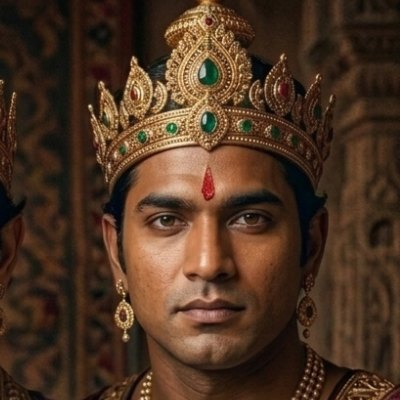
Babhru was the son of Devavridha, a son of King Satvata of the Yadava lineage, and is celebrated in the Puranic tradition as the foremost among human beings — a distinction complementing his father's renown as the equal of the gods. He was a Maharatha of the Satvata clan, described in the Harivamsha as a performer of many sacrifices, a lavish giver of gifts, learned and conversant with the knowledge of Brahman, of glorious deeds and great effulgence. Together, Babhru and Devavridha are commemorated in a verse of praise that was recited across the Yadava community and remained current when the Puranas were composed. Their association resulted, according to the different primary texts, in thousands of their descendants or followers attaining liberation. Babhru appears principally in the Harivamsha Purana (Adi Parva, Chapter 37), the Bhagavata Purana (Canto 9, Chapter 24), the Vishnu Purana (Book IV, Chapter XIII), the Brahmanda Purana, and the Vayu Purana. He is also mentioned in the Mahabharata (Sabha Parva, Anushasana Parva) and is attested in the Aitareya Brahmana through the patronymic Daivavridha applied to him. The name Babhru is shared by several distinct figures in the Puranic corpus, and the son of Devavridha must be carefully distinguished from them.
✦ The Name
The Sanskrit word babhru is a common noun and adjective carrying the primary meaning of tawny, reddish-brown, or dark brown — a colour associated with animals such as the mongoose, certain cows, and the ichneumon. In Dharmashastra literature the word is used to describe tawny-coloured animals and the colour of certain plants in Vedic ritual contexts, as the Wisdomlib definition entry records. As a personal name, Babhru appears in early Vedic texts: the Rig Veda contains references to a figure or deity called Babhru in the context of Soma ritual (Rig Veda X.86, among others), and the name occurs in the early Vedic literature as a designation for a divine or semi-divine being associated with Indra. The patronymic Daivavridha — meaning son of Devavridha — is applied to Babhru in the Aitareya Brahmana (VII.34), a Rigvedic Brahmana text, confirming that the fame of this father-son pair had entered Vedic Brahmana literature.
✦ Lineage
- Descent: Babhru was of the Yadava lineage, descending from Yadu through the Kroshtu line and subsequently through Satvata, who was the ancestor of the major Yadava sub-clans.
- Father: Devavridha, son of Satvata and a king of the Yadava lineage, characterised in the praise verse as equal to the gods. The Harivamsha narrates that Devavridha undertook severe austerities on the banks of the river Parnasha to obtain an accomplished son, whereupon the river herself assumed human form and became his wife.
- Mother: The Harivamsha Purana (Chapter 37) identifies Babhru's mother as the river Parnasha, who assumed human form in response to Devavridha's austerities. The Wisdomlib Puranic Index entry for Babhru (1d), drawing on the Brahmanda Purana, names the mother as Gandhini rather than Parnasha. These two names represent two distinct traditions about Babhru's mother, neither of which is confirmed by the Bhagavata Purana (which does not name the mother at all). This discrepancy is discussed below in the variants section.
- Descendants: The Harivamsha records that Babhru's family was extensive and that his descendants were the Marttikavata Bhojas, the Bhoja rulers of Mrittikavati on the Parnasha river. This attributionconflicts with the Vishnu Purana (IV.13.7), which traces the Marttikavata Bhojas to Mahabhoja, a different son of Satvata, rather than to Babhru.
✦ The Praise Verse
The most famous testimony to Babhru's standing is the verse of praise that circulated orally among the Yadava clans and was recorded in three different primary texts with significant variation. The Bhagavata Purana (9.24.9–11) frames the verse as something heard from a distance in the past and still seen and sung in the present — a striking locution suggesting active oral transmission. The verse declares that it has been decided that Babhru is the best among human beings and that Devavridha is equal to the divine beings, and states that 14,065 descendants of both men attained liberation through their association. The Vishnu Purana (IV.13) records a parallel version of the praise verse: Babhru is first of men and Devavridha equal to the gods; sixty-six persons followed the precepts of one, and six thousand and eight disciples of the other obtained immortality. The Harivamsha (Chapter 37, verses 14–16) gives yet a third version: the verse praises both figures and reports that four hundred and sixty-two thousand men attained the realm of Brahma through being slain in battle by Devavridha and Babhru. The three versions thus differ not only in the count — 14,065, approximately 6,074, and 462,000 — but in the mechanism of liberation: discipleship in the Bhagavata Purana and Vishnu Purana, and death in battle against them in the Harivamsha.
✦ Character and Qualities
The Harivamsha (Chapter 37, verses 14–16) describes Babhru's qualities in some detail. He performed many sacrifices and gave gifts liberally. He was learned and conversant with the knowledge of Brahman. His weapon was very strong. He was of glorious deeds, highly effulgent, and described as the foremost of the Satvatas. The Wisdomlib Puranic Index entry (1d) adds that he was a Maharatha — a warrior of the highest classification, capable of fighting ten thousand ordinary warriors simultaneously — righteous and truthful. The Wisdomlib Immortal Son entry, which draws on the Puranic tradition, confirms that Babhru and Devavridha's sons are described as those who transcended mortality, framing both figures within the discourse of spiritual liberation.
✦ Association with the Syamantaka Gem
The Wisdomlib Puranic Index entry for Babhru (1d), citing the Brahmanda Purana (III.71), records that Babhru obtained the celebrated Syamantaka gem — the divine jewel given by Surya to Satrajit and associated with a cascade of events in the Yadava world — and gave it to Krishna, who subsequently returned it. The identity of this Babhru with the son of Devavridha is asserted in the Puranic Index compilation. The Syamantaka episode as narrated at length in the Vishnu Purana and the Bhagavata Purana centres on the gem's movement among various Yadava figures, but neither of those texts names this particular Babhru as the holder of the gem in the main narrative; the association with Babhru son of Devavridha and the gem appears most explicitly in the Brahmanda Purana tradition as compiled in the Wisdomlib Puranic Index.
✦ The Many Figures Named Babhru
The Wisdomlib Babhru definition entry and the Vishnu Purana index of Wilson's translation both confirm that at least four distinct figures named Babhru appear in the Puranic and epic corpus, and they must not be confused with one another. First, the Babhru who is the son of Devavridha and the subject of this profile. Second, the Babhru who is the son of Druhyu — Druhyu being one of the five sons of Emperor Yayati — whose son was Setu; this Babhru is attested in the Bhagavata Purana (9.23.14), the Brahmanda Purana (III.74.7), the Vayu Purana (99.7), and the Vishnu Purana (IV.17.1–2), and belongs to an entirely different branch of the lunar dynasty with no connection to the Yadava lineage. Third, the Babhru who is the son of Romapada, attested in the Bhagavata Purana (9.24.2), the Brahmanda Purana (III.70.38), and the Vishnu Purana (IV.12.39), who had a son named Kriti and belonged to the line of the Anga kings. Fourth, the Babhru who was a disciple of Shunaka and taught a Samhita, attested in the Bhagavata Purana (12.7.3), the Brahmanda Purana (II.35.60), and the Vishnu Purana (III.6.12), a figure from the lineage of Vedic preceptors. In addition to these, the Puranic Encyclopaedia entry in the Wisdomlib Babhru definition records several further figures of the same name mentioned in the Mahabharata: a Yadava warrior of the Vrishni dynasty who was a friend of Krishna and was killed by an arrow from a bow in the Mausala Parva (distinct from the son of Devavridha); a king of Kashi; and a son of King Virata.
✦ Textual Variants and Inconsistencies
Mother named Gandhini versus Parnasha: The most significant variant for Babhru's own biography concerns the identity of his mother. The Harivamsha Chapter 37 identifies her as the river Parnasha, who assumed human form. The Wisdomlib Puranic Index entry (1d) for the son-of-Devavridha Babhru names the mother as Gandhini, citing the Brahmanda Purana. The Bhagavata Purana (9.24.9) names only Devavridha as the father and does not name the mother. These two names — Parnasha and Gandhini — may represent different textual traditions about Babhru's mother, or Gandhini may be an alternative name for Parnasha in her assumed human form; but no primary text examined states such an equivalence.
The liberation count and mechanism: As discussed in the Devavridha profile, the three primary sources give incompatible numbers for those who attained liberation through Devavridha and Babhru: 14,065 in the Bhagavata Purana, approximately 6,074 in the Vishnu Purana, and 462,000 in the Harivamsha. The mechanism also differs: discipleship in the Bhagavata Purana and Vishnu Purana, death in battle in the Harivamsha.
The Bhoja attribution conflict: The Harivamsha states that Babhru's descendants were the Marttikavata Bhojas. The Vishnu Purana attributes the Bhojas of Mrittikavati to Mahabhoja, a different son of Satvata. These two attributions are not reconcilable without arbitrarily suppressing one source, and both traditions must be acknowledged as existing in the primary corpus.
✦ Connection to the Wider Genealogy
Through his father Devavridha, Babhru was the grandson of Satvata and a member of the broader Satvata clan network that formed the core of the Yadava world at Mathura and later Dvaraka. Through the Marttikavata Bhojas — his descendants in the Harivamsha tradition — Babhru's line remained a recognised presence in the Mahabharata period, when the Bhoja clan allied with the Vrishnis and Andhakas in the defence of Dvaraka and in the Kurukshetra war. The Aitareya Brahmana's use of the patronymic Daivavridha for Babhru represents an unusually early attestation — in a Vedic Brahmana text — of the fame of this father-son pair, confirming that their renown was not merely a late Puranic elaboration but was grounded in the older Vedic textual memory.
✦ References
Primary Sources
- Harivamsha Purana, Adi Parva, Chapter 37, verses 11–16 (Wisdomlib, Dutt translation; mahabharata-resources.org Sanskrit text) — Records the birth of Babhru from Devavridha and the river Parnasha; describes his qualities; gives the liberation count as 462,000 through death in battle; attributes the Marttikavata Bhojas to Babhru's descendants. The chapter title in the Harivamsha is itself "An Account of Vabhru's Family," underscoring the centrality of Babhru to the genealogical tradition of this chapter.
- Bhagavata Purana, 9.24.9–11 (Vedabase; Red Zambala) — States that Babhru was the son of Devavridha; records the praise verse declaring Babhru foremost among human beings; gives the liberation count as 14,065.
- Vishnu Purana, IV.13 (Wisdomlib, Wilson translation; Vishnu Purana index) — Records the praise verse in a variant form; gives the liberation count as approximately 6,074 in two groups; attributes the Marttikavata Bhojas to Mahabhoja rather than Babhru. The Wilson index entry confirms Babhru as son of Devavridha on p. 424.
- Brahmanda Purana, III.71 — Names Babhru's mother as Gandhini (differing from the Harivamsha's Parnasha); associates Babhru with the Syamantaka gem episode; attested through the Wisdomlib Puranic Index.
- Aitareya Brahmana, VII.34 — Uses the patronymic Daivavridha for Babhru; the Cologne Sanskrit Dictionaries confirm this usage and its derivation from Devavridha, giving the lineage a Vedic Brahmana attestation.
- Mahabharata, Anushasana Parva, Chapter 4, verse 50 — References Babhru in the context of righteous warriors; attested in the Wisdomlib Babhru definition entry.
Secondary and Reference Sources
- Wisdomlib — "Babhru: 18 definitions" (wisdomlib.org/definition/babhru) — Compiles all four distinct Babhrus from across the Bhagavata, Vishnu, Brahmanda, and Vayu Puranas and the Mahabharata; provides the Puranic Index entry (1d) for the son-of-Devavridha Babhru including the Gandhini mother variant and the Syamantaka gem association.
- Wisdomlib — "Babhru: Significance and symbolism" (wisdomlib.org/concept/babhru) — Describes Babhru as the brilliant child of Devavridha and the river, characterised by exceptional qualities; confirms the spiritual significance of the father-son pair.
- Wisdomlib — "Daivavridha: 3 definitions" (wisdomlib.org/definition/daivavridha) — Confirms the patronymic Daivavridha as applied to Babhru in the Aitareya Brahmana; provides the Cologne Sanskrit Dictionaries derivation.
- Wisdomlib — "Immortal son: Significance and symbolism" (wisdomlib.org/concept/immortal-son) — Confirms the tradition framing Babhru and Devavridha's descendants as transcending mortality.
- Wikipedia — "Bhoja tribe" (en.wikipedia.org/wiki/Bhoja_tribe) — Discusses both the Mahabhoja and Babhru attributions for the Bhojas of Mrittikavati; confirms the Parnasha river location of the Bhoja capital.