
About
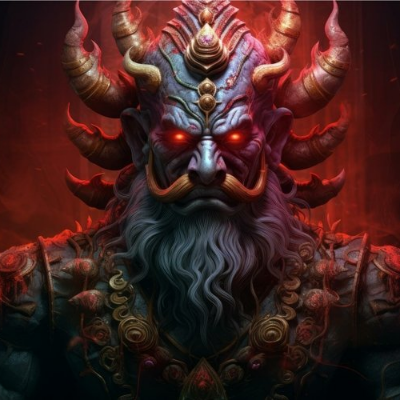
Dhumralochana — Danava Chieftain of Shumbha, Vanguard Commander, Reduced to Ashes by the Goddess
Dhumralochana · Dhumralocha · The Smoke-Eyed One · Adhipa of the Asuras
Dhumralochana is a Danava chieftain, described in the Markandeya Purana as an Adhipa — a commander or lord — among the Asuras, and one of the most trusted military leaders in the service of Shumbha, the Danava king who conquered the three worlds and dethroned Indra. He belongs to the Danava lineage of Kashyapa and Danu, the primordial progenitor pair of the Danava race. Dhumralochana holds the distinction of being the first high-ranking general dispatched by Shumbha against the goddess Ambika, making his encounter the opening act of the great war between the goddess and the Shumbha-Nishumbha empire in the Devi Mahatmya. His death is the most singular of all the generals' deaths in that text: he was not slain by any physical weapon but was reduced instantly to ashes by the sound of a single syllable uttered by the goddess. His narrative is recorded in the Devi Mahatmya of the Markandeya Purana, Chapter 6. In the esoteric interpretation of the Shakta tradition he represents clouded and distorted perception — the delusion that arises from ignorance and prevents the recognition of divine truth even when it stands directly before one.
✦ The Name
The name Dhumralochana is a Sanskrit compound of two elements: dhumra, meaning smoke or smoky, and lochana, meaning eye or vision. The compound therefore means the smoke-eyed one or he whose eyes are filled with smoke, denoting a being whose sight is obscured, clouded, or distorted. The name carries its symbolic meaning on its surface: just as smoke obscures the clarity of physical vision, Dhumralochana's name announces the quality he embodies — the inability to perceive clearly, and specifically the inability to perceive the divine reality of the goddess standing before him. The shorter form Dhumralocha is occasionally used as a variant. The title Adhipa, applied to him in the Markandeya Purana, is a Sanskrit term meaning chieftain or lord, indicating his status as a commander of authority rather than a mere soldier within Shumbha's military hierarchy.
✦ Lineage
- Father: Kashyapa — the great progenitor sage, son of Marichi and grandson of Brahma, who fathered the Danava race through his wife Danu and the Deva race through his wife Aditi; the patrilineal ancestor of Dhumralochana's line.
- Mother: Danu — a daughter of the progenitor Daksha and wife of Kashyapa; the mother of the entire Danava race, which takes its collective name from her.
- Affiliation: Shumbha — the Danava king who conquered the three worlds and dethroned Indra; Dhumralochana served as one of his most trusted Adhipas and was the first general specifically chosen to lead the military campaign to capture the goddess Ambika.
- Children: None recorded in any primary source.
✦ The Mission
The Devi Mahatmya records that after Shumbha's messenger Sugriva returned from his mission to the goddess Ambika with her declaration that she would only accept as husband the one who could defeat her in battle, Shumbha was consumed by fury at what he interpreted as defiance and provocation. He turned first to Dhumralochana as his most trusted vanguard commander and charged him with the task of bringing the goddess to him by force. The instructions were explicit and without ceremony: Dhumralochana was to take an army of sixty thousand Asuras to the Himalayan mountains where the goddess dwelt, seize her, and bring her to Shumbha — by her hair if she refused to come willingly. The scale of the force allocated to this mission — sixty thousand soldiers under a named chieftain — reflects the seriousness with which Shumbha regarded the task and the confidence he placed in Dhumralochana as the commander most capable of carrying it out.
✦ The Confrontation and the Death of Dhumralochana
Dhumralochana arrived at the Himalayan mountain with his army of sixty thousand and confronted the goddess Ambika. He issued his demands that she submit to Shumbha's authority and accompany him. The goddess did not respond with weapons, movement, or any form of physical engagement. When Dhumralochana rushed forward to seize her by force, she uttered a single syllable — the bija mantra Hum, understood in the Shakta and Tantric tradition as the seed-sound of divine wrath and absolute protective power. The Devi Mahatmya records that the vibrational force and fire contained within this single utterance was sufficient to reduce Dhumralochana entirely to ashes in an instant. He did not survive long enough to lay hands upon her. His destruction was total, immediate, and required no physical weapon, no combat, and no sustained engagement on the goddess's part whatsoever. Following his instantaneous death, the sixty thousand Asuras of his army found themselves leaderless and were decimated by the goddess's lion, her mount, which fell upon the disoriented forces and destroyed them across the battlefield.
✦ The Significance of the Weaponless Death
Dhumralochana's death stands apart from every other general's destruction in the Devi Mahatmya precisely because no weapon was used. Chanda and Munda were decapitated with Kali's sword. Raktabija was drained of his blood and slain in direct combat. Nishumbha was pierced by the trident after a fierce exchange of weapons. Shumbha fell after a cosmic duel involving the full range of divine armaments. Dhumralochana alone was destroyed by sound alone — by the bare vibrational power of a single syllable spoken with divine authority. The Devi Mahatmya's presentation of this death as the first and opening act of the war establishes from the outset that the goddess's power operates at a register beyond the merely physical and martial. She does not need to exert herself against Dhumralochana; the sound of her wrath is sufficient. This gradation — the first general destroyed by sound alone, subsequent generals requiring progressively greater and more spectacular engagements — provides the war narrative with a structural escalation in which the goddess's power is revealed in increasingly elaborate manifestations as the adversaries grow in stature.
✦ Theological Significance
In the esoteric interpretation of the Chandi Path, the ritual recitation of the Devi Mahatmya, Dhumralochana is understood as a personification of the delusion that arises from ignorance — specifically the form of ignorance that clouds perception and prevents the recognition of divine reality even when it is immediately present and fully visible. Just as smoke fills the eyes and makes it impossible to see clearly what lies before one, Dhumralochana represents the state of a consciousness so thoroughly obscured by the smoky residue of accumulated ignorance that it cannot perceive the sovereign divine truth standing directly in front of it. He looks at the goddess and sees only an object to be seized, a possession to be delivered to his master. He is constitutionally incapable of perceiving what she actually is. His destruction by the syllable Hum carries a corresponding teaching: the delusion of smoke-filled vision is not removed by physical struggle or prolonged effort but is dissolved instantaneously by the power of the sacred word, the vibrational force of spiritual insight that cuts through obscuration at its root. The single syllable accomplishes in an instant what no amount of combat could.
✦ Connection to the Wider Genealogy
Through his Danava classification, Dhumralochana belongs to the same broad lineage of Kashyapa and Danu that includes Shumbha, Nishumbha, Chanda, Munda, Raktabija, Rambha, Dhenukasura, Pralambhasura, Arishtasura, Kesi, and the other Danava figures of the Puranic tradition. He stands as a collateral member of this lineage in his capacity as an Adhipa and vanguard commander in Shumbha's service. His narrative ends entirely with his instantaneous reduction to ashes in Chapter 6 of the Devi Mahatmya, and no children or further descendants are recorded. His structural role in the Devi Mahatmya is that of the first to fall — the opening sacrifice of the war that escalates through Chanda and Munda, Raktabija, Nishumbha, and finally Shumbha himself, each death requiring a greater and more remarkable manifestation of the goddess's power than the one before.
✦ References
- Primary Sources:
- Markandeya Purana, Devi Mahatmya, Chapter 6: The sole primary source for Dhumralochana's narrative; records Shumbha's fury at the goddess's refusal, his charge to Dhumralochana to seize her with sixty thousand soldiers, the confrontation at the Himalayan mountain, the utterance of Hum, Dhumralochana's instantaneous reduction to ashes, and the lion's decimation of the leaderless army.
- Secondary Sources:
- Coburn, Thomas B. Devi-Mahatmya: The Crystallization of the Goddess Tradition. Motilal Banarsidass, 1984: Provides essential scholarly context for the structure of the Devi Mahatmya's battle narrative and the escalating series of generals, within which Dhumralochana's weaponless death serves as the opening act.
- Mani, Vettam. Puranic Encyclopaedia. Motilal Banarsidass, 1975: Provides a consolidated summary of Dhumralochana's episode within the broader Shumbha-Nishumbha narrative.