
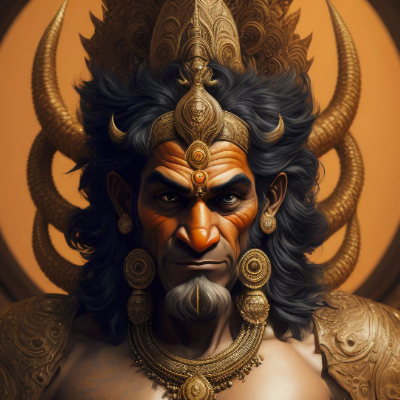
About
Sugriva — Danava Envoy of Shumbha, Diplomatic Messenger, Catalyst of the War with the Goddess
Sugriva Danava · Sugriva the Asura Envoy · Messenger of Shumbha and Nishumbha
Sugriva is a Danava in the service of Shumbha and Nishumbha, the two Danava kings who conquered the three worlds and dethroned Indra, who employed him as their principal diplomatic envoy. He belongs to the Danava lineage of Kashyapa and Danu, the primordial progenitor pair of the Danava race. In the Devi Mahatmya of the Markandeya Purana he appears in Chapter 5 as the figure dispatched by Shumbha to the Himalayan mountain to propose marriage to the goddess Ambika on his master's behalf. His mission failed: the goddess replied with a firm and playful declaration that she would only accept a husband who could defeat her in battle. Sugriva returned to Shumbha with this rejection, and his report prompted Shumbha to abandon diplomacy entirely and command his first general, Dhumralochana, to seize the goddess by force. Sugriva thus functions as the critical narrative hinge between the diplomatic and the violent phases of the Shumbha-Nishumbha conflict with the goddess. He is entirely distinct from the Vanara king Sugriva of the Ramayana, who is a son of Surya the sun god and belongs to a wholly separate genealogical and narrative tradition. The Danava Sugriva receives no specific death scene in the Devi Mahatmya and is understood to have perished in the general destruction of Shumbha's forces.
✦ The Name and Disambiguation
The name Sugriva is a Sanskrit compound of su, meaning good or beautiful, and griva, meaning neck, yielding the meaning one with a beautiful neck or fair-throated one. The name is shared by two entirely distinct figures in the Puranic and epic tradition. The first and more widely known is the Vanara king Sugriva of the Ramayana, a son of Surya the sun god, the younger brother of the Vanara king Vali, and an ally of Rama in the war against Ravana. The second is this Danava figure of the Devi Mahatmya, a member of the Kashyapa-Danu lineage in Shumbha's diplomatic service. The two share only a name and have no genealogical, narrative, or thematic connection. The qualifying designation Sugriva Danava is used in the genealogical tradition to distinguish this figure from his Vanara namesake.
✦ Lineage
- Father: Kashyapa — the great progenitor sage, son of Marichi and grandson of Brahma, who fathered the Danava race through his wife Danu and the Deva race through his wife Aditi; the patrilineal ancestor of Sugriva's line.
- Mother: Danu — a daughter of the progenitor Daksha and wife of Kashyapa; the mother of the entire Danava race, which takes its collective name from her.
- Affiliation: Shumbha and Nishumbha — the two Danava kings who jointly conquered the three worlds and dethroned Indra; Sugriva served as their principal diplomatic envoy and was dispatched by Shumbha to deliver the marriage proposal to the goddess Ambika and to return with her response.
- Children: None recorded in any primary source.
✦ The Embassy to the Goddess
Chapter 5 of the Devi Mahatmya records the circumstances and conduct of Sugriva's mission. Following the intelligence report delivered to Shumbha by his Parshvacharas Chanda and Munda, who had observed the goddess dwelling in radiant beauty on the Himalayan mountain and described her as an incomparable jewel that rightfully belonged to the Danava king, Shumbha resolved to acquire her. He chose Sugriva as his envoy and dispatched him to the goddess with a formal proposal of marriage. Sugriva's presentation of the proposal was not a simple delivery of a message but a sustained act of persuasion. He presented Shumbha's credentials: his mastery of the three worlds, his possession of all the treasures and prerogatives of the gods whom he had defeated, his supremacy over every being in the cosmos. He offered the goddess a choice between Shumbha and his brother Nishumbha as husband, framing this as an honour of the highest order. He further deployed an argument of logic and warning, pointing out that no woman — however powerful she appeared — could realistically stand against the army that had already defeated the assembled gods of heaven. His embassy combined flattery, inducement, and implicit threat in a single rhetorical act.
✦ The Goddess's Reply and the Return to Shumbha
The goddess received Sugriva's proposal with a tone that the Devi Mahatmya characterises as at once playful and immovable. She acknowledged that Shumbha and Nishumbha were indeed lords of great power and that Sugriva's description of their sovereignty was not false. She then replied with the declaration that had the force of an irrevocable vow: she had made a foolish promise in her youth, she said, and was bound by it. She would only accept as husband the one who could match her in strength, overcome her in battle, and remove her pride by his own power. She invited whichever of the two brothers, or any champion they chose to send, to come and accomplish this. The reply was courteous in its framing but absolute in its substance. Sugriva, receiving this response, returned to Shumbha and delivered the goddess's words. The Devi Mahatmya records that Shumbha, upon hearing the reply, was consumed with anger. The failure of Sugriva's diplomatic mission — the most eloquent and logically constructed approach available to the Danava court — marked the definitive close of the non-violent phase of the conflict and the opening of the military campaign that would ultimately consume Shumbha's entire army and both kings themselves.
✦ Fate
The Devi Mahatmya does not provide Sugriva with a specific death scene. After delivering the goddess's reply to Shumbha and thus triggering the military escalation that followed, he disappears from the text's named narrative as the high-ranking military commanders — Dhumralochana, Chanda and Munda, Raktabija, Nishumbha, and finally Shumbha himself — successively take the field and are destroyed. The Puranic interpretive tradition understands him to have perished in the general and comprehensive destruction of Shumbha's forces during the final battle, though no verse in the primary text records his individual end. His narrative existence is entirely consumed by his diplomatic function, and the text does not return to him once that function is fulfilled.
✦ Theological Significance
In the esoteric reading of the Shakta tradition, Sugriva represents the voice of worldly temptation dressed in the language of reason and logic. He is the articulate advocate of material power, comfort, and worldly status — the figure who presents the accumulated wealth, sovereignty, and prestige of the ego-driven world as an irresistible and rational choice, and who uses the language of pragmatic persuasion to suggest that no one could or should stand against such overwhelming force. His argument to the goddess — that no woman could withstand the army that had defeated the gods — is the voice of the world telling the seeking soul that resistance to material power is futile and that surrender to ego-sovereignty is simply realistic. The goddess's rejection of his proposal, delivered with gentle playfulness rather than outrage, represents the soul's serene and unshakeable refusal to compromise its orientation toward the divine in exchange for worldly acquisition, however impressively it is offered and however logically its acceptance is argued.
✦ Connection to the Wider Genealogy
Through his Danava classification, Sugriva belongs to the same broad lineage of Kashyapa and Danu that includes Shumbha, Nishumbha, Chanda, Munda, Dhumralochana, Raktabija, Rambha, and the other Danava figures of the Puranic tradition. He stands as a collateral member of this lineage in his capacity as the diplomatic envoy of the Danava court rather than as a military commander or ruler. His narrative role is structurally indispensable to the Devi Mahatmya's account of the Shumbha-Nishumbha conflict: without his failed embassy there is no transition from desire to aggression, no triggering of Shumbha's military response, and no opening act of the war. No children or further descendants are recorded for him in any primary source, and his line ends with his presumed death in the destruction of Shumbha's forces.
✦ References
- Primary Sources:
- Markandeya Purana, Devi Mahatmya, Chapter 5: The sole primary source for Sugriva's narrative; records the background of the intelligence report by Chanda and Munda that prompted Shumbha to send an envoy, Sugriva's presentation of the marriage proposal citing Shumbha's sovereignty and treasures, his argument of logical persuasion to the goddess, the goddess's declaration of her vow to marry only one who defeats her in battle, and Sugriva's return to Shumbha with her reply whose receipt triggered the military escalation.
- Secondary Sources:
- Coburn, Thomas B. Devi-Mahatmya: The Crystallization of the Goddess Tradition. Motilal Banarsidass, 1984: Provides essential scholarly context for the structure of the Devi Mahatmya's narrative arc within which Sugriva's embassy functions as the hinge between the diplomatic and violent phases of the conflict.
- Mani, Vettam. Puranic Encyclopaedia. Motilal Banarsidass, 1975: Provides a consolidated summary of Sugriva's episode within the broader Shumbha-Nishumbha narrative and notes the disambiguation from the Vanara king Sugriva of the Ramayana.