
About
Kaushiki — Goddess Emergent from Parvati's Sheath, Slayer of Shumbha and Nishumbha
Kaushiki · Ambika · Chandika · Kosha-sambhava · Gauri (in some traditions) · Kanya · Vindhyavasini
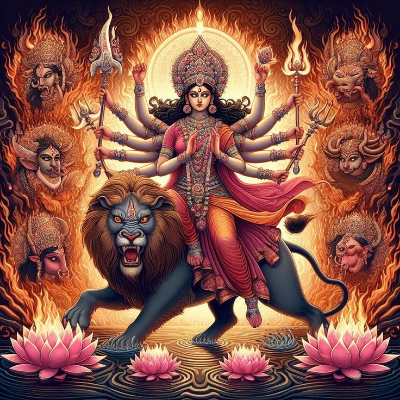
Kaushiki is a goddess of the Hindu tradition who emerges directly from the body-sheath (kosha) of Parvati — the daughter of Himavat, the divine king of mountains, and his wife Mena, and the consort of Shiva, the great ascetic and destroyer god — in response to the gods' prayers for deliverance from the demon brothers Shumbha and Nishumbha. She is the specific narrative agent who undertakes the mission against those two demon kings in the third episode of the Devi Mahatmya, the foundational Shakta scripture forming chapters 81 through 93 of the Markandeya Purana. Kaushiki is simultaneously a distinct goddess in the narrative and, within the theological framework of the Devi Mahatmya itself, an aspect of the one supreme Chandika-Devi. She appears principally in the Devi Mahatmya, with references in the Devi Bhagavata Purana and the Skanda Purana. Regional traditions, particularly those of the Vindhya region, identify Kaushiki with the goddess Vindhyavasini, she who dwells in the Vindhya mountains.
✦ The Name
The name Kaushiki derives from the Sanskrit word kosha, meaning sheath, covering, or envelope. The name thus means "she who came forth from the sheath" or "she who is of the sheath," directly referencing the manner of her emergence from Parvati's body-covering. This etymology is consistent across the Devi Mahatmya and related commentarial literature.
The name Ambika, meaning "the mother" or "the little mother," is applied to her in the Devi Mahatmya during the Shumbha-Nishumbha episode, where it functions as her primary name of address in that narrative. Chandika, meaning "the fierce one," is used in the Devi Mahatmya as both a name for this goddess specifically and as a collective theological name for the supreme goddess of whom all forms are aspects. Kanya means "the maiden" or "the virgin," pointing to her emergence in an unmarried, self-complete form. Vindhyavasini means "she who dwells in the Vindhyas," the name by which she is worshipped at the Vindhyachal shrine in what is now Uttar Pradesh.
✦ Lineage
- Source of emergence: Parvati, daughter of Himavat and Mena, consort of Shiva. Kaushiki emerged from Parvati's outer body-sheath (kosha) as a luminous, golden-complexioned, fully formed goddess. The Devi Mahatmya presents this emergence as simultaneous with Parvati's own transformation into Kalika.
- Relationship to Kalika / Kali: The Devi Mahatmya states that after Kaushiki's emergence, the remaining form of Parvati became dark in complexion and is identified as Kalika — the dark goddess, also known as Kali. Kaushiki and Kali are thus understood in this text as twin products of a single transformative event in Parvati's being.
- Relationship to the Matrikas: During the battle with Shumbha and Nishumbha's forces, Kaushiki produced the seven Matrikas — Brahmi, Maheshvari, Kaumari, Vaishnavi, Varahi, Narasimhi, and Aindri — as emanations of her own power. Each Matrika bore the attributes and weapons of a corresponding male deity. These seven are thus understood as Kaushiki's own projections rather than independent divine lineages.
- Relationship to the supreme Chandika: Within the Devi Mahatmya's overarching theological framework, Kaushiki is not a separate divine being from the goddess who slew Mahishasura or from Kali. All are aspects of the one supreme Chandika-Devi. This theological non-difference coexists with the narrative distinction between them.
✦ The Emergence from Parvati
The Devi Mahatmya narrates that after the demon brothers Shumbha and Nishumbha had conquered the three worlds and expelled the gods from heaven, the gods travelled to the Himalayas and recited a hymn of praise to Parvati near the banks of the Ganga. While Parvati was bathing there, she asked the assembled gods whom they were addressing in their hymn. At that moment, from Parvati's body-sheath there emerged a distinct goddess, radiant and golden-complexioned, who announced herself as the one the gods were seeking. This emergent goddess is Kaushiki. Following her emergence, the form of Parvati that remained became dark and is identified as Kalika. The two goddesses — Kaushiki luminous, Kalika dark — are thus presented as complementary products of a single transformation.
The commentarial and devotional tradition has understood Kaushiki's emergence as arising specifically from the pure sattvic (luminous, quality-of-goodness) energy of Parvati, giving Kaushiki a character that is both martial and radiant rather than wrathful in the manner of the darker goddess forms. This interpretation underpins the theological explanation for why a new goddess was required for the Shumbha-Nishumbha mission despite the prior existence of other powerful goddess forms.
✦ The Mission Against Shumbha and Nishumbha
Shumbha and Nishumbha were demon kings of extraordinary power who had, through severe austerities, received boons rendering them effectively invincible against any existing being. Having conquered the three worlds, they appropriated the positions, offerings, and pleasures of the gods. On hearing of Kaushiki's surpassing beauty, Shumbha dispatched his servant Sugriva (a demon messenger, not the monkey king Sugriva of the Ramayana tradition) with a proposal of marriage. Kaushiki declined, stating a personal vow: she would accept as husband only one who could defeat her in combat.
Shumbha responded by sending the demon general Dhumralochana with an army. Kaushiki destroyed Dhumralochana with a single exhalation of breath and annihilated his army with her lion. Shumbha then sent Chanda and Munda with a vast force. In this battle Kaushiki's countenance became fierce with rage, and from her furrowed brow emerged Kali — dark, skeletal, carrying a skull-topped staff and a garland of severed heads — who slaughtered Chanda and Munda and brought their heads to Kaushiki. Because she brought the heads of Chanda and Munda, Kali received from Kaushiki the name Chamunda.
Shumbha then dispatched his full armies under the demon Raktabija. Raktabija possessed a specific power: from every drop of his blood that fell to the ground, a replica of himself of equal size and strength arose instantly. Every wound inflicted upon him multiplied him further, threatening to overwhelm the battlefield with countless duplicates. Kaushiki directed Kali to spread her tongue across the entire battlefield and consume every drop of blood before it could reach the ground. With Raktabija's replication power thus neutralised, Kaushiki slew him. During this battle Kaushiki also brought forth the seven Matrikas — Brahmi, Maheshvari, Kaumari, Vaishnavi, Varahi, Narasimhi, and Aindri — as emanations of her own shakti, each bearing the weapons and attributes of a corresponding male god, and these goddesses fought alongside her.
Nishumbha then entered battle personally and was killed by Kaushiki after a fierce combat. Shumbha, witnessing his brother's death, challenged Kaushiki directly. He accused her of fighting through the aid of others rather than by her own power alone. Kaushiki's response — that she alone was present in the battle and that all the other goddesses who fought alongside her were projections of her own singular power — is the Devi Mahatmya's most concentrated doctrinal statement of the unity of all divine feminine manifestations. She then withdrew all the emanated goddesses back into herself and fought Shumbha in single combat. After an extended battle in which both rose into the sky, Kaushiki drove her spear through Shumbha and slew him.
✦ Why a New Goddess Was Required
The commentarial and devotional tradition offers a specific explanation for why the goddess who slew Mahishasura — the collective manifestation of the gods' combined energies — did not herself confront Shumbha and Nishumbha. Shumbha and Nishumbha had obtained their boon of invincibility with the specific formulation that no being already in existence at the time of the boon's granting could kill them. Kaushiki, emerging newly from Parvati's body-sheath at the time of the gods' prayer, was a being who had not existed when that boon was granted. She was therefore not bound by its protective terms. Furthermore, the tradition emphasises that Kaushiki emerged from the pure sattvic essence of Parvati — an unmarried, self-complete, virile power — which the demons had not anticipated as a possible source of threat. The Devi Mahatmya itself does not spell out these terms explicitly in comparative form; this explanatory framework belongs to the commentarial tradition that grew around the text rather than to the text's own verses.
✦ Identification with Vindhyavasini
Regional devotional traditions, particularly those associated with the Vindhyachal shrine in what is now Uttar Pradesh, identify Kaushiki with Vindhyavasini, the goddess who dwells in the Vindhya mountains. The Harivamsa and some Puranic passages connect this identification to the episode of the infant goddess substituted for the newborn Krishna: after proclaiming Kamsa's doom, the goddess is described as proceeding to the Vindhya mountains, where she established herself as Vindhyavasini and became the object of local and regional worship. Some traditions understand this goddess and Kaushiki as the same being; others treat Vindhyavasini as a distinct regional form. The Skanda Purana contains passages elaborating the Vindhyavasini cult and its connection to the broader Kaushiki-Ambika identity.
✦ Theological Significance
Kaushiki's narrative role in the Devi Mahatmya serves several theological functions simultaneously. Her emergence from Parvati's body-sheath demonstrates that the supreme divine feminine power is inexhaustible and capable of self-multiplication into distinct forms without diminishment. Her declaration to Shumbha that all the goddesses arrayed against him are projections of her single power is the clearest statement of Shakta non-dualism in the entire text: multiplicity of divine feminine forms is real at the level of manifestation but resolves into unity at the level of ultimate reality. Her character as a golden, radiant, sattvic goddess who commands but does not herself embody the fiercer dark forms — Kali, the Matrikas — places her in a mediating position between the transcendent supreme goddess and the more terrifying aspects of divine power that she deploys as instruments.
✦ References
- Primary Sources
- Markandeya Purana, chapters 81–93 (Devi Mahatmya), particularly chapters 85–93: The primary source for Kaushiki's emergence from Parvati, her mission against Shumbha and Nishumbha, the Raktabija episode, the production of Kali and the Matrikas, and her declaration of divine unity.
- Harivamsa, Vishnu Parva: Contains the episode of the infant goddess substituted for Krishna and her subsequent establishment in the Vindhya mountains as Vindhyavasini, which the regional tradition connects to Kaushiki.
- Devi Bhagavata Purana: Contains references to the Kaushiki episode within its broader Shakta theological framework and elaborates her identity as an aspect of Mahadevi.
- Skanda Purana (Vindhya Khanda and related sections): Elaborates the Vindhyavasini cult and its connection to the Kaushiki-Ambika identity.
- Modern Reference Works
- Thomas Coburn, Devi-Mahatmya: The Crystallization of the Goddess Tradition (Motilal Banarsidass, 1984): Provides close analysis of the Kaushiki emergence episode and its theological implications within the Devi Mahatmya's structure.
- Thomas Coburn, Encountering the Goddess: A Translation of the Devi-Mahatmya and a Study of Its Interpretation (SUNY Press, 1991): Provides translation and commentary on the specific passages involving Kaushiki, Kali, and the Matrikas.
- David Kinsley, Hindu Goddesses (University of California Press, 1986): Provides comparative analysis of Kaushiki's identity in relation to Parvati, Kali, and the broader goddess tradition.
- Vettam Mani, Puranic Encyclopaedia (Motilal Banarsidass, 1975): Provides consolidated entries on Kaushiki and Vindhyavasini with cross-references to relevant Puranic passages.