
About
Kali — Goddess of Time, Death, and Transcendent Destruction
Kali · Kalika · Mahakali · Chamunda · Bhadrakali · Dakshina Kali · Smashana Kali · Adya Kali · Krishnakali · Kalasankarshini · Raktakali · Guhyakali · Mahakala-Rupini · Kapalini
Kali is one of the most powerful and theologically significant goddesses of the Hindu tradition, understood variously as a terrifying war goddess, a destroyer of evil, the personification of time and death, and — in the Shakta Tantric traditions — as the supreme reality itself from whom all creation arises and into whom all creation is reabsorbed. She appears in her earliest clearly defined narrative form in the Devi Mahatmya, the foundational Shakta scripture forming chapters 81 through 93 of the Markandeya Purana, where she emerges from the forehead of the goddess Kaushiki — herself an emanation from the body-sheath of Parvati, the consort of Shiva — during the battle against the demon Raktabija. She appears subsequently in the Devi Bhagavata Purana, the Kalika Purana, the Linga Purana, the Vamana Purana, the Varaha Purana, the Mahabhagavata Upapurana, the Devi Upanishad, the Mahabharata, and a vast body of Tantric literature including the Mahanirvana Tantra, the Karpuradistotra, the Tantrasara, and the Todalatantra, in which she becomes the supreme deity of the Kalikula — the family or lineage of Kali. Precursor references to a dark, tongue-lolling, terrifying goddess appear in the Atharva Veda, the Mundaka Upanishad, and in the Rigvedic hymns associated with Rudra, though the fully developed Kali figure of the Puranic and Tantric traditions represents a later and more elaborate crystallisation of these earlier elements.
✦ The Name
The name Kali derives from the Sanskrit root kala, which carries the dual meanings of "time" and "black" or "dark." The name thus encompasses two overlapping meanings: "the black one" or "the dark one," referring to her complexion in iconographic tradition, and "she who is time" or "she who transcends time," pointing to her philosophical identity as the power that devours all things without exception. The Mahakala Samhita and Tantric commentaries elaborate extensively on the kala-Kali etymology, identifying her with the all-consuming nature of time that destroys every created thing.
The epithet Chamunda was given to her by Kaushiki after she killed the demon generals Chanda and Munda during the Shumbha-Nishumbha conflict; the name is a compound of Chanda and Munda. Mahakali means "the great Kali" and is used in the Devi Mahatmya itself and in Tantric literature to indicate her supreme form. Bhadrakali means "the auspicious Kali," a form worshipped particularly in Kerala and South India in which her fierce energy is understood as ultimately benevolent. Smashana Kali means "Kali of the cremation ground," referring to her association with cremation grounds in the Tantric tradition. Adya Kali means "the primordial Kali," used in the Bengal Tantric tradition to denote her as the original and supreme form of the goddess. Dakshina Kali means "the benevolent" or "southern Kali" and is the most widely worshipped form in Bengal. Kapalini means "she who wears skulls" and refers specifically to her garland of severed heads. Guhyakali means "the secret Kali," a form described in the Mahanirvana Tantra associated with the most esoteric Tantric practices. Kalasankarshini means "she who draws in time itself," used in philosophical contexts to convey her identity as the power that transcends and consumes even time.
✦ Lineage and Origin
- Origin — Account One (Devi Mahatmya, battle context): Kali emerged from the forehead of Kaushiki — a goddess who had herself emerged from the body-sheath of Parvati — when Kaushiki's face became dark with extreme rage during the advance of the demon generals Chanda and Munda. This account makes Kali a manifestation of concentrated wrath within an already-emanated goddess, produced in a specific battle context.
- Origin — Account Two (Devi Mahatmya, cosmological context): A second passage in the Devi Mahatmya, associated with the Mahishasura episode, refers to a dark goddess emerging from Durga in the heat of battle. Some commentators treat this as an earlier appearance of Kali in the same text, making her a direct emanation of Durga rather than of Kaushiki. The two accounts are not easily reconciled at the narrative level and represent a genuine textual tension within the Devi Mahatmya itself.
- Origin — Account Three (Devi Bhagavata Purana): The Devi Bhagavata Purana contains an account in which after Kaushiki's emergence from Parvati's body-sheath, the darkened residual form of Parvati herself became Kalika. In this version Kali is not a wrath-emanation from Kaushiki's forehead but the transformed Parvati herself — the dark remainder left after the luminous sattvic energy separated out as Kaushiki. This account makes Kali and Kaushiki twin products of a single transformation of Parvati rather than placing Kali as a derivative of Kaushiki.
- Origin — Account Four (Tantric Kalikula tradition): In the Tantric texts of the Kalikula tradition, particularly the Mahanirvana Tantra and the Karpuradistotra, Kali is not derivative of any other goddess. She is the supreme, self-existent primordial reality — Adya Shakti — from whom all other forms of the goddess and all male deities including Brahma, Vishnu, and Shiva are derived. In this framework she has no origin because she is herself the ground of all origins.
- Relationship to Shiva: In the Tantric tradition, Kali stands upon the prone body of Shiva — the great ascetic and destroyer god, one of the three principal deities of the Hindu triad — which is understood as indicating that Shiva as pure consciousness (Purusha) is inert and motionless without Kali's activating Shakti. She is the dynamic power that animates even the supreme male deity. This relationship is elaborated in full in the episode of her post-battle frenzy described below.
- Relationship to Sati: In the Shakta Peetha tradition, Kali is understood as a form of Sati — the first wife of Shiva, daughter of Daksha (one of the Prajapatis, the progenitors of creation), who immolated herself after her father insulted Shiva by excluding him from a great sacrifice. Sati is understood as an earlier incarnation of Parvati, and through Parvati she connects to Kali. The Kamakhya shrine in Assam — the most important Tantric seat of Kali worship — is identified as one of the Shakti Peethas, the sacred sites where portions of Sati's body fell after Vishnu dismembered her corpse with his discus to release Shiva from his grief-stricken wandering.
✦ Kali in the Devi Mahatmya — The Battle Episodes
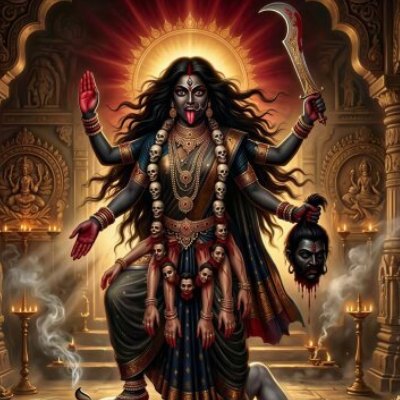
In the Devi Mahatmya, Kali's primary role is functional and martial. She emerges from Kaushiki's forehead in a terrifying form — dark-skinned, emaciated, with sunken eyes, a gaping mouth with protruding tongue, wearing a garland of human heads and a tiger-skin, holding a skull-topped staff and a severed head, and emitting a terrifying roar that shakes the three worlds. She immediately attacks the demon armies of Shumbha and Nishumbha, consuming demons, elephants, horses, and chariots wholesale, her mouth wide enough to swallow entire contingents at once.
She kills the demon generals Chanda and Munda — seizing Chanda by the hair and severing his head with her sword, then killing Munda — and brings their severed heads to Kaushiki as battle trophies. Kaushiki, acknowledging the feat, gives her the name Chamunda: since she killed Chanda and Munda, she will be known as Chamunda forever. This naming establishes one of Kali's most important epithets and her identity as an independent figure beyond the immediate battle context.
Her most significant tactical role in the Devi Mahatmya is in the battle against Raktabija. Raktabija — whose name means "blood-seed" — possessed the power to replicate himself from every drop of his blood that fell to earth. Every wound inflicted upon him produced thousands of new Raktabijas of equal size and power, threatening to overwhelm the battlefield with countless duplicates. Kaushiki directed Kali to stretch her tongue across the entire battlefield and consume every drop of blood before it could touch the ground, thereby preventing new Raktabijas from arising. With his replication power thus neutralised, Kaushiki slew him. This episode establishes Kali's signature attribute of all-consuming appetite — an attribute that carries deep theological resonance in later interpretations as the power of time consuming all things without remainder.
✦ The Post-Battle Frenzy and Shiva's Intervention
After the destruction of Raktabija and the subsequent slaying of Shumbha and Nishumbha, Kali's battle-frenzy did not subside with the end of the conflict. The Mahanirvana Tantra, the Kalika Purana, and related Tantric texts narrate that Kali continued her destructive dance across the battlefield, intoxicated with the blood of the slain demons, her energy wild and uncontained. As her dance intensified, it ceased to be merely a celebration of victory and became a cosmic threat — her steps shaking the earth, her movement threatening the stability of the three worlds themselves. Mountains trembled, the seas churned, and the gods watched in terror as the power that had saved them now threatened to destroy everything indiscriminately.
The gods appealed to Shiva to intervene and pacify her. Shiva, recognising that no force could restrain Kali by confrontation — for she was beyond any opposition — chose a different method. He lay down on the ground directly in the path of her dance, prostrating himself before her. When Kali, in the frenzy of her dance, stepped upon his body and felt beneath her foot the form of her own husband, she stopped abruptly. The shock of recognition — that she had placed her foot upon Shiva — overcame her battle-rage. Overcome with a sudden rush of shame and self-awareness, she bit down on her own tongue, the protruding tongue retracting slightly as she bit it between her teeth in the gesture of embarrassed realisation. Her destructive dance ceased.
This episode is the standard narrative explanation offered in the Tantric literature for Kali's most recognisable iconographic features: her standing or dancing upon the prone body of Shiva, and her protruding tongue bitten between her teeth. The Kalika Purana is particularly detailed in its narration of this episode, and it is elaborated in numerous commentarial texts associated with the Bengali Shakta tradition.
The theological interpretations layered onto this narrative by the Tantric commentarial tradition are multiple and operate simultaneously. At the most philosophically developed level, Shiva's prostration before Kali encodes the Tantric metaphysical position that the divine masculine principle — Shiva as pure, unchanging consciousness (Chit) — is passive and inert (Shava, a corpse) without the activating dynamic power of the feminine (Shakti-Kali). The pun on Shiva and Shava (corpse) is made explicit in Tantric texts: without Kali's energy, Shiva is Shava. At a second level, Shiva's voluntary submission is read not as helplessness but as the supreme act of devotion — the greatest of gods laying himself at the feet of the supreme goddess, acknowledging her sovereignty over him. At a third level, the moment of Kali's shame is reinterpreted philosophically as the moment of her self-recognition as Brahman — the realisation that even her own destructive power arises within and cannot exceed the ground of consciousness upon which she dances.
✦ The Tongue and the Eye — Iconographic Origins
The protruding and bitten tongue that is one of Kali's most immediately recognisable iconographic features has its primary narrative explanation in the Shiva-underfoot episode described above. However, the Devi Mahatmya itself introduces the protruding tongue earlier, in the description of Kali's initial emergence — she appears with her tongue lolling out even before the battle, as a feature of her inherently wild and uncontained nature. The Tantric tradition harmonises these two appearances by treating the initial lolling tongue as the expression of her consuming, all-devouring nature — the tongue ready to lap up blood and consume all things — and the bitten tongue of the Shiva episode as the moment of that consuming energy being suddenly arrested and turned inward in self-recognition.
Regarding the eye: the Linga Purana contains a significant episode in which a demon named Daruka — who had received a boon from Parvati that he could only be killed by a woman — terrorised the world and defeated the gods. Shiva, unable to fight Daruka directly due to the terms of the boon, asked Parvati to take a form capable of killing him. Parvati agreed and entered into Shiva's body, merging with him. She then transformed within him, absorbing the poison (halahala) that Shiva held in his throat — the same cosmic poison he had consumed during the churning of the ocean to protect creation — and from that transformation she emerged as Kali, dark and fierce, the poison having darkened her form and intensified her destructive power. She then proceeded to destroy Daruka and his demon army. In this account, Kali's origin is directly linked to Shiva's own body and specifically to the poison in his throat, giving the episode a physiological intimacy distinct from the battlefield emanation accounts of the Devi Mahatmya.
The connection between Kali and Shiva's third eye is elaborated in several Shaiva-Shakta texts. Shiva's third eye, located on his forehead, is the eye of fire and wisdom whose opening destroys what it looks upon — most famously incinerating Kamadeva, the god of desire, when he attempted to disturb Shiva's meditation. In the Tantric synthesis, the destructive fire-energy of Shiva's third eye and the all-consuming destructive power of Kali are understood as the same energy — one expressed through a male deity's organ of destruction, the other as a fully independent dark goddess. Some Tantric texts describe Kali as having emerged from or as being the personalised form of the fire that streams from Shiva's third eye, making her the embodied, active goddess-form of that specific divine destructive power.
✦ Kali in the Mahabharata
The Mahabharata contains several references to a dark, fierce battlefield goddess whose characteristics overlap significantly with the developed Kali figure, though she is not always named Kali directly. In the Stri Parva and in passages of the Karna Parva, a dark goddess is described moving across the Kurukshetra battlefield consuming the dead and the dying, accompanied by jackals and other scavenger creatures, exulting in the carnage of war. This figure is addressed with epithets such as Kalaratri (the dark night) and Mrityu (death personified), both of which are later absorbed into Kali's epithet tradition. The Sauptika Parva of the Mahabharata, which describes the night massacre by Ashvatthama — the son of Dronacharya, the Kuru army's preceptor — of the sleeping Pandava camp, contains a vision of a terrible dark goddess standing at the gate of the camp and facilitating the slaughter, a figure whose description in that passage aligns closely with the Kali iconography that crystallises in the Puranic period. These Mahabharata passages represent the epic tradition's contribution to the Kali figure, predating or running parallel to the Puranic crystallisation and demonstrating that the dark battlefield goddess was a recognised concept in the epic literature.
✦ Kali in the Linga Purana and Vamana Purana
The Linga Purana contains the Daruka episode described above under the eye section, in which Kali emerges from within Parvati-Shiva's combined form after absorbing the halahala poison, specifically to kill the demon Daruka whose boon restricted his death to a female agent. This account is significant because it places Kali's origin within the body of Shiva himself — making her in this tradition an emergence from the Shiva-Parvati unity rather than from Parvati alone or from a battle-goddess context. The Linga Purana's account also specifically explains Kali's dark complexion as a consequence of absorbing the cosmic poison rather than as an inherent attribute of her nature.
The Vamana Purana contains passages in which Kali appears as an attendant or emanation of Durga during the Mahishasura conflict, an account that overlaps with the second Devi Mahatmya origin account discussed above. The Vamana Purana's treatment is less theologically elaborate than the Devi Mahatmya's but confirms the association of Kali with Durga's own battle-fury in a separate textual tradition.
✦ Chamunda as Independent Figure
While Chamunda is most frequently treated as an epithet of Kali acquired after her killing of Chanda and Munda, the Puranic and Agamic traditions also treat Chamunda as a goddess of independent identity with her own iconographic canon, temple cult, and mythological episodes distinct from those of Kali as a whole. The Devi Mahatmya itself introduces the name as a title given by Kaushiki, making it an honorific conferred in recognition of a specific act. However, in the Agamic temple tradition, Chamunda is listed as an eighth Matrika added to the seven — making the group an Ashtamatrika rather than a Saptamatrika — and is worshipped in a shrine position distinct from the seven who correspond to male deities. In this Ashtamatrika tradition, Chamunda does not correspond to any male deity but stands as an autonomous fierce goddess whose iconography is among the most skeletal and terrifying in the entire Hindu iconographic canon: emaciated to the point of visible bones, sitting on a corpse or a cremation pyre, with sunken eyes and a deeply hollowed abdomen. This independent Chamunda tradition is particularly prominent in the Chamunda Devi temple traditions of Himachal Pradesh and in certain Karnataka temple complexes, and is elaborated in the Agni Purana and regional Agamic texts.
✦ Kali in the Kalika Purana and Tantric Literature
The Kalika Purana, composed in the Kamarupa region of what is now Assam, is the major Puranic text dedicated to Kali's mythology and cult. In this text she is the presiding deity of the Kamakhya shrine, associated specifically with the yoni — the generative feminine principle — of the goddess Sati, which fell to earth at that location after Vishnu dismembered Sati's corpse to release Shiva from his grief-stricken carrying of her dead body. The Kalika Purana treats Kali as the supreme deity of creation, preservation, and destruction and provides detailed prescriptions for her worship. It also contains extensive narrative material about her various battles, her relationships with Shiva, and her manifestations in different cosmic periods (kalpas).
In the Tantric literature of the Kalikula tradition — which includes texts such as the Mahanirvana Tantra, the Karpuradistotra, and the Todalatantra — Kali is identified as Adya Shakti, the primordial power, the supreme reality who is simultaneously the ground of pure consciousness and the dynamic energy of the manifest world. Her ten principal forms are codified in this tradition as the Dasha Mahavidyas — the ten great wisdom goddesses: Kali herself as the first and supreme, followed by Tara, Tripura Sundari (also known as Shodashi or Lalita), Bhuvaneshvari, Bhairavi, Chhinnamasta, Dhumavati, Bagalamukhi, Matangi, and Kamala. Each of these ten goddesses is understood in the Kalikula tradition as a distinct aspect or emanation of Kali's own supreme nature. It must be noted that this hierarchical positioning — with Kali as the source of the other nine — is the Kalikula tradition's own theological claim and is not accepted in all traditions: the Sri Vidya tradition, which centres on Tripura Sundari-Lalita as the supreme goddess, holds the reverse position, treating Kali as one aspect of Lalita's power rather than the source from whom Lalita emanates.
✦ Kali in the 64 Yogini Tradition
The tradition of the 64 Yoginis — fierce, semi-divine, often partly animal-formed goddess figures worshipped in circular open-air temples (Yogini Peethas) of which the most significant surviving examples are at Hirapur and Ranipur-Jharial in Odisha and at Khajuraho in Madhya Pradesh — places Kali at the centre or head of the Yogini assembly in several textual and ritual traditions. The Yoginis are understood as emanations or attendants of the supreme goddess, and Kali as Mahakali is identified as the presiding power from whom the 64 Yoginis arise. This tradition is elaborated in the Tantric texts associated with the Kaula and Trika schools of Kashmir Shaivism and in the ritual manuals (paddhatis) associated with the Yogini Peetha temples. The 64 Yogini tradition represents one of the most archaic surviving layers of goddess worship in the subcontinent and connects Kali to a very ancient stratum of fierce goddess veneration that predates the full Puranic literary elaboration of her mythology.
✦ Kali's Relationship to Pratyangira
Pratyangira is a fierce, lion-headed goddess of the Atharva Veda tradition associated with protection against hostile ritual power, black magic, and the neutralisation of enemies. She is described in the Atharva Veda and its associated Parishishtas as a goddess of terrible aspect whose invocation can counter and destroy any hostile magical working. In South Indian Tantric traditions, particularly in Tamil Nadu, Pratyangira is sometimes identified with or closely associated with Narasimhi — the lion-headed Matrika — and in a separate stream of identification, she is also associated with Kali through their shared dark, fierce, lion-and-tongue iconography and their shared function as destroyers of hostile supernatural forces. The Pratyangira Devi temple traditions of Tamil Nadu, particularly the Aathi Parasakthi temple at Sholingur and the Pratyangira Devi temple in Chennai, worship a goddess whose attributes draw simultaneously on the Pratyangira Vedic tradition, the Kali Tantric tradition, and the Narasimhi Matrika tradition, representing a South Indian synthesis of these three streams. The primary texts do not formally equate Pratyangira and Kali as identical beings; the association is a regional devotional synthesis rather than a textual equation found in any single canonical source.
✦ Kali in the Smashana Tradition
The Smashana Kali tradition — Kali of the cremation ground — is one of the most theologically dense aspects of her cult and is elaborated in the Kalika Purana, the Mahanirvana Tantra, and in the literature of the Aghora and Kapalika ascetic schools. The cremation ground (smashana) is understood in this tradition not as a place of horror or pollution to be avoided but as the most concentrated site of reality — the place where the illusion of the permanent self is most nakedly dissolved, where the body that the living cling to as their identity is revealed as temporary matter returning to its elements. Kali's presence in the smashana is therefore not ghoulish or peripheral but philosophically central: she is at home in the place where the deepest truth of impermanence is most directly visible. The Aghora tradition, whose practitioners perform sadhana (spiritual practice) in cremation grounds, understands Kali as the presiding deity of the smashana and as the ultimate teacher of non-attachment, since she inhabits the place that most forcibly strips away every attachment, every pretension, and every comfortable illusion about the nature of existence.
In this tradition, Shiva is also understood as a smashana deity — he is described in the Shaiva Puranas as smearing his body with cremation ash, sitting in meditation in cremation grounds, and wearing bone ornaments. The shared smashana location of both Kali and Shiva is understood as the deepest expression of their unity: both are deities who have transcended the conventional boundary between auspiciousness and inauspiciousness, between the acceptable and the terrible, and who inhabit the ultimate boundary space where life and death meet.
✦ Textual Variants and Inconsistencies
The Devi Mahatmya presents two distinct accounts of Kali's emergence — from Kaushiki's forehead during the Chanda-Munda battle, and from Durga during the Mahishasura battle — and these are not easily harmonised at the narrative level. The Devi Bhagavata Purana's account that Kali is the darkened residual Parvati after Kaushiki's emergence is a third distinct origin story. The Linga Purana's account of Kali emerging from within Shiva's body after absorbing the halahala poison is a fourth. The Tantric Kalikula texts contradict all four by treating Kali as primordial and self-existent, with no derivation from any prior being.
The question of whether Kali and Parvati are the same being — or whether Kali is Parvati's dark aspect, or Parvati is Kali's gentle aspect — is answered differently across traditions. The Shaiva Puranas subordinate Kali to Parvati as one of her fierce forms. The Tantric Kalikula texts reverse this, treating Parvati as a softer, more accessible manifestation of the primordial Kali. The Linga Purana's account of Kali emerging from the Shiva-Parvati fusion places her at the intersection of both without fully resolving the question. These are not errors or corruptions in the tradition; they represent genuinely different theological positions developed within different schools and expressed through different narrative choices.
The Dasha Mahavidya system's positioning of Kali as the first and supreme of ten great wisdom goddesses is specifically a Kalikula tradition claim and is not accepted across all Shakta schools. The Sri Vidya tradition, the Tara tradition, and several regional goddess traditions maintain independent hierarchies in which their own presiding goddess is supreme and Kali is one important form among several rather than the source of all others.
✦ Theological and Philosophical Significance
Kali's theological significance operates at multiple levels simultaneously. At the mythological level she is the destroyer of specific demons and the instrument of cosmic restoration. At the philosophical level she is the personification of time — the force that dissolves all created things back into the undifferentiated ground of being. In the Tantric non-dualist traditions, particularly the Kashmir Shaiva Trika school and the Bengal Shakta school, she is identified with pure consciousness itself — the ground from which the entire manifest world arises and into which it returns. Her terrifying form is understood in these traditions not as a symbol of evil or chaos but as a direct representation of ultimate reality stripped of all comfortable illusion: time devours everything without exception, the ground of being is beyond all conventional categories of beauty and goodness, and liberation (moksha) comes from confronting rather than fleeing this truth.
The Bengal Tantric tradition, articulated most fully in the works of the eighteenth-century saint-poets Ramprasad Sen and Kamalakanta Bhattacharya and in the nineteenth-century practice of Ramakrishna Paramahamsa, develops a devotional relationship to Kali as the Divine Mother — simultaneously terrifying and tender, simultaneously the destroyer of all things and the ultimate refuge of the devoted soul. This tradition does not resolve the paradox of Kali's simultaneous destructiveness and motherliness but holds both as essential to her nature and as expressing the fullness of ultimate reality more adequately than any single attribute could.
✦ Iconography and Worship
The standard iconographic form of Kali, as established in the Puranic and Tantric traditions and prescribed in texts such as the Kalika Purana and regional Agamas, depicts her as a dark or blue-black woman — the darkness expressing both her identity as time and the formlessness of the absolute — with dishevelled hair, wide eyes, and a gaping mouth with a protruding tongue bitten between her teeth. She is emaciated in some forms, powerfully built in others, depending on the specific form being represented. She wears a garland of fifty-one severed human heads — the number corresponding to the fifty-one letters of the Sanskrit alphabet, encoding the idea that she is the source and consumer of all sacred speech and language. She wears a skirt of severed human arms. In her left hands she carries a severed head and a sword or cleaver. Her right hands are held in the gestures of protection (abhaya mudra) and boon-granting (varada mudra), expressing that the same goddess who destroys is also the protector and bestower of liberation. She stands or dances upon the prone, ash-smeared body of Shiva.
In the Smashana Kali form she is depicted in a cremation ground surrounded by corpses, jackals, owls, and attendant spirits, seated on a corpse or dancing on a funeral pyre. In the Dakshina Kali form — the most widely worshipped in Bengal — she is depicted with a slightly more composed and accessible expression, with her right foot forward on Shiva's chest, which in the iconographic tradition signifies the more accessible, grace-bestowing aspect of the same supreme power. The Bhadrakali form, particularly prominent in Kerala where she is the presiding deity of numerous ancient temples including the Kodungallur Bhagavathy temple, presents her with a more golden or reddish complexion and emphasises her role as a protective and ultimately benevolent deity.
The primary festival of Kali worship is Kali Puja, observed on the new moon night of the month of Kartik (October-November) — the same night on which the rest of India celebrates Diwali. In Bengal, where Kali Puja rivals Durga Puja in scale and importance, the night-long worship involves elaborate rituals, the recitation of Tantric texts, and in traditional practice blood offerings. The Kamakhya temple in Assam is the most significant Tantric seat of Kali-Shakti worship in the subcontinent, and the annual Ambubachi Mela festival held there draws hundreds of thousands of devotees and Tantric practitioners. Kalighat in Kolkata is one of the fifty-one Shakti Peethas and one of the most visited goddess shrines in India, understood as the site where Sati's right toe fell to earth.
✦ References
- Primary Sources
- Markandeya Purana, chapters 81–93 (Devi Mahatmya): The earliest clearly defined Puranic source for Kali, narrating her emergence from Kaushiki's forehead, her role in the Chanda-Munda battle, the Raktabija episode, and the bestowal of the name Chamunda.
- Kalika Purana: The major Shakta Purana of the eastern tradition, treating Kali as the supreme deity of the Kamakhya shrine, containing detailed mythology of the post-battle frenzy, the Shiva-underfoot episode, the Daruka episode in its eastern recension, and detailed ritual prescription for her worship.
- Linga Purana: Contains the Daruka episode in which Kali emerges from within the Shiva-Parvati combined form after absorbing the halahala poison, providing one of the most distinct and physiologically specific accounts of Kali's origin.
- Devi Bhagavata Purana: Provides the account of Kali as the darkened residual form of Parvati after Kaushiki's emergence, and elaborates her identity within the Shakta theological framework.
- Vamana Purana: Contains passages identifying Kali as an attendant or emanation of Durga during the Mahishasura conflict.
- Mahabharata (Stri Parva, Karna Parva, Sauptika Parva): Contains multiple references to a dark battlefield goddess with Kali-like characteristics moving across the Kurukshetra battlefield and facilitating the night massacre by Ashvatthama, representing the epic tradition's contribution to the Kali figure.
- Mahanirvana Tantra: A major Tantric text treating Kali as Adya Shakti, the primordial supreme reality, providing the theological basis for the Kalikula tradition and elaborating the Shiva-underfoot theology.
- Karpuradistotra: A Tantric hymn to Kali providing concentrated theological statements about her nature as supreme reality and her relationship to Shiva.
- Atharva Veda and associated Parishishtas: Contain early references to dark, terrifying goddess forms and to Pratyangira, representing the Vedic antecedents of the developed Kali figure.
- Mundaka Upanishad: Contains early references to a dark, tongue-bearing goddess figure that the tradition understands as a precursor to Kali.
- Devi Upanishad (Atharva Veda tradition): Contains the goddess's declaration of her identity with Brahman and the elements, applicable to Kali in her Adya Shakti dimension.
- Modern Reference Works
- David Kinsley, Kali: Mistress of Death (Motilal Banarsidass, 1997): A dedicated scholarly study of Kali's iconography, mythology, textual history, and theological significance across the Puranic and Tantric traditions.
- David Kinsley, The Sword and the Flute: Kali and Krsna (University of California Press, 1975): Provides analysis of Kali's character and significance in the Devi Mahatmya and in relation to the broader Hindu theological tradition.
- David Kinsley, Tantric Visions of the Divine Feminine: The Ten Mahavidyas (University of California Press, 1997): Analyses Kali's position as the first of the Dasha Mahavidyas and her relationships to the other nine goddesses in the Kalikula Tantric tradition.
- Thomas Coburn, Devi-Mahatmya: The Crystallization of the Goddess Tradition (Motilal Banarsidass, 1984): Analyses Kali's role and origin within the Devi Mahatmya and the textual inconsistencies in her appearance across that text's three episodes.
- June McDaniel, Offering Flowers, Feeding Skulls: Popular Goddess Worship in West Bengal (Oxford University Press, 2004): Documents the living devotional tradition of Kali worship in Bengal, including the Smashana tradition and the saint-poet devotional lineage.
- Vidya Dehejia, Yogini: Cult and Temples (National Museum, New Delhi, 1986): Provides analysis of Kali's position within the 64 Yogini tradition and the architecture of the Yogini Peetha temples.
- Vettam Mani, Puranic Encyclopaedia (Motilal Banarsidass, 1975): Provides consolidated entries on Kali, Chamunda, Kalika, and related epithets with cross-references across the major Puranic sources.