
About
Brahmani — Divine Mother Bearing the Power of Brahma
Brahmani · Brahmi · Brahmayani · Prajapati-Shakti
Brahmani, also known as Brahmi, is one of the seven divine mothers — the Saptamatrikas — who appear in Hindu scripture as a collective group of fierce, powerful goddesses associated with war, protection, and in some traditions with disease and misfortune. She is the Matrika whose form, weapons, and attributes correspond to those of Brahma, the four-faced creator god of the Hindu triad who is understood as the originator of the Vedas and the progenitor of all created beings. Brahmani appears in the Devi Mahatmya (the foundational Shakta scripture forming chapters 81 through 93 of the Markandeya Purana), the Matsya Purana, the Varaha Purana, the Skanda Purana, the Agni Purana, the Devi Bhagavata Purana, and in Agamic texts governing temple worship and iconography. Her character and function vary considerably between the martial goddess tradition of the Devi Mahatmya and the malevolent spirit tradition of the Matsya Purana and Agamic sources.
✦ The Name
The name Brahmani is the feminine form of Brahma and means "she who is the Shakti of Brahma" or "she who partakes of the nature of Brahma." The alternate form Brahmi carries the same meaning and is used interchangeably across the texts. The name Prajapati-Shakti, used in some Agamic contexts, means "the power of the Lord of Creatures," Prajapati being one of Brahma's principal epithets.
✦ Lineage and Origin
- Origin (Devi Mahatmya): Brahmani emerged as an emanation of Kaushiki — a goddess who had herself arisen from the body-sheath of Parvati, the consort of Shiva — during the battle against the forces of the demon kings Shumbha and Nishumbha. Kaushiki projected the Matrikas from her own power, each bearing the weapons and marks of a corresponding male deity. Brahmani arose bearing the attributes of Brahma.
- Corresponding male deity: Brahma, the four-faced creator god, originator of the Vedas, and progenitor of the Prajapatis (lords of creatures). He is one of the three principal deities of the Hindu triad alongside Vishnu and Shiva. Brahmani replicates his characteristic attributes — the four faces, the rosary, the water-pot — in female form.
- Relationship to other Matrikas: Brahmani is consistently listed first among the Saptamatrikas across most textual sources, a position that reflects the conventional precedence of Brahma as creator in the enumeration of the male gods. She acts collectively with Maheshvari, Kaumari, Vaishnavi, Varahi, Narasimhi, and Aindri (or Chamunda in some lists) as the group of seven divine mothers.
✦ Iconography
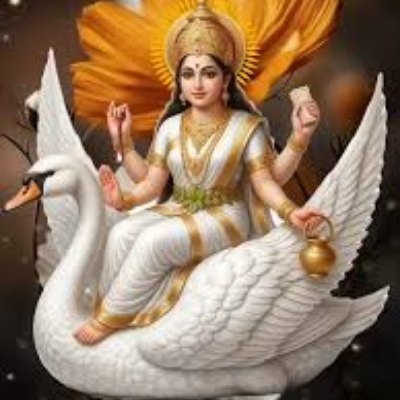
Brahmani's standard iconographic form, as prescribed in the Agamic texts and elaborated in texts such as the Rupamandana and regional Shilpashastra traditions, presents her as a golden-complexioned goddess with four faces corresponding to those of Brahma. She carries in her hands a rosary (aksha mala) and a water-pot (kamandalu), which are Brahma's characteristic attributes, and she may also hold a lotus and display the gesture of bestowing boons. She wears the distinctive conical crown (karanda mukuta) associated with Brahma. Her vehicle (vahana) is the swan (hamsa), which is Brahma's own mount and serves as a symbol of the capacity to discriminate between truth and illusion. In some iconographic schemes she is depicted with two faces rather than four, representing an adaptation of Brahma's four-faced form to the conventions of goddess imagery.
✦ Role in the Devi Mahatmya
In the Devi Mahatmya, Brahmani appears as one of the seven Matrikas who emerge from Kaushiki during the battle against the armies of Shumbha and Nishumbha. The text describes her as pouring libations from her water-pot upon the demon armies — an act that in the martial context of the battle functions as a weapon of destruction — and fighting alongside the other Matrikas. The Devi Mahatmya does not assign individual narrative episodes to each Matrika but describes them collectively as fighting forces of tremendous power. After the completion of the battle and the death of Shumbha, the Matrikas are understood to be reabsorbed into Kaushiki as she declared that all the goddesses who fought alongside her were projections of her own singular power.
✦ Variant Traditions
The Matsya Purana and the Varaha Purana contain a significantly different tradition regarding the Matrikas, including Brahmani, in which they are not benevolent war goddesses but dangerous, malevolent spirits who afflict children and infants with disease, madness, and death. In this tradition, the Matrikas are propitiated not with the expectation of martial assistance but to avert their anger and protect vulnerable people — particularly newborns and young children — from their harmful attention. This tradition connects the Matrikas to a broader category of child-harming female spirits (grahas or bhutas) described in Puranic and Ayurvedic literature. The Ashtanga Hridayam, the classical Ayurvedic text, contains prescriptions for protecting infants from the Matrika-grahas, treating them as a recognised class of disease-causing spirits.
The Skanda Purana and the Agni Purana contain yet another tradition in which the Matrikas, including Brahmani, are attendants (parivara devatas) of Skanda-Kartikeya, the divine commander of the gods' armies, and are associated with his retinue and worship rather than with the Durga-Kaushiki tradition. In this Skanda-related tradition, the Matrikas were originally malevolent spirits who afflicted children but were subdued by Skanda and made into his servants and protectors.
Temple traditions across South India, particularly in Kerala and Tamil Nadu, maintain living Saptamatrika shrines in which the seven goddesses including Brahmani are worshipped collectively as village protectors and goddesses of the boundaries (kshetrapalas), responsible for guarding communities against disease and evil. This temple tradition draws on all three streams — the martial war-goddess tradition of the Devi Mahatmya, the propitiation tradition of the Matsya Purana, and the Skanda-attendant tradition — and the practical ritual reflects a synthesis of all three.
✦ Theological Significance
Brahmani's theological function within the Matrika group is to represent the creative, generative power of the cosmos in its feminine form. Just as Brahma represents the principle of creation, origination, and the elaboration of all things from an initial unity, Brahmani embodies this same principle as an active, dynamic, martial shakti. The rosary she carries — one of Brahma's primary attributes — represents the enumeration and perpetuation of time and existence; the water-pot represents the primordial waters from which creation emerges. In Tantric contexts, Brahmani is also understood as the power that animates sacred speech, since Brahma is the origin of the Vedas and thus of the entire tradition of sacred language.
✦ References
- Primary Sources
- Markandeya Purana, chapters 81–93 (Devi Mahatmya): The foundational source for Brahmani as a martial war goddess and member of the Saptamatrika group, narrating her emergence from Kaushiki and her role in the battle against Shumbha and Nishumbha's forces.
- Matsya Purana: Contains the tradition of the Matrikas including Brahmani as malevolent child-afflicting spirits, providing the basis for the propitiation tradition.
- Varaha Purana: Provides additional accounts of the Matrikas in their dangerous aspect and their ritual management.
- Skanda Purana: Contains the tradition of the Matrikas as attendants of Skanda-Kartikeya and their subduing by that deity.
- Agni Purana: Provides iconographic prescriptions for Brahmani and the other Matrikas in the context of temple worship.
- Ashtanga Hridayam (Vagbhata): The classical Ayurvedic text containing prescriptions for protecting infants from Matrika-grahas, treating Brahmani and her sisters as a recognised class of disease-causing spirits.
- Modern Reference Works
- Vidya Dehejia, Yogini: Cult and Temples (National Museum, New Delhi, 1986): Provides analysis of the Matrika tradition including Brahmani in the context of goddess cult development and temple iconography.
- Thomas Coburn, Devi-Mahatmya: The Crystallization of the Goddess Tradition (Motilal Banarsidass, 1984): Analyses the Matrika episode in the Devi Mahatmya and its relationship to earlier Matrika traditions.
- Vettam Mani, Puranic Encyclopaedia (Motilal Banarsidass, 1975): Provides consolidated entries on Brahmani and the Saptamatrikas across the major Puranic sources.