
About
Vaishnavi — Divine Mother Bearing the Power of Vishnu
Vaishnavi · Vishnumaya · Narayani · Vishnu-Shakti · Vaishnavi-Devi
Vaishnavi is one of the seven divine mothers — the Saptamatrikas — of the Hindu tradition, a collective group of fierce goddesses associated with war, protection, and cosmic power. She is the Matrika whose form, weapons, and attributes correspond to those of Vishnu — the great preserver god, one of the three principal deities of the Hindu triad — who is understood as the sustainer of the cosmos and the source of the ten principal avatars (divine descents). Vaishnavi appears in the Devi Mahatmya (the foundational Shakta scripture forming chapters 81 through 93 of the Markandeya Purana), the Matsya Purana, the Varaha Purana, the Skanda Purana, the Agni Purana, and in Agamic texts. Her character varies between the martial tradition of the Devi Mahatmya and the malevolent spirit tradition of other Puranic sources.
✦ The Name
The name Vaishnavi is the feminine form of Vaishnava, meaning "she who belongs to Vishnu" or "she who is the Shakti of Vishnu." Narayani is derived from Narayana, one of Vishnu's most important epithets meaning "he who moves on the waters" or "the refuge of man," and thus means "she who is the power of Narayana." Vishnumaya means "the illusive power (maya) of Vishnu," connecting Vaishnavi to the Vaishnava concept of Vishnu's divine creative illusion (Vishnu-maya) through which the material world is projected. Vishnu-Shakti is a compound used in Agamic contexts to denote her as the dynamic feminine power of Vishnu specifically.
✦ Lineage and Origin
- Origin (Devi Mahatmya): Vaishnavi emerged as an emanation of Kaushiki — a goddess who had herself arisen from the body-sheath of Parvati, the consort of Shiva — during the battle against the forces of Shumbha and Nishumbha. She arose bearing the attributes of Vishnu.
- Corresponding male deity: Vishnu, also known as Narayana, Hari, and Madhusudana — the great preserver god, second of the Hindu triad alongside Brahma and Shiva. He is characterised by his four arms holding the conch (shankha), discus (Sudarshana Chakra), mace (kaumodaki), and lotus; his dark blue complexion; his vehicle the eagle Garuda; and his reclining posture on the cosmic serpent Shesha upon the primordial ocean.
- Relationship to Lakshmi: Vaishnavi's identity as the Shakti of Vishnu places her in close conceptual proximity to Lakshmi — the goddess of wealth, fortune, and beauty who is Vishnu's consort and who is herself understood as his Shakti in the Vaishnava tradition. Vaishnavi and Lakshmi are distinct figures: Lakshmi is Vishnu's eternal consort, while Vaishnavi is a martial goddess who is an emanation of Kaushiki bearing Vishnu's weapons. The two are not typically conflated in the texts, though both carry the epithet Narayani in different contexts.
✦ Iconography
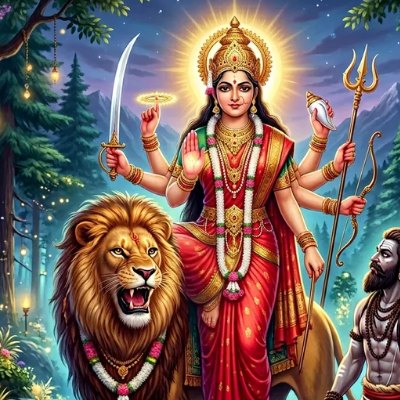
Vaishnavi's standard iconographic form presents her as a dark blue or green-complexioned goddess — reflecting Vishnu's own dark complexion — with four arms. She carries the four characteristic attributes of Vishnu: the conch (shankha), whose sound represents the primordial sound of creation; the discus (Sudarshana Chakra), the spinning weapon of divine sovereignty; the mace (kaumodaki), representing the power of knowledge and time; and the lotus (padma), representing purity and creation. She wears the tall cylindrical crown (kirita mukuta) associated with Vishnu. Her vehicle is the eagle Garuda — the divine king of birds, son of the sage Kashyapa and Vinata, and Vishnu's mount — who is one of the most distinctive elements of the Vaishnava iconographic tradition. In some regional forms she is depicted holding additional Vaishnava attributes such as the Vaijayanti garland or the Kaustubha gem.
✦ Role in the Devi Mahatmya
In the Devi Mahatmya, Vaishnavi appears as one of the seven Matrikas who emerge from Kaushiki during the battle against the forces of Shumbha and Nishumbha. The text specifically notes that she arrived mounted on Garuda and bearing Vishnu's weapons, making her one of the more vividly described individual Matrikas in that text's brief enumeration of the group. She fights collectively with the other Matrikas against the demon armies. Following the death of Shumbha, the Matrikas including Vaishnavi are reabsorbed into Kaushiki.
✦ Variant Traditions
The Matsya Purana and Varaha Purana present Vaishnavi, alongside the other Matrikas, as a dangerous spirit who afflicts children and infants. The Skanda Purana contains the tradition of the Matrikas as attendants of Kartikeya, subdued from their originally malevolent state. In the South Indian Agamic and temple traditions, Vaishnavi is worshipped within Saptamatrika shrines, and her Vaishnava attributes — particularly the Garuda vehicle — make her visually and theologically distinctive within the group. In some North Indian and Rajasthani temple traditions, the Saptamatrika group including Vaishnavi is worshipped as a set of boundary-protecting goddesses whose shrines are placed at the cardinal directions of temple complexes or village boundaries.
A notable feature of Vaishnavi's reception in the tradition is that her Vaishnava attributes — which in the male deity are primarily associated with preservation, cosmic order, and grace — are here transposed into a martial register, making her the preservative power of the cosmos made fierce and warlike. This transposition is theologically consistent with the Shakta principle that the female form of a deity represents the dynamic, active dimension of that deity's power.
✦ Theological Significance
Vaishnavi represents the preserving, sustaining, sovereignty-maintaining power of the cosmos in martial feminine form. Vishnu as preserver upholds dharma (cosmic and moral order) and descends as an avatar whenever that order is threatened. Vaishnavi as his Shakti is the same sustaining power made active and dynamic. Her presence in the Saptamatrika group ensures that the preservative dimension of cosmic power is represented among the divine mothers alongside the creative power of Brahmani, the destructive power of Maheshvari, the martial vigour of Kaumari, and the other aspects. In the Devi Mahatmya's theological framework, her emergence from Kaushiki demonstrates that the supreme divine feminine encompasses and activates all divine masculine powers, including Vishnu's preserving sovereignty.
✦ References
- Primary Sources
- Markandeya Purana, chapters 81–93 (Devi Mahatmya): Primary source for Vaishnavi as a martial Matrika bearing Vishnu's attributes, narrating her emergence from Kaushiki and her role in the battle.
- Matsya Purana: Contains the tradition of Vaishnavi and the Matrikas as dangerous child-afflicting spirits.
- Varaha Purana: Provides additional accounts of the Matrikas in their dangerous aspect.
- Skanda Purana: Contains the tradition of the Matrikas as attendants of Kartikeya.
- Agni Purana: Provides iconographic prescriptions for Vaishnavi in temple worship.
- Modern Reference Works
- Vidya Dehejia, Yogini: Cult and Temples (National Museum, New Delhi, 1986): Provides analysis of the Matrika tradition and Vaishnavi's iconographic context.
- Thomas Coburn, Devi-Mahatmya: The Crystallization of the Goddess Tradition (Motilal Banarsidass, 1984): Analyses the Matrika episode and Vaishnavi's place within it.
- Vettam Mani, Puranic Encyclopaedia (Motilal Banarsidass, 1975): Provides consolidated entries on Vaishnavi and the Saptamatrikas.