
About
Varahi — Divine Mother Bearing the Power of Varaha
Varahi · Vaishnavi-Varahi · Panchami · Dantura · Vajravarahi · Varahi-Devi
Varahi is one of the seven divine mothers — the Saptamatrikas — of the Hindu tradition, a collective group of fierce goddesses associated with war, protection, and cosmic power. She is the Matrika whose form corresponds to that of Varaha — the boar avatar of Vishnu, the great preserver god — who descended to earth in the form of a cosmic boar to rescue the goddess Earth (Bhudevi) from the depths of the primordial ocean into which the demon Hiranyaksha had cast her. Among the Saptamatrikas, Varahi is distinctive in that she corresponds not to an independent male deity in his full divine identity, as the other Matrikas do, but specifically to Vishnu in one of his avatar forms. Varahi appears in the Devi Mahatmya (the foundational Shakta scripture forming chapters 81 through 93 of the Markandeya Purana), the Matsya Purana, the Varaha Purana, the Skanda Purana, the Agni Purana, various Tantric texts, and in the Shakta Tantric tradition where she holds a particularly prominent independent position.
✦ The Name
The name Varahi is the feminine form of Varaha, the Sanskrit word for boar. The name means "she who is the boar-goddess" or "she who partakes of the nature of Varaha." The epithet Dantura means "the tusked one," referring to her boar's tusks in iconographic representations. Panchami means "the fifth one," a name used in some Agamic and Tantric contexts that reflects her position as fifth in certain enumerations of the Saptamatrikas; the name has also acquired independent significance in certain Tantric traditions where Varahi is worshipped on the fifth lunar day. Vajravarahi, meaning "the thunderbolt boar-goddess," is a form particularly prominent in the Vajrayana Buddhist Tantric tradition, where she is a major deity in her own right. Vaishnavi-Varahi distinguishes her from the Matrika Vaishnavi by specifying her boar-form identity.
✦ Lineage and Origin
- Origin (Devi Mahatmya): Varahi emerged as an emanation of Kaushiki — a goddess who had herself arisen from the body-sheath of Parvati, the consort of Shiva — during the battle against the forces of Shumbha and Nishumbha. She arose bearing the attributes of Varaha, Vishnu's boar avatar.
- Corresponding male deity / avatar: Varaha is the third of Vishnu's ten principal avatars (the Dashavatara). In the Varaha Purana and the Bhagavata Purana, Vishnu descended as a cosmic boar of immense size, dove into the primordial ocean, defeated the demon Hiranyaksha in single combat, and raised the goddess Earth (Bhudevi) from the ocean floor on his tusks, restoring her to her proper place.
- Relationship to the Matrika Vaishnavi: Both Vaishnavi and Varahi are derived from Vishnu — Vaishnavi from his full divine form, Varahi specifically from his Varaha avatar. The two are distinct Matrikas with different iconographic attributes, though both carry the Vaishnava theological association with preservation and cosmic order.
✦ Iconography
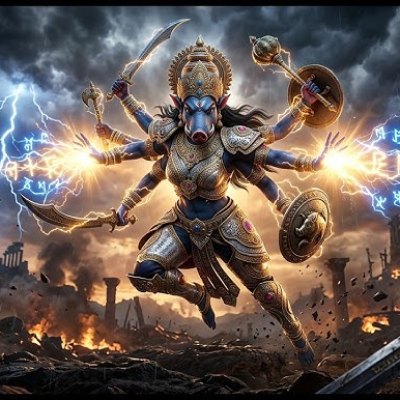
Varahi's iconographic form is among the most immediately distinctive of the seven Matrikas. She is depicted as a goddess with the head of a boar — dark-complexioned, with prominent upward-curving tusks — and a powerful human body. She carries in her hands a discus (chakra) and a plough or club, the plough being a weapon associated with the earth-churning, earth-rescuing dimension of Varaha's activity. Her vehicle is typically a buffalo or in some traditions a boar. In some forms she holds a skull-cup (kapala) and a sword, reflecting her fiercer Tantric dimension. The Agamic texts prescribe multiple arm configurations for her ranging from four to six arms. In the Vajrayana Buddhist tradition the corresponding figure Vajravarahi is depicted with a sow's head emerging from the side of her own human head and is one of the most complex and elaborated deity forms in that tradition.
✦ Role in the Devi Mahatmya
In the Devi Mahatmya, Varahi appears as one of the seven Matrikas who emerge from Kaushiki during the battle against the armies of Shumbha and Nishumbha. She fights collectively with the other Matrikas. Following the death of Shumbha, the Matrikas including Varahi are reabsorbed into Kaushiki.
✦ Variant Traditions
The Matsya Purana and Varaha Purana present Varahi, alongside the other Matrikas, as a dangerous spirit who afflicts children and infants. The Skanda Purana contains the tradition of the Matrikas as attendants of Kartikeya, subdued from their originally malevolent state. Among the Matrikas, Varahi has one of the strongest independent Tantric traditions outside the Saptamatrika group context. In the Shakta Tantric literature she appears as a major independent goddess — commander of Lalita Tripura Sundari's armies in the Sri Vidya tradition, where she is known as Dandanatha or Varahi, the general who wields the staff of punishment. The Vamakeshvara Tantra and the Lalitasahasranama tradition, both important Sri Vidya texts, describe her as one of the two principal commanders of the supreme goddess's forces, the other being Kurukulla or Shyamala.
In the Vajrayana Buddhist tradition of Tibet and Nepal, the corresponding figure Vajravarahi is one of the most important meditation deities (yidams) and is associated with the highest Tantric practices. This cross-tradition reception demonstrates the wide reach of the Varahi deity complex beyond the Hindu Saptamatrika context alone.
✦ Theological Significance
Varahi's theological significance within the Saptamatrika group lies in her embodiment of the earth-rescuing, world-grounding power of the divine. The Varaha avatar is specifically the power that recovers and restores the earth — the material foundation of existence — from the depths of chaos. As Varahi, this power is feminised and made an active martial force. Her boar-headed form, which might superficially appear merely terrifying, carries the theological resonance of Vishnu's own descent into the depths to retrieve what had been lost — a motif of descent, recovery, and restoration that is one of the defining dimensions of Vaishnava theology. In the Sri Vidya Tantric context, her role as the commander who enforces the supreme goddess's will places her as an embodiment of divine justice and punishment (danda).
✦ References
- Primary Sources
- Markandeya Purana, chapters 81–93 (Devi Mahatmya): Primary source for Varahi as a martial Matrika, narrating her emergence from Kaushiki and her collective role in the battle.
- Varaha Purana: Contains the detailed account of the Varaha avatar whose form Varahi replicates, and additional Matrika traditions.
- Matsya Purana: Contains the tradition of Varahi and the Matrikas as dangerous child-afflicting spirits.
- Skanda Purana: Contains the tradition of the Matrikas as attendants of Kartikeya.
- Vamakeshvara Tantra and Lalitasahasranama tradition: Sri Vidya Tantric texts presenting Varahi as a major independent goddess and commander of the supreme goddess's armies.
- Agni Purana: Provides iconographic prescriptions for Varahi in temple worship.
- Modern Reference Works
- Vidya Dehejia, Yogini: Cult and Temples (National Museum, New Delhi, 1986): Provides analysis of Varahi's iconography and cult context within the Matrika and wider Tantric traditions.
- Thomas Coburn, Devi-Mahatmya: The Crystallization of the Goddess Tradition (Motilal Banarsidass, 1984): Analyses the Matrika episode and Varahi's place within it.
- Vettam Mani, Puranic Encyclopaedia (Motilal Banarsidass, 1975): Provides consolidated entries on Varahi and the Saptamatrikas.