
About
Maheshvari — Divine Mother Bearing the Power of Shiva
Maheshvari · Maheshvara-Shakti · Raudri · Shiva-Shakti · Mahesvari
Maheshvari is one of the seven divine mothers — the Saptamatrikas — venerated in the Hindu tradition as a collective group of fierce, powerful goddesses associated with war, protection, and cosmic power. She is the Matrika whose form, weapons, and attributes correspond to those of Shiva — also called Maheshvara, the great lord — the ascetic and destroyer god who is one of the three principal deities of the Hindu triad. Maheshvari appears in the Devi Mahatmya (the foundational Shakta scripture forming chapters 81 through 93 of the Markandeya Purana), the Matsya Purana, the Varaha Purana, the Skanda Purana, the Agni Purana, and in Agamic texts governing temple iconography and worship. Her character varies between the martial tradition of the Devi Mahatmya and the malevolent spirit tradition of the Matsya Purana.
✦ The Name
The name Maheshvari is the feminine form of Maheshvara, one of Shiva's principal epithets, meaning "the great lord." Maheshvari thus means "she who is the Shakti of Maheshvara" or "she who partakes of the nature of the great lord." The epithet Raudri derives from Rudra, an earlier Vedic name for Shiva associated with storms, wildness, and healing, and means "she who is the power of Rudra." Shiva-Shakti is a compound used in some Agamic contexts to denote her as the dynamic feminine power of Shiva specifically.
✦ Lineage and Origin
- Origin (Devi Mahatmya): Maheshvari emerged as an emanation of Kaushiki — a goddess who had herself arisen from the body-sheath of Parvati, the consort of Shiva — during the battle against the forces of Shumbha and Nishumbha. She arose bearing the attributes of Shiva.
- Corresponding male deity: Shiva, also known as Maheshvara, Rudra, Mahadeva, and Shankar — the great ascetic god of destruction and regeneration, one of the three principal deities of the Hindu triad alongside Brahma and Vishnu. He is characterised by the trident, the crescent moon in his matted hair, the bull Nandi as his vehicle, and the third eye on his forehead.
- Relationship to Parvati: Maheshvari's identity as the Shakti of Shiva places her in close conceptual proximity to Parvati (and her forms Durga, Uma, and others), who is the consort of Shiva and is herself understood as his Shakti in the broader Shaiva-Shakta tradition. Maheshvari is, however, a distinct figure within the Matrika group — an emanation of Kaushiki bearing Shiva's attributes — rather than an identification of Parvati herself.
✦ Iconography
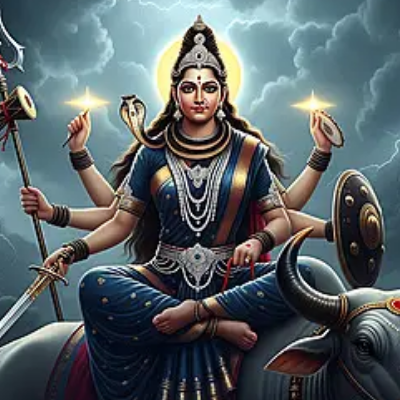
Maheshvari's standard iconographic form presents her as a fair or white-complexioned goddess with three eyes, reflecting Shiva's own third eye which is associated with wisdom and destructive fire. She carries a trident (trishula), Shiva's primary weapon, and a small drum (damaru), which is another of Shiva's characteristic attributes associated with the rhythm of creation and destruction. She wears the crescent moon in her matted or piled hair, again replicating one of Shiva's most distinctive marks. Serpents — which adorn Shiva's body as ornaments — appear in her iconography as well. Her vehicle is the bull Nandi, Shiva's divine mount and gatekeeper. In some regional traditions she is depicted with four arms; in others with two. She may also be shown bearing a skull-cup (kapala), reflecting the Shaiva Kapalika traditions.
✦ Role in the Devi Mahatmya
In the Devi Mahatmya, Maheshvari appears as one of the seven Matrikas who emerge from Kaushiki during the battle against the armies of Shumbha and Nishumbha. She fights collectively with the other Matrikas as a force of tremendous destructive power against the demon armies. The text describes the Matrikas collectively causing havoc among the demon forces; individual narrative episodes specific to Maheshvari are not separately distinguished in the Devi Mahatmya's account. Following the death of Shumbha, the Matrikas including Maheshvari are reabsorbed into Kaushiki as aspects of her singular power.
✦ Variant Traditions
The Matsya Purana and Varaha Purana present Maheshvari, along with the other Matrikas, as dangerous spirits who afflict children and infants with disease and madness. In this tradition they are propitiated to avert their wrath rather than invoked as martial allies. The Matsya Purana's account of the Matrikas' origin is distinct from the Devi Mahatmya's: in the Matsya Purana they are created by Shiva himself — rather than by Kaushiki — to assist in battle, but they prove so destructive and uncontrollable that they threaten all of creation and must be pacified. This origin story makes Maheshvari, as the Matrika most directly associated with Shiva, particularly significant in that account.
In the Skanda Purana's tradition the Matrikas including Maheshvari are associated with the retinue of Skanda-Kartikeya, the divine war god and son of Shiva, and are understood as having been originally malevolent but subdued by Skanda into protective roles. In the Agamic and temple traditions of South India, Maheshvari is worshipped as part of the Saptamatrika group in shrines that serve as boundary guardians of villages and temples, her Shaiva attributes marking her as the most formidable of the group in terms of her connection to the most feared aspects of the divine.
✦ Theological Significance
Maheshvari represents the destructive and regenerative power of Shiva in active, martial, feminine form. Where Shiva as the great lord operates as the destroyer of the cosmos at the end of each cycle of time, Maheshvari as his Shakti is the same destructive energy made active and dynamic — for in Shaiva-Shakta theology, Shiva is the passive, unchanging male principle while Shakti is the dynamic, active feminine power that actually moves and accomplishes. Maheshvari's presence in the Matrika group thus represents the specific inclusion of Shaiva cosmic destructive power within the collective divine feminine force that defends the cosmic order.
✦ References
- Primary Sources
- Markandeya Purana, chapters 81–93 (Devi Mahatmya): Primary source for Maheshvari as a martial Matrika, narrating her emergence from Kaushiki and her collective role in the battle against Shumbha and Nishumbha's forces.
- Matsya Purana: Contains the alternate tradition of Maheshvari and the Matrikas as dangerous spirits created by Shiva and subsequently requiring pacification.
- Varaha Purana: Provides additional accounts of the Matrikas in their dangerous aspect.
- Skanda Purana: Contains the tradition of the Matrikas as attendants of Skanda-Kartikeya.
- Agni Purana: Provides iconographic prescriptions for Maheshvari in temple worship.
- Modern Reference Works
- Vidya Dehejia, Yogini: Cult and Temples (National Museum, New Delhi, 1986): Provides analysis of the Matrika tradition and Maheshvari's iconography and cult context.
- Thomas Coburn, Devi-Mahatmya: The Crystallization of the Goddess Tradition (Motilal Banarsidass, 1984): Analyses the Matrika episode and Maheshvari's place within it.
- Vettam Mani, Puranic Encyclopaedia (Motilal Banarsidass, 1975): Provides consolidated entries on Maheshvari and the Saptamatrikas.