
About
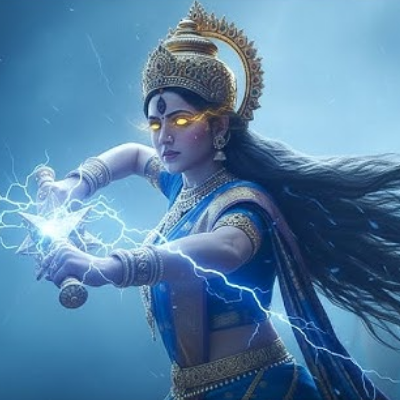
Aindri — Divine Mother Bearing the Power of Indra
Aindri · Indrani · Mahendri · Shakra-Shakti · Indra-Shakti
Aindri is one of the seven divine mothers — the Saptamatrikas — of the Hindu tradition, a collective group of fierce goddesses associated with war, protection, and cosmic power. She is the Matrika whose form, weapons, and attributes correspond to those of Indra — the king of the gods (devas), the thunderbolt-wielding lord of heaven and rain, the chief deity of the Rigveda and the foremost of the Vedic gods. Aindri appears in the Devi Mahatmya (the foundational Shakta scripture forming chapters 81 through 93 of the Markandeya Purana), the Matsya Purana, the Varaha Purana, the Skanda Purana, the Agni Purana, and in Agamic texts. Her character varies between the martial war-goddess tradition of the Devi Mahatmya and the malevolent spirit tradition of other Puranic sources. It must be noted that in certain Puranic and Agamic enumerations of the Saptamatrikas — particularly the Matsya Purana and some Agamic lists — the seventh Matrika is given as Chamunda rather than Aindri, and Chamunda is understood as the goddess who killed Chanda and Munda rather than as a correspondence to a male deity. The Devi Mahatmya itself names Aindri as one of the seven who emerge from Kaushiki, and that account is followed here; the Chamunda variant is noted as a genuine textual inconsistency.
✦ The Name
The name Aindri is the feminine form of Aindra, meaning "of or belonging to Indra." Aindri thus means "she who is the Shakti of Indra" or "she who partakes of the nature of Indra." The alternate name Indrani is more commonly used in common usage and general Puranic literature, and means the same — "wife or power of Indra" or "the feminine Indra." Mahendri is derived from Mahendra, "the great Indra," and means "she who is the power of the great Indra." Shakra-Shakti uses Shakra — meaning "the powerful one," one of Indra's principal epithets — and means "the power of the powerful one."
✦ Lineage and Origin
- Origin (Devi Mahatmya): Aindri emerged as an emanation of Kaushiki — a goddess who had herself arisen from the body-sheath of Parvati, the consort of Shiva — during the battle against the forces of Shumbha and Nishumbha. She arose bearing the attributes of Indra, the king of the gods.
- Corresponding male deity: Indra, also known as Shakra, Mahendra, Purandara (destroyer of citadels), and Vasava — the king of the thirty-three gods (devas) and lord of Svarga (heaven). He is the chief deity of the Rigveda, the god of thunder, lightning, storms, and rain, wielder of the thunderbolt (vajra) which is his primary weapon, and rider of the great white elephant Airavata. In the Puranic period Indra's pre-eminence among the gods diminished relative to his Vedic supremacy, but he retained his role as the king of the gods and the figure whose position is most frequently threatened by powerful demons and ascetics.
- Textual variant — Chamunda: The Matsya Purana and certain Agamic texts enumerate the seventh Matrika as Chamunda — the fierce goddess who killed Chanda and Munda — rather than Aindri. In these lists the seven are Brahmi, Maheshvari, Kaumari, Vaishnavi, Varahi, Narasimhi, and Chamunda. The Devi Mahatmya, however, names the seven who emerge from Kaushiki as including Aindri, and treats Chamunda as a separate figure who emerged directly from Kaushiki's own forehead in rage. Both lists are found in primary sources and neither is incorrect within its own textual tradition.
✦ Iconography
Aindri's standard iconographic form presents her as a golden or yellow-complexioned goddess with a thousand eyes — replicating one of Indra's most distinctive mythological attributes, his body being said to be covered with eyes (a consequence, in one Puranic account, of a curse transformed into a boon). She wields the thunderbolt (vajra), Indra's primary weapon, which is understood as representing divine sovereignty and the power to destroy falsehood and demons. She may also carry a noose, a goad, and other weapons associated with Indra's royal and martial functions. Her vehicle is the great white elephant Airavata — Indra's own mount, said to have arisen from the churning of the cosmic ocean — which is one of the most majestic and immediately recognisable vehicles in the iconographic tradition. She wears Indra's crown and royal ornaments. The Agamic texts prescribe multiple arm configurations for her, most commonly four or six arms.
✦ Role in the Devi Mahatmya
In the Devi Mahatmya, Aindri appears as one of the seven Matrikas who emerge from Kaushiki during the battle against the armies of Shumbha and Nishumbha. She fights collectively with the other Matrikas as a force of tremendous power against the demon armies. The Devi Mahatmya's account of the Matrikas' emergence specifies that Aindri came forth bearing the marks and weapons of Indra, including the thunderbolt and mounted on Airavata, making her among the most vividly characterised of the seven in that brief description. Following the death of Shumbha, the Matrikas including Aindri are reabsorbed into Kaushiki.
✦ Variant Traditions
The Matsya Purana and Varaha Purana present Aindri, alongside the other Matrikas, as a dangerous spirit who afflicts children and infants, to be propitiated rather than invoked as a martial ally. This tradition presents a significant theological inversion: Indra as king of the gods is the figure most responsible for maintaining divine order and protecting the heavens, and his Shakti in her dangerous aspect becomes a source of disorder and affliction rather than protection. The Skanda Purana contains the tradition of the Matrikas as attendants of Kartikeya, subdued from their originally malevolent state.
In the Agamic and temple traditions, Aindri is worshipped as part of the Saptamatrika group in shrines that function as boundary guardians of villages and temple complexes. Her presence in this protective role carries a particular historical resonance: Indra's own primary function in the Vedic tradition was as the defender of the gods against the asuras (demons) and as the maintainer of the cosmic order through his thunderbolt-wielding power. Aindri as his Shakti thus carries the memory of this primordial Vedic defensive function into the Puranic and Agamic goddess tradition.
The Devi Mahatmya's narrative context gives Aindri's appearance a particular resonance: she emerges to fight in the battle that restores the gods' lost heaven, and she does so as a manifestation of Kaushiki — a goddess whose power surpasses that of Indra himself. This reflects the broader Puranic and Shakta trajectory in which Indra's power and status decline relative to his Vedic pre-eminence, and the supreme feminine power supersedes the once-foremost male deity.
✦ Theological Significance
Aindri represents the divine sovereignty and royal authority of the gods — the power of the king of heaven — in active, dynamic feminine form. Indra as the king of gods embodies divine sovereignty, the right order of the celestial world, and the thunderbolt of truth and power. Aindri as his Shakti makes this sovereign power mobile, fierce, and war-ready. Her thousand eyes represent omniscience — the capacity to see all things — which in the martial context of the Devi Mahatmya serves as the power to detect and confront every demonic threat. In the context of the Saptamatrika group, Aindri provides the element of royal divine authority and celestial sovereignty that complements the creative power of Brahmani, the destructive power of Maheshvari, and the preserving powers of Vaishnavi, Varahi, and Narasimhi.
✦ References
- Primary Sources
- Markandeya Purana, chapters 81–93 (Devi Mahatmya): Primary source for Aindri as a martial Matrika bearing Indra's attributes, narrating her emergence from Kaushiki and her role in the battle against Shumbha and Nishumbha's forces.
- Matsya Purana: Contains the tradition of Aindri and the Matrikas as dangerous child-afflicting spirits, and provides the variant Saptamatrika list substituting Chamunda for Aindri.
- Varaha Purana: Provides additional accounts of the Matrikas in their dangerous aspect.
- Skanda Purana: Contains the tradition of the Matrikas as attendants of Kartikeya, subdued from their originally malevolent state.
- Agni Purana: Provides iconographic prescriptions for Aindri in temple worship.
- Rigveda (multiple hymns to Indra): The primary source for Indra's attributes, weapons, and mythology, whose replication in feminine form constitutes Aindri's identity.
- Modern Reference Works
- Vidya Dehejia, Yogini: Cult and Temples (National Museum, New Delhi, 1986): Provides analysis of Aindri's iconography and cult context within the Matrika tradition, including the variant enumeration question.
- Thomas Coburn, Devi-Mahatmya: The Crystallization of the Goddess Tradition (Motilal Banarsidass, 1984): Analyses the Matrika episode in the Devi Mahatmya and the textual question of Aindri versus Chamunda as the seventh Matrika.
- Vettam Mani, Puranic Encyclopaedia (Motilal Banarsidass, 1975): Provides consolidated entries on Aindri, Indrani, and the Saptamatrikas with cross-references to the variant traditions.
- Jan Gonda, Aspects of Early Visnuism (Motilal Banarsidass, 1969): Provides background on the development of the male deity traditions — including Indra's declining status in the Puranic period — that contextualise Aindri's position within the Saptamatrika group.