
About
Narasimhi — Shakti of Narasimha, Matrika of the Lion-Faced Form
Narasimhi · Narasimhini · Narasimhika · Pratyangira · Atharvana Bhadrakali
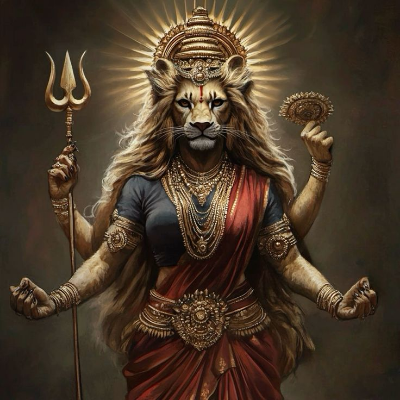
Narasimhi is a goddess of the Matrika tradition, identified as the Shakti — the feminine power — of Narasimha, the fourth avatar of Vishnu who takes the form of a lion-headed man. She bears a lion's head on a woman's body, carries weapons mirroring those of her male counterpart, and is described in the primary sources as a warrior of ferocious force. She figures centrally in the third episode of the Devi Mahatmya, the Uttama Charitra, embedded within the Markandeya Purana, where she is one of the Matrikas who emerge from the bodies of the gods at the summons of Kaushiki — the goddess who arises from the sheath of Parvati — to join the battle against the Asura brothers Shumbha and Nishumbha and their general Raktabija. Narasimhi's position within the Matrika enumeration is contested across the textual tradition: some texts count her as the seventh Matrika in place of Chamunda, others add her as an eighth figure, and several traditions — including the Devi Purana and the Nepal Ashtamatrika system — omit her entirely. She is frequently identified in later Shakta and Tantric literature with the goddess Pratyangira, also known as Atharvana Bhadrakali, a lion-faced deity of independent standing. Her node in the present genealogical system is placed under Kaushiki, along with the other Matrikas who arise in the same episode of the Devi Mahatmya.
✦ The Name
The name Narasimhi is the feminine form of Narasimha, itself a compound of nara (man) and simha (lion), designating the man-lion — the hybrid form Vishnu assumed in order to slay the demon king Hiranyakashipu without violating the terms of the boon that protected the latter. The feminine suffix transforms the avatar-name into the name of his Shakti: the woman-lion, or the feminine power inherent in the man-lion form. The name Narasimhini and Narasimhika are variant forms carrying the same meaning. The epithet Pratyangira, by which she is widely known in the Shakta and Tantric traditions of South India, is of distinct etymological origin and may derive from a tradition of protective counter-magic associated with the Atharvaveda; the identification of Narasimhi with Pratyangira appears to rest on their shared iconographic feature of the lion's head and their shared function as destroyers of malevolent forces. The name Atharvana Bhadrakali links her further to the Atharvavedic tradition of protective and apotropaic practice.
✦ Lineage and Theological Origin
- Male counterpart: Narasimha — the fourth avatar of Vishnu, the man-lion who tears apart the demon Hiranyakashipu; the divine form of whose Shakti Narasimhi is the embodiment.
- Originating goddess: Kaushiki — the goddess who emerges from the sheath of Parvati and undertakes the destruction of Shumbha and Nishumbha; the figure in whose battle the Matrikas, including Narasimhi, are generated from the bodies of the gods. Kaushiki is identified in the Devi Mahatmya as a manifestation of Mahasaraswati and also referred to as Ambika or Chandika in this episode.
- Sister Matrikas in this tradition: Brahmani — Shakti of Brahma; Maheshvari — Shakti of Shiva; Kaumari — Shakti of Skanda; Vaishnavi — Shakti of Vishnu; Varahi — Shakti of Varaha, the boar avatar of Vishnu; Indrani — Shakti of Indra; Chamunda — Shakti of Devi Chandi. The exact composition of this group varies by text and tradition, and Narasimhi's place within it is among the most disputed of the seven or eight positions.
✦ The Devi Mahatmya Episode
The principal narrative in which Narasimhi appears is the eighth chapter of the Devi Mahatmya, forming part of the Uttama Charitra — the third and final narrative arc of that text, which is embedded in the Markandeya Purana. In this episode, the demon brothers Shumbha and Nishumbha have conquered the three worlds and dispossessed the gods. The gods assemble in the Himalayas and praise Kaushiki, who has emerged from the body of Parvati to undertake the demons' destruction. When battle is joined and the demon general Raktabija enters the field, the gods call forth their own Shaktis — the feminine powers latent within each deity — which emerge from their bodies as distinct warrior goddesses. From Vishnu's Narasimha form emerges Narasimhi, fierce and lion-headed, entering the battlefield ready to slaughter demons.
The Devi Mahatmya's verse of salutation in the Narayani Stuti, which forms part of the eleventh chapter, addresses the goddess directly in her Narasimhi aspect: it salutes her as the one who in the fierce form of the woman-lion set out in righteous fury to slay the demons, and who carries the task of protecting the three worlds. Narasimhi's specific role in the Raktabija battle is as one of the assembled Matrikas who, along with Kali, together prevent the demon's blood from touching the ground — since each drop spawned a new demon — and thereby enable his destruction.
✦ Textual Variants and the Question of the Matrika Count
The most significant textual question surrounding Narasimhi concerns her disputed position within the Matrika enumeration. The first six Matrikas — Brahmani, Maheshvari, Kaumari, Vaishnavi, Varahi, and Indrani — are unanimously attested across the major sources. The seventh and eighth positions are where the traditions diverge sharply. The Devi Mahatmya itself names Chamunda as the seventh and does not include Narasimhi in the Saptamatrika list, although Narasimhi is addressed in the Narayani Stuti of the same text. In some versions of the Devi Mahatmya, Narasimhi appears in place of Chamunda as the seventh Matrika. The Vamana Purana, in its account of the origin of the Matrikas, describes them as emerging from the bodies of Kaushiki and Kali — with Narasimhi emerging from the heart of the Devi — and its enumeration includes her. The Varaha Purana, by contrast, names Yami (Shakti of Yama) as the seventh and Yogeshvari as the eighth, omitting Narasimhi from its list altogether. The Devi Purana similarly does not include Narasimhi in its Matrika enumeration. In Nepal's Ashtamatrika tradition, the eighth goddess is Mahalakshmi, and Narasimhi is again absent.
The iconographic descriptions of Narasimhi also vary between sources. The Shilpashastra tradition, as summarised in secondary scholarship, describes her with four arms holding a skull, trident, damaru, and nagapasha (serpent-noose), seated on a lion. The Devi Mahatmya tradition, however, aligns her attributes with those of Vishnu — conch, discus, mace, and lotus — since the Matrikas in that text carry the weapons and ride the vahanas of their corresponding male deities. These two iconographic traditions are not harmonised within the primary sources and reflect different theological framings of the goddess: the first emphasising her independent terrific character, the second her derivation from Narasimha-Vishnu.
✦ Identification with Pratyangira
In later Shakta and Tantric sources, particularly in South Indian temple tradition, Narasimhi is frequently identified with or treated as equivalent to Pratyangira, a lion-headed goddess of formidable power who is associated with the Atharvaveda and with the neutralisation of hostile magic. Pratyangira bears a lion's head on a woman's body, wields a trident, damaru, skull, and noose, and rides a lion — attributes that overlap significantly with the Shilpashastra description of Narasimhi. The identification is attested in temple tradition at Aivarpadi near Kumbakonam, Tamil Nadu, where the deity enshrined is called both Narasimhi and Pratyangira Devi. The Pratyangira tradition has its own independent scriptural background rooted in the Atharvavedic corpus, making her a figure of older and more specifically apotropaic character than the Matrika Narasimhi; the conflation in temple practice reflects the convergence of these two lion-headed goddess traditions in the living worship of South India. The two figures are not always treated as equivalent in the textual sources and should be distinguished in careful scholarship, even while acknowledging their overlapping worship.
✦ Iconography
Narasimhi bears the head of a male lion atop the body of a woman. Her hair stands erect on her head. Across the different source traditions she is described with four, eight, or ten arms; in some extreme accounts from later sources, with two thousand arms and a thousand tongues, though these belong to the more hyperbolic registers of devotional literature rather than the canonical Shilpashastra prescriptions. The standard four-armed form holds either the Vaishnava weapons — conch, discus, mace, and lotus — following the Devi Mahatmya model in which Matrikas mirror their corresponding male deity's attributes, or the independent terrific attributes of skull, trident, damaru, and nagapasha, following the Shilpashastra and Tantric model. Her vahana is a lion in both iconographic traditions. The verse of salutation in the Narayani Stuti describes her as one who shakes her lion's mane and throws the stars into disorder — imagery evoking the cosmic scale of her ferocity.
✦ Connection to the Wider Genealogy
Narasimhi stands within the lineage of Shakti manifestations that descend from Kaushiki's battle with Shumbha and Nishumbha. In the genealogical tree of this project, her node is placed under Kaushiki — the Parvati-derived goddess who is the presiding figure of the Devi Mahatmya's third narrative arc — alongside the other Matrikas generated in the same episode: Brahmani, Maheshvari, Kaumari, Vaishnavi, Varahi, Indrani, and Chamunda. As Shakti of the Narasimha avatar, she connects also to the Vaishnava theological tradition: Narasimha is the fourth of the Dashavatara, the ten principal avatars of Vishnu, and Narasimhi as his Shakti stands in the same relation to the avatar tradition that Vaishnavi stands to Vishnu's general form and Varahi to the Varaha avatar. She is thus doubly rooted — in the Shakta Matrika tradition through the Devi Mahatmya and in the Vaishnava avatar theology through her male counterpart.
✦ References
- Devi Mahatmya (Markandeya Purana, chapters 8 and 11): Primary source for Narasimhi's role in the Raktabija battle as one of the Matrikas emerging from the gods' bodies at Kaushiki's summons; the Narayani Stuti in chapter 11 addresses her directly in her lion-formed aspect.
- Vamana Purana, chapter 56: Alternative account of the Matrikas' origin from the bodies of Kaushiki and Kali; specifies that Narasimhi emerged from the heart of the Devi; includes her in the Matrika enumeration.
- Varaha Purana: Gives a divergent Matrika list omitting Narasimhi and naming Yami and Yogeshvari in the seventh and eighth positions; essential for documenting the contested nature of her place in the tradition.
- Devi Purana: Matrika enumeration that omits Narasimhi; further evidence for the disputed status of her inclusion.
- Markandeya Purana (Devi Mahatmya, chapter 8, Vamana Purana, Matsya Purana, Agni Purana, Vishnudharmottara Purana): The broader corpus of Puranic texts and Agamas — including the Amsumadbhedagama and Rupamandana — that collectively constitute the scriptural background for Matrika iconography and worship.
- Devi Bhagavata Purana, Book VII: Lists ten Matrikas including Narasimhi among the Shaktis of the gods who assist in battle; provides additional attestation for her inclusion in extended Matrika lists.
- Atharvaveda: The scriptural background for the Pratyangira tradition with which Narasimhi is identified in South Indian temple worship and later Tantric sources.
- Vettam Mani, Puranic Encyclopaedia (1975): Secondary reference consolidating Narasimhi's attestations and the Pratyangira identification across texts.
- Wisdomlib.org, s.v. "Narasimhi" (citing Kamakoti Mandali and Sreenivasarao's Saptamatrka series): Secondary reference providing Shilpashastra iconographic specifications for Narasimhi's four-armed form.