
About
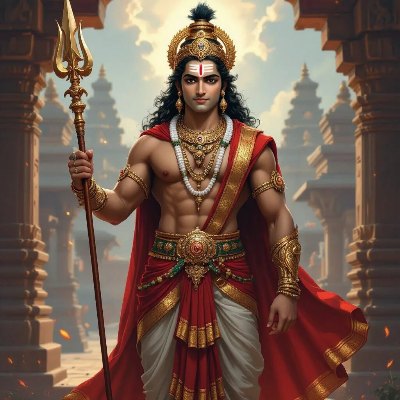
Kartikeya — God of War, Commander of the Divine Army, Son of Shiva
Kartikeya · Skanda · Murugan · Kumara · Subrahmanya · Shanmukha · Shadanana · Guha · Senani · Mahasena · Deva-Senapati · Agneya · Pavaki · Sharavana-Bhava · Vishakha · Naigameya · Balagraha · Karthigeya · Velan · Swaminatha
Kartikeya is one of the most widely worshipped deities of the Hindu tradition, venerated as the god of war, the eternal commander of the celestial armies of the gods, and the destroyer of demonic forces that threaten cosmic order. He is the son of Shiva — the supreme ascetic deity and one of the principal gods of Hinduism, identified with the processes of destruction and regeneration — and is regarded across most Puranic sources as also the son of Parvati, the daughter of the Himalaya mountain-deity and the devoted consort of Shiva. He is the elder brother of Ganesha in the most widely received Puranic tradition, though the relative birth order of the two brothers is reversed in certain regional and textual streams. Kartikeya appears in embryonic mythological form in the Vedic corpus, receives extended treatment in the Mahabharata — particularly in the Vana Parva — and is the subject of the Skanda Purana, the largest of the eighteen Mahapuranas, which is entirely devoted to his mythology. He is also celebrated in the Shiva Purana, the Kumara Sambhava of the poet Kalidasa, and across the ancient Tamil literary tradition as Murugan, one of the oldest continuously worshipped deities of the Tamil country. His principal mythological function is the destruction of the demon Taraka, who had obtained a boon of near-invincibility and whose tyranny over the three worlds could only be ended by a son of Shiva. The narrative of Kartikeya's birth is one of the most elaborately developed origin stories in all of Sanskrit literature, involving the fire god Agni, the river goddess Ganga, the six Krittikas (the Pleiades star-nymphs), and the complex interplay of ascetic power, divine desire, and cosmic necessity.
✦ The Names and Their Meanings
The deity's many names reflect different aspects of his nature, the varied circumstances of his birth, and the regional traditions that have preserved his worship across millennia. The name Kartikeya derives from the six Krittikas — the six divine women of the Pleiades who nursed him after his birth and are considered his foster mothers in most Puranic accounts. The name means "he who belongs to the Krittikas" or "he who was raised by the Krittikas." The form Karthigeya is a Tamil and South Indian phonetic variant of the same name.
Skanda is among his oldest and most important names in the Sanskrit tradition. It derives from the root skand, meaning to leap, to spurt, or to flow — interpreted variously as referring to the manner in which his divine seed was emitted and scattered during the circumstances of his birth, or to his role as a deity of vital and generative energy. The Mahabharata and the early Puranas use this name extensively. Kumara means "the eternal youth" or "the prince," reflecting his nature as a deity who never ages and whose youthful vigour is an enduring aspect of his divine power. Subrahmanya, widely used in South India, is a name of ancient derivation generally interpreted as "dear to the Brahmanas" or "beloved of the highest principle," and it is under this name that he receives extensive Agamic and temple worship in Tamil Nadu and Kerala.
Shanmukha and Shadanana both mean "the six-faced one," referring to his iconographic form with six heads. This form arose from his birth from six separate sparks of Shiva's seed, each received and nurtured by one of the six Krittikas; the six infants merged into one body with six faces when Parvati embraced them. Guha means "the hidden one" or "he who dwells in the cave," referring to his esoteric identity as the divine consciousness concealed within the innermost heart of the devotee — a philosophically important name in the Shaiva Siddhanta tradition. Senani and Deva-Senapati both signify "commander of the army" and "general of the gods" respectively, describing his functional role as the war-leader appointed to command the celestial forces against demonic enemies. Mahasena means "he who commands a great army." Agneya and Pavaki link him to Agni, the fire god, who played a decisive role in the transmission of Shiva's seed; these names mean "son of Agni" or "belonging to the fire." Sharavana-Bhava means "born of the thicket of reeds," a reference to the reed grove or reed-lake where the divine seed came to rest and Kartikeya emerged. Vishakha is a name or associated divine figure mentioned in the Mahabharata — in that text treated as a companion or emanation of Skanda. In the Tamil tradition he is most commonly called Murugan — an ancient Tamil name meaning "the beautiful" or "the youthful" — and Velan, meaning "he who holds the vel (spear)," both of extreme antiquity in the Tamil Sangam literary corpus. Swaminatha, "lord of the lord" or "teacher of the supreme deity," refers to the episode in which Kartikeya taught the meaning of Om to Shiva himself.
✦ Lineage
- Father: Shiva (also known as Maheshvara, Mahadeva, Rudra, Hara, and Shankara) — the supreme deity of the Shaiva tradition, one of the principal gods of Hinduism, identified with cosmic destruction and regeneration, with ascetic power, with the resolution of opposites, and with the absolute ground of being. He dwells with Parvati on Mount Kailasha and is the father of both Kartikeya and Ganesha.
- Mother (primary tradition): Parvati (also known as Uma, Gauri, Shakti, Ambika, and Devi) — the daughter of Himavan, the divine personification of the Himalaya mountain range, and his wife Mena. She is the devoted consort of Shiva and is regarded as the mother of Kartikeya in the predominant Puranic tradition, though the specific mechanics of his birth mean that Parvati's relationship as biological mother is complicated across different textual streams.
- Foster mothers (the six Krittikas): The six divine women of the Pleiades star cluster who discovered the six infants born from Shiva's seed in the reed grove and nursed each one simultaneously. Because Kartikeya nursed from all six at once with his six mouths, he grew to extraordinary divine strength in an instant. They are the source of the name Kartikeya and are venerated as his six mothers.
- Additional maternal figure in several accounts: Ganga — the sacred river goddess and personification of the Ganga river, who received the divine seed from Agni and held it in her waters, releasing it onto her banks in the reed thicket. In these accounts Ganga is honoured as one of his birth-mothers.
- Maternal grandfather: Himavan (Himavat) — the divine king of mountains, personification of the Himalaya range, father of Parvati.
- Maternal grandmother: Mena (Menaka in some texts) — wife of Himavan and mother of Parvati.
- Sibling: Ganesha (also known as Ganapati, Vighneshvara, and Vinayaka) — the elephant-headed son of Shiva and Parvati, the remover of obstacles, the lord of beginnings and of the divine attendants (ganas). In the predominant Puranic tradition Kartikeya is the elder brother, though in certain South Indian traditions their birth order is reversed.
- Consort (celestial lineage): Devasena (also called Devayanai) — daughter of Indra, the king of the gods, who rules the celestial realm. Devasena represents divine sovereignty and celestial grace. She was given to Kartikeya by Indra after Kartikeya's victory over Taraka, and in the Tamil narrative she had been imprisoned by the demon Surapadma and was liberated by Kartikeya.
- Consort (earthly lineage, Tamil tradition): Valli — a girl raised among the Veda tribal community of hunters and forest-dwellers, daughter of the tribal chief Nambirajan. Valli represents earthly devotion and the grace that transcends all boundaries of birth and social origin. Her story appears primarily in the Tamil Kanda Puranam and in the Skanda Purana's Tamil-influenced sections.
- Divine vehicle (vahana): The peacock, named Paravani or Parvani — a bird of great beauty associated with the ability to kill serpents, which in the tradition's symbolic language represent the ego and worldly entanglements. A rooster also appears on his battle banner in the older iconographic tradition.
- Divine weapon: The Vel — the divine spear or lance, known in Sanskrit as the Shakti-Ayudha, given to him by Parvati as a physical embodiment of her own Shakti (divine feminine power). It is the central object of his iconography and the weapon with which he defeated Taraka and the demon armies.
✦ The Cosmic Context: The Tyranny of Taraka
The entire narrative of Kartikeya's birth and divine purpose is framed by the problem of the demon Taraka, an Asura of extraordinary power who had undertaken severe austerities and obtained from Brahma — the creator deity and grantor of boons — the boon that he could only be slain by a son of Shiva. At the time this boon was granted, Shiva was immersed in the deepest ascetic withdrawal following the death of his first wife Sati, and showed no inclination toward any union or worldly engagement. Taraka therefore considered himself effectively immortal and proceeded to conquer and subjugate the three worlds — the celestial realm, the earth, and the underworld — expelling the gods from their abodes, disrupting sacred order, and oppressing all beings without restraint. The gods, headed by Indra, were powerless against him and turned to Brahma for a solution. Brahma directed them toward Shiva, explaining that only a son born from Shiva's seed could end Taraka's reign. The challenge then was to draw Shiva out of his ascetic withdrawal and toward union with a woman worthy of bearing his child.
✦ The Death of Sati and Shiva's Withdrawal
The events preceding Kartikeya's birth begin with Sati, Shiva's first wife. Sati was the daughter of Daksha — the lord of all created beings and one of the Prajapatis, the progenitors born from Brahma. Despite Daksha's contempt for Shiva's unconventional ascetic manner, Sati married Shiva out of deep devotion. When Daksha organised a great sacrifice and deliberately excluded both Shiva and Sati from the invitation list, Sati attended uninvited and was publicly humiliated by her father's open contempt for her husband. Unable to endure the dishonour done to Shiva, Sati immolated herself in the sacrificial fire. This event is narrated in the Shiva Purana, the Devi Bhagavata Purana, and the Mahabharata.
Shiva's grief at Sati's death was immeasurable. He retrieved her body and wandered through the worlds in devastating sorrow. In one prominent account, Vishnu — the preserver deity — used his discus to dismember Sati's body as Shiva carried it, so that pieces fell across the subcontinent at various sites now venerated as the Shakti Peethas, the great shrines of the goddess. Shiva subsequently withdrew entirely into the deepest meditative absorption, seated on Mount Kailasha in a state utterly indifferent to the condition of the three worlds. It was into this state of profound ascetic withdrawal that the gods needed to introduce the impulse toward desire and union.
✦ Parvati's Austerities
Sati was reborn as Parvati, the daughter of Himavan and Mena. From her earliest years Parvati was devoted to Shiva, attending to him on the mountain, bringing him flowers and fruit, and rendering faithful service to the absorbed ascetic who remained largely oblivious to her presence. When the sage Narada counselled that only intense tapas (austerities) on Parvati's part could move Shiva's attention, Parvati left her royal comforts and undertook the most severe penances — standing on one leg, fasting completely, enduring extreme heat in summer and bone-chilling cold in winter, and remaining motionless in unwavering contemplation. Her austerities grew so formidable that their heat and power began to disturb the equilibrium of the cosmos itself.
The gods, meanwhile, sent Kama — the god of desire, armed with his bow of flowers and arrows tipped with blossoms — to pierce Shiva's absorption and kindle desire within him so that the union with Parvati might occur. Kama approached Shiva's meditation and released his arrow. The shaft struck, and Shiva — disturbed from his samadhi for the first time — opened his third eye in fury and incinerated Kama with a single glance of fire. Kama was reduced to ash, and thereafter existed as Ananga, "the bodiless one" — whose influence continued to act invisibly without form. Kama's wife Rati was left a widow, grieving until Kama's eventual restoration. This episode, recounted in the Shiva Purana and the Kumara Sambhava of Kalidasa, established the enormous cost at which the first breach in Shiva's withdrawal was made, and demonstrated that even the god of desire could not directly overpower Shiva's will.
What ultimately moved Shiva was not Kama's arrow but Parvati's own sustained tapas. Her ascetic power and unwavering devotion grew until even Shiva could not remain indifferent to it. He came to her in disguise — as a young Brahmin student — and argued strongly against her devotion to the wild, ash-smeared god Shiva, portraying him as unfit for a princess. Parvati's faith remained unshaken through all these arguments, and Shiva revealed his true form, moved by the depth of her devotion and by the recognition of Sati reborn in her. The marriage of Shiva and Parvati was thereafter celebrated by all the gods and sages, with the divine marriage procession described at length in the Kumara Sambhava.
✦ The Birth of Kartikeya: The Core Narrative
The birth of Kartikeya is among the most complex and variously narrated origin stories in Sanskrit literature. Following the union of Shiva and Parvati, the seed of Shiva — described in the texts as of unbearable luminosity and cosmic potency — could not be contained in any ordinary vessel. The gods, who both needed a son of Shiva and feared the overwhelming power that such a child might embody, further complicated the situation. In the most widely received Puranic narrative, the divine seed was taken up by Agni, the fire god, who had been present as the witness of the divine union in the form of the sacred fire. Agni, unable to bear the intensity of Shiva's seed, deposited it into the waters of Ganga. The river goddess received the seed but she too could not hold it within her without suffering, and released it onto her banks — into a forest of reeds (sharavanam) on the shores of a Himalayan lake. From these reeds, in the form of six radiant infants glowing with divine light, Kartikeya was born.
The six Krittikas — the divine women of the Pleiades — discovered the six infants and each took one to nurse. The infants nursed with such cosmic hunger that the Krittikas' own bodies transformed in the process. When Parvati arrived to claim her son, she embraced all six infants simultaneously with such intensity of motherly love that they merged into a single child possessing six faces and twelve arms. This is the mythological origin of Kartikeya's form as Shanmukha. Parvati's embrace as the unifying act is theologically central: it establishes her as the true mother even without the biological role, and it resolves the multi-birth narrative by making maternal love itself the force that creates a unified being from six.
✦ The Infant Deity's Immediate Manifestation of Power
The Mahabharata's Vana Parva account describes how the newly born Kartikeya immediately manifested as a force of cosmic magnitude. He erupted from his birth-place in a blaze of divine energy that shook the worlds. Confused celestial beings and frightened demons fled before the overwhelming power of the divine child. Though an infant, Kartikeya spoke with authority and displayed the ability to generate subsidiary divine beings from his own body — including figures named Vishakha, Shakha, and Naigameya, who appear in the Mahabharata as associated divine entities. This Mahabharata account is distinct from the later Puranic systematisation and contains elements not found in the Shiva Purana or Skanda Purana versions.
In the Mahabharata account, when the gods encountered the child Skanda, Indra — king of the celestial realm, the bearer of the thunderbolt (vajra) — struck him with that weapon in alarm. The blow did not destroy Kartikeya but caused a portion of his body to split away and become a separate divine being. Recognising the futility and danger of further confrontation with the child deity, Indra submitted to Kartikeya. The other gods followed, and together they formally installed him as their supreme commander.
✦ Installation as Commander of the Divine Army
After the tumult of his birth and the recognition of his divine authority, the gods performed a formal coronation and installation of Kartikeya as Deva-Senapati, the general of the celestial armies. Indra, Brahma, Vishnu, the Ashvins (the twin divine physicians), the Maruts (storm deities), and the full assembly of gods, sages, and Apsaras gathered for this ceremony. Shiva and Parvati presided. Each god offered gifts that became attributes of Kartikeya's divine form: Indra conferred a portion of his own power; Brahma bestowed knowledge; Vishnu offered strength; the Maruts gave speed; the rivers gave purity. Parvati gave him the Vel — the divine spear that embodied her own Shakti — and the peacock was designated as his divine vehicle. He was installed on a throne of gold, invested with the authority of supreme commander over all celestial forces, and the divine army was placed under his command for the campaign against Taraka.
✦ The War Against Taraka and the Victory of the Gods
Once installed as commander, Kartikeya marshalled the divine armies and led them against Taraka and the Asura forces. The war was vast and ferocious. The demon armies, which had long dominated the three worlds, were numerous and experienced in battle. Under Kartikeya's leadership, however, the gods fought with a renewed courage and strategic direction they had lacked in earlier unsuccessful engagements. The Skanda Purana and the Shiva Purana both describe the battle across multiple encounters, with accounts of the fallen commanders on each side and the shifting fortunes of the combat.
The culmination was Kartikeya's single combat with Taraka himself. The demon was of immense power, protected by his boon, and the encounter was fierce and prolonged. Kartikeya hurled the Vel — the divine spear given to him by Parvati — at Taraka, and the weapon pierced the demon's chest and killed him. With Taraka's death, the Asura armies were routed and destroyed. The three worlds were liberated from demonic subjugation. The gods returned to their celestial abodes, the order of the cosmos was restored, sacrificial worship resumed throughout the worlds, and Kartikeya's divine purpose in this birth was fulfilled.
✦ The War Against Surapadma and the Demon Brothers (Tamil Tradition)
In the Skanda Purana and particularly in the Tamil Kanda Puranam — the Tamil language adaptation of the Skanda Purana composed by the poet Kachchiappa Shivacharya — a second and even larger war is narrated, involving the demon brothers Surapadma, Simhamukha, and Tarakasura. These three Asura brothers, sons of a sage and an Asura woman in this tradition, had obtained boons of extraordinary power and proceeded to dominate the three worlds for millions of years in mythological reckoning — a period far longer and more oppressive than Taraka's reign in the earlier narrative.
Surapadma was the most powerful of the three brothers and ruled with absolute tyranny. Indra's daughter Devasena had been captured and imprisoned by Surapadma, and her liberation was among the explicit motivations of the divine campaign. Kartikeya led the divine armies against all three brothers in a campaign of enormous scale. Simhamukha and Tarakasura were slain in the course of the war, but the confrontation with Surapadma himself was the defining encounter. Surapadma was capable of assuming any form and fought through multiple transformations of extraordinary power. When Kartikeya hurled his Vel at Surapadma in the culminating moment of the battle — said to have taken place on the shores of the sea at Tiruchendur — Surapadma transformed himself into a great mango tree, hoping the weapon would be unable to destroy him in this form. The Vel split the mango tree into two halves. One half became the peacock that serves as Kartikeya's divine vehicle; the other became the rooster emblazoned on his battle flag. This transformation of the defeated demon into the god's own sacred emblems is unique to the Tamil tradition and carries theological significance: the demonic force, once conquered, is not annihilated but absorbed and sublimated into service of the divine. After the war, Kartikeya married Devasena, who had been freed from her captivity.
✦ The Contest with Ganesha and the Fruit of Wisdom
One of the most beloved episodes involving Kartikeya is his contest with his brother Ganesha. In the version narrated in the Shiva Purana and carried through countless regional traditions, Shiva and Parvati announced that they would give a magnificent divine fruit — described as the fruit of immortality and perfect wisdom — to whichever of their two sons first circumambulated the entire universe and returned first. Kartikeya, confident in his speed and mounted on his peacock, immediately set off to circle the three worlds, traversing celestial realms, oceans, and mountains with great swiftness. Ganesha, whose vehicle was a small mouse and who appeared wholly unable to complete such a journey quickly, instead walked slowly around his parents Shiva and Parvati and declared that they were his entire universe: his parents being the source and sum of all creation, to circumambulate them was to circumambulate the cosmos itself.
Shiva and Parvati accepted this as the most profound and correct answer, and gave the fruit to Ganesha. When Kartikeya returned and learned what had happened, he was overcome by hurt and anger at what he felt was an unfair judgment. In the version recounted in the Shiva Purana, he left Kailasha in his displeasure and withdrew to the Palani Hills of South India — one of his most sacred shrines — where he dwelt as an ascetic. His departure southward became the mythological explanation for why Murugan worship is of such extraordinary depth and antiquity in Tamil Nadu, and the Palani temple (Dandayuthapani) remains among the most frequented pilgrimage sites in all of India. The reconciliation between Kartikeya and his parents, and the establishment of his permanent presence in the South as his chosen abode, are narrated at length in the Tamil Skanda-related texts.
✦ Kartikeya and Valli: The God and the Huntress
The story of Kartikeya's courtship of Valli appears primarily in the Tamil tradition, in the Kanda Puranam and in regional oral and literary sources, though it is incorporated into the Skanda Purana's sections that draw on South Indian material. Valli was a girl raised among the Veda (or Vedava) tribal community — hunters and gatherers of the forest — and the daughter of the tribal chief Nambirajan. She had been found as an infant near a hole dug to protect millet fields from deer, and was named Valli, meaning "creeper" or "earth" in Tamil.
Kartikeya saw Valli and was captivated by her beauty and devotion. He approached her in various disguises — as an old man, as a hunter, and in other forms — in order to court her. The mischievous assistance of Ganesha is integral to this courtship narrative: Ganesha disguised himself as a wild elephant to terrify Valli, driving her into the arms of the disguised Kartikeya for protection. The entire story is marked by playfulness, persistence, and the delight of a god who pursues an earthly devotee with the ardour of a lover. Valli's eventual acceptance of Kartikeya is understood in the devotional tradition as an allegory for the soul's acceptance of divine grace — the soul (Valli) being pursued, playfully and persistently, by the god who comes through the disguises of ordinary life until the soul recognises and accepts him.
✦ Kartikeya and the Pranava: The Teaching of Om to Shiva
An episode of great philosophical significance, narrated in the Skanda Purana and elaborated in South Indian devotional literature, involves Kartikeya, Brahma, and the sacred syllable Om (the Pranava). In this account, Kartikeya asked Brahma — the four-faced creator deity who presides over all Vedic knowledge and learning — to explain the complete meaning of the Pranava. Brahma recited the syllable but was unable to satisfy Kartikeya's demand for its ultimate and complete meaning. Kartikeya declared that a teacher who cannot fully explain what he proclaims is unfit for the role of teacher, and imprisoned Brahma, temporarily taking over the functions of cosmic creation himself.
Shiva intervened and asked Kartikeya to release Brahma, then offered to come to his own son as a humble student, asking Kartikeya to reveal the meaning of Om. Kartikeya whispered the meaning of the Pranava into Shiva's ear — the son thereby becoming the teacher of the father, the child instructing the supreme deity himself. This inversion of the expected teacher-student and parent-child relationship is the basis for one of Kartikeya's most philosophically resonant epithets, Swaminatha: "lord of the lord" or "teacher of the supreme deity." The Swamimalai temple in Tamil Nadu is dedicated to this event and is among the six most sacred shrines of Murugan worship.
✦ The Six Sacred Abodes (Arupadai Veedu)
In the Tamil tradition, six temples are venerated as the Arupadai Veedu — the six sacred encampments or abodes of Murugan — each associated with a central episode of his mythology and constituting the sacred geography of his divine presence in the Tamil country.
Palani (Dandayuthapani), in the Dindigul district of Tamil Nadu, is associated with Kartikeya's departure from Kailasha following the fruit-contest episode with Ganesha; here he is worshipped as an ascetic standing alone on a hilltop. Swamimalai (Swaminathaswamy), near Kumbakonam, is associated with the episode in which Kartikeya taught the meaning of Om to Shiva, and here he is worshipped as the teacher-deity, the Swaminatha. Tiruchendur (Senthil Andavar), on the sea coast of Tamil Nadu, is associated with his great war against Surapadma on the seashore and is the site most celebrated during Skanda Sashti. Thiruparankundram, near Madurai, is associated with his marriage to Devasena and is one of the oldest rock-cut temples in the Tamil country. Tiruttani, in Andhra Pradesh near the Tamil Nadu border, is associated with Kartikeya's return to rest after the wars, and is also linked to his courtship of Valli. Kunrakkudi (Pazhamudircholai), near Madurai, is a natural hill shrine associated with his identity as the youthful deity of the hills and forests, the Murugan of the ancient Sangam landscape. These six shrines represent the theological and narrative geography of Murugan's mythology as it is lived and practised in Tamil devotional culture.
✦ The Sangam Tamil Tradition and the Antiquity of Murugan Worship
Murugan is one of the oldest continuously worshipped deities of South Asia. His presence in the Tamil literary tradition predates the extensive Puranic systematisation of his mythology and extends back into the earliest stratum of Tamil literature. The ancient Tamil Sangam corpus — composed approximately between the third century BCE and the third century CE, though the dates remain debated among scholars — contains numerous references to Murugan as the god of the hills (kurinji landscape), of youth and beauty, of the season of monsoon and lovers' union, and of warfare. The Paripadal, one of the eight Sangam anthologies, contains hymns addressed directly to Murugan as a major deity of the Tamil country.
The Tirumurugaatruppadai — "Guide to Lord Murugan" — is among the earliest Tamil texts devoted entirely to this deity and is included in the Pattupattu anthology (the Ten Idylls). It describes Murugan's six sacred shrines, his divine appearance, the character of his attendants, and the manner in which a devotee should journey to his presence. This text demonstrates that the geography of the six shrines and the core framework of the South Indian Murugan mythology were well established long before the composition of the Sanskrit Skanda Purana. The Tamil Murugan tradition is therefore not simply a translation or regional adaptation of Sanskrit Puranic literature — it is a distinct and in some respects chronologically prior tradition that has interacted with, and in the later period been partially integrated into, the Sanskrit Puranic framework.
✦ Vedic Antecedents
The Vedic antecedents of Kartikeya-Skanda are complex and subjects of scholarly discussion. The Rigveda does not name Skanda or Kartikeya explicitly. However, the figure of Kumara (the divine youth) appears in Vedic contexts. The Vedic deity Rudra — who is regarded as a forerunner of or an earlier form of Shiva — is associated with the Maruts, the storm deities sometimes described as his children, and with fierce, burning energy that parallels later descriptions of Kartikeya. The connections between Rudra, Agni, and the birth of a divine warrior-youth from fire and cosmic seed are present in embryonic form in the older Vedic layer. The Atharvaveda contains references in some manuscript traditions to a figure identifiable as Skanda. The Shatapatha Brahmana contains material relating to Rudra and the Maruts, and astronomical Vedic literature refers to the Krittikas as a divine group of significance. The coherent mythological figure of Skanda-Kartikeya as the six-faced, peacock-riding son of Shiva emerges most clearly in the epic period, with the Mahabharata's Vana Parva representing an early classical statement, thereafter fully elaborated in the Puranas.
✦ The Mahabharata Account in the Vana Parva
The third book of the Mahabharata — the Vana Parva — contains the most extensive early Sanskrit account of Skanda's birth, the installation of his divine authority, and the creation of his attendant beings. The Mahabharata version shares the core elements of the birth narrative (the divine seed, the role of Agni and Ganga, the Krittikas) with the Puranic versions but contains distinctive features. In the Mahabharata account, Skanda immediately after birth generates a set of subsidiary divine beings from his own body — Vishakha, Shakha, Naigameya — who are treated as associated deities or companions rather than being absorbed into Kartikeya's own identity as in later texts. The encounter with Indra and the thunderbolt episode is also specific to the Mahabharata account. The Mahabharata describes Skanda as a celibate deity — a feature directly contradicted by the later Tamil and Puranic tradition of his marriages to Devasena and Valli.
✦ The Skanda Purana
The Skanda Purana is the largest of the eighteen Mahapuranas and is entirely dedicated to Kartikeya-Skanda. It is a massive text that substantially exceeds in volume any other Purana and is divided into multiple Khandas (sections), each treating different sacred sites, mythological narratives, genealogies, and ritual instructions. Scholars widely recognise the Skanda Purana as a compilation accumulated over a long period from different regions and periods rather than a unified composition: some portions are considerably older than others, and regional material from South India, North India, and various pilgrimage centres was incorporated over many centuries.
The Skanda Purana contains the fullest Sanskrit version of Kartikeya's mythology: the detailed accounts of the wars against Taraka and Surapadma, the narratives of Devasena and Valli (incorporating Tamil material), the accounts of the six sacred shrines, the episode in which Kartikeya taught the Pranava to Shiva, and extensive philosophical sections that develop Kartikeya's identity as a form of the supreme consciousness accessible through devotion.
✦ Textual Variants and Inconsistencies
The mythology of Kartikeya is among the most variously told in all of Hindu scripture, and the discrepancies between sources are substantial and significant. The major areas of inconsistency are as follows.
The sequence and agents of birth: The most common Puranic version (Shiva Purana, Skanda Purana) places the sequence as: Shiva's seed → Agni → Ganga → reed thicket → six Krittikas → Parvati's unifying embrace. In the Mahabharata's Vana Parva the roles of Agni and Ganga are present but their relative prominence and the exact sequence differ. In some versions Ganga alone is named as the direct birth-mother, with the Krittikas serving only as nurses. In others the seed fell directly from Agni to the Himalayan reeds without explicit mediation by Ganga. Kalidasa's Kumara Sambhava — which is the most celebrated literary treatment — stops before the birth episode itself, so its account of the actual birth cannot be used to adjudicate between these versions.
Parvati's biological role: In some accounts, particularly certain passages in the Shiva Purana, Parvati herself receives the divine seed and carries the child; in others she plays no biological role in the birth whatsoever and is solely the mother who claims and unifies the six infants through her embrace. This tension reflects the theological need to honour both the multi-mother birth narrative and Parvati's unambiguous status as the supreme mother.
Celibacy versus marriage: The Mahabharata describes Skanda as an eternal celibate (Kumara, the permanent bachelor). This is directly contradicted by the Skanda Purana, the Tamil Kanda Puranam, and the dominant South Indian devotional tradition, all of which celebrate his marriages to Devasena and Valli. The celibate warrior-youth appears to represent an older stratum of the tradition; the marital narratives are a later development reflecting the deity's integration into householder contexts and the incorporation of Tamil regional material.
One war or two: The two major demonic wars — against Taraka in the Sanskrit mainstream and against Surapadma in the Tamil tradition — are treated by some texts as separate events in different cosmic ages, and by others as different aspects or elaborations of a single campaign. The Puranic texts are not internally consistent on whether there was one defining war or two distinct demonic crises.
Birth order relative to Ganesha: The Shiva Purana treats Kartikeya as the elder son of Shiva and Parvati and Ganesha as the younger. Certain regional traditions in Maharashtra and parts of North India reverse this, treating Ganesha as elder. Some texts present them as born at approximately the same cosmic moment without assigning a definitive order.
The identity of Vishakha: The Mahabharata introduces Vishakha as a distinct divine entity associated with Skanda. Later Puranic tradition absorbs Vishakha as simply one of Kartikeya's many names or manifestations rather than a separate being, resolving what appears to have been an earlier independent association.
✦ Theological and Philosophical Significance
Within the Shaiva theological tradition, Kartikeya occupies a specific and irreplaceable position. As the son of Shiva, he embodies the creative and militant aspect of Shiva's vast ascetic power directed outward into the world — the energy of the supreme ascetic, which ordinarily turns inward, redirected into purposeful action for the protection of cosmic order. His role as the destroyer of Taraka carries the allegorical meaning of the destruction of the ego, of spiritual ignorance (avidya), and of the obstruction to liberation that traps the soul in worldly bondage. The demon Taraka in this reading is not merely a political tyrant but a cosmic symbol of the forces that prevent the soul from recognising its identity with the divine.
The episode of Kartikeya teaching the meaning of Om to Shiva is philosophically the most audacious moment in his mythology. It inverts the expected relationships of hierarchy — teacher above student, father above child, supreme deity above subordinate — in order to make the point that wisdom is not determined by position or age but by direct insight. Kartikeya as Kumara, the eternal youth, embodies a form of immediate knowing that is prior to and independent of all accumulated learning. This episode is related in certain interpretations to the Dakshinamurti tradition, in which Shiva-as-teacher imparts wisdom through silence — but here the inversion is complete: it is the son who teaches the father.
In the Shaiva Siddhanta tradition — the dominant theology of Tamil Shaivism — Murugan-Subrahmanya is venerated as the son of Shiva who embodies divine grace (arul) in its most accessible and immanent form. The Tamil bhakti tradition presents Murugan as a deity who destroys ignorance, grants liberation, and is accessible to all devotees regardless of caste, learning, or social standing. This theology of universal grace is expressed most powerfully in the Valli narrative: the beautiful god who pursues an unlettered forest girl with the ardour of a devoted lover, and whose love transforms her into his consort, is a model of divine grace that reaches down to the most ordinary human life.
✦ Iconography and Worship
Kartikeya appears in two principal iconographic forms across the tradition. In the South Indian Agamic temple tradition, he most commonly appears as a beautiful young man with a single face and either two or twelve arms, riding the peacock or standing with the peacock at his side, holding the Vel in his primary right hand. His appearance is radiant and youthful, often adorned with kadamba flower garlands, a divine crown, and jewelled ornaments. He may be flanked by his two consorts Devasena and Valli in the full iconic program. In the six-faced Shanmukha form, his six heads face the six directions, symbolising his omniscient awareness that perceives all realms simultaneously.
In the North Indian tradition and in older Kushana-period sculptural programs, Kartikeya appears as a more martial figure — a warrior armed with spear, shield, and sword, sometimes with the rooster banner prominent. The Kushana sculptures from northern India represent among the oldest known physical representations of this deity, demonstrating his pan-Indian presence from a very early period.
The festival of Thaipusam — celebrated in the Tamil month of Thai (January-February) — is among the most spectacular expressions of Murugan devotion. It involves elaborate processions, the carrying of the Kavadi (a decorated frame balanced on the shoulders of devotees as an act of devotional offering), and in some communities acts of intense bodily devotion. Thaipusam is observed with extraordinary fervour in Tamil Nadu, Sri Lanka, Singapore, Malaysia, Mauritius, and wherever Tamil communities have established themselves, making Murugan veneration one of the most geographically dispersed forms of Hindu devotional practice in the contemporary world.
The festival of Skanda Sashti — observed in the Tamil month of Aippasi (October-November), commemorating the six-day war against Surapadma — is another major occasion, particularly centred on the Tiruchendur temple on the Tamil Nadu coast. The Tiruchendur Skanda Sashti draws enormous numbers of pilgrims annually and involves the narration of the entire Kanda Puranam over the course of the festival days, culminating in the ceremonial enactment of Surapadma's defeat.
✦ Connection to the Wider Genealogy
Through his father Shiva, Kartikeya is connected to the lineage of Rudra-Shiva, who is associated in the Vedic and Puranic genealogical scheme with the eleven Rudras, the Maruts, and the vast category of auspicious-terrible cosmic power. Shiva's own genealogical position varies across Puranic traditions — he is sometimes presented as self-born or as the ultimate unbegotten deity, and sometimes as one of the great gods who emerged from Brahma's creative act. Through his mother Parvati, Kartikeya is the grandson of Himavan — the divine king of mountains and personification of the Himalaya — and of Mena his wife, and thus connected to the lineage of the mountains and rivers of the subcontinent. Through Parvati's identity as the rebirth of Sati, Kartikeya is further connected to Daksha — the Prajapati and lord of created beings — who was Sati's father and thus his maternal grandfather in the lineage of Parvati's previous life.
As the brother of Ganesha — the elephant-headed son of Shiva and Parvati, the remover of obstacles and lord of the ganas — Kartikeya shares the innermost divine family of Kailasha. The two brothers together represent the sons of the supreme divine couple of Shaivism, and they appear together in countless Shaiva temple programs and devotional contexts. Through his consort Devasena, Kartikeya is connected to the lineage of Indra, the king of the celestial realm, who is the son of Kashyapa and Aditi in the Puranic genealogical scheme. Through his consort Valli, he is connected by marriage to the Veda tribal lineage of South India, a connection that carries theological significance in the Tamil devotional tradition as the embodiment of the god's embrace of devotees of all social origins.
✦ References
- Primary Sources — Sanskrit
- Mahabharata, Vana Parva (Aranyaka Parva), chapters 213–228: The most extensive early Sanskrit narrative account of Skanda's birth, his encounter with and submission of Indra, his installation as commander of the divine armies, the creation of his attendant divine beings, and the description of his iconographic and mythological attributes. Contains the description of Skanda as a celibate deity and the episode of Indra striking him with the thunderbolt.
- Shiva Purana, Rudra Samhita, Kumara Khanda: The principal Puranic narrative of the full sequence from Sati's death through Parvati's austerities, the burning of Kama, the marriage of Shiva and Parvati, and the birth of Kartikeya via the transfer of divine seed through Agni and Ganga to the Krittikas. Contains the detailed installation narrative and description of Taraka's defeat.
- Skanda Purana (multiple Khandas): The primary dedicated textual source for Kartikeya's mythology in Sanskrit. Contains full accounts of the wars against Taraka and Surapadma, the narratives of Devasena and Valli, the six sacred Arupadai Veedu shrines, the Pranava episode, and extensive philosophical and pilgrimage material. Scholars recognise this as a compilation from multiple periods and regions.
- Kumara Sambhava of Kalidasa: The classical Sanskrit mahakavya covering the events from the gods' appeal through Parvati's austerities and the marriage of Shiva and Parvati. Stops before the birth of Kartikeya in the surviving text. A foundational literary treatment of the framing mythology; later cantos attributed to Kalidasa cover the birth.
- Rigveda and Atharvaveda: Vedic texts examined by scholars for early antecedents of the Skanda-Kumara mythology, particularly in references to Rudra's children, divine youth, and the Krittikas. Connections are indirect but identified as formative for the later mythology.
- Shatapatha Brahmana: Contains material relating to Rudra and the Maruts that scholars have associated with early Kartikeya mythological elements.
- Devi Bhagavata Purana, Book VII: Accounts of Sati's death and the Shakti Peethas, establishing the background of Shiva's grief and withdrawal that frames the necessity of Kartikeya's birth.
- Brahmanda Purana: Genealogical and cosmological material relevant to Kartikeya's place in the wider Puranic divine lineage.
- Primary Sources — Tamil
- Tirumurugaatruppadai (Pattupattu anthology, Sangam period): Among the earliest Tamil texts devoted entirely to Murugan, describing the six sacred shrines, the deity's appearance, and the manner of pilgrimage. Foundational document of the Tamil Murugan tradition, demonstrating the antiquity and independence of South Indian Murugan worship.
- Paripadal (Sangam anthology, Sangam period): Contains hymns to Murugan among the earliest Tamil Sangam compositions, establishing Murugan as a major deity of the hills, youth, and lovers' union within the Sangam literary landscape (tinai) system.
- Kanda Puranam of Kachchiappa Shivacharya (medieval Tamil): The Tamil language adaptation of the Skanda Purana's mythological core; primary source for the detailed narrative of the Surapadma war, the battle at Tiruchendur, and the courtship of Valli. Contains material distinctive to the Tamil tradition not found in the Sanskrit Skanda Purana.
- Tirupugazh of Arunagirinathar (15th century CE): A large corpus of devotional Tamil hymns to Murugan widely used in worship, representing the mature bhakti tradition of Murugan veneration and contributing to the understanding of his living devotional context.
- Secondary Sources
- Vettam Mani, Puranic Encyclopaedia (1975): Comprehensive reference entries for Skanda-Kartikeya, Subrahmanya, Kumara, and associated figures, consolidating references across Sanskrit sources and identifying key variant accounts. Useful for cross-referencing Puranic passages.
- Zvelebil, Kamil V., The Smile of Murugan (1973): A scholarly study of the Tamil Murugan tradition, tracing the deity's history in Tamil literature from the Sangam period through the medieval bhakti era. Establishes the independence and antiquity of the Tamil tradition relative to the Sanskrit Skanda mythology.
- Clothey, Fred W., The Many Faces of Murukan (1978): A scholarly monograph examining the historical development, regional variations, and ritual dimensions of Murugan worship in South Asia and in diaspora communities. Provides detailed treatment of the six sacred shrines and Tamil devotional practices including Thaipusam and Skanda Sashti.
- O'Flaherty, Wendy Doniger, Siva: The Erotic Ascetic (1973): Scholarly analysis of Shaiva mythology, with extensive treatment of the Kartikeya birth narrative and its central paradox — the ascetic god's seed producing the war-deity — in the context of the broader logic of Shaiva myth-making.
- Wisdomlib.org — Kartikeya, Skanda, Shanmukha, Subrahmanya, Kumara entries: A secondary digital reference tool providing verse-indexed cross-references to appearances of these names across Sanskrit texts. Useful for locating passages but should be verified against primary texts.