
About
Kaumari — Divine Mother Bearing the Power of Kartikeya
Kaumari · Kumari · Kartikeyani · Skanda-Shakti · Kaumarya
Kaumari is one of the seven divine mothers — the Saptamatrikas — of the Hindu tradition, a collective group of fierce goddesses associated with war, protection, and cosmic power. She is the Matrika whose form, weapons, and attributes correspond to those of Kartikeya — also called Skanda, Kumara, and Murugan — the six-headed divine war god, commander of the gods' armies, who destroyed the demon Tarakasura and is one of the most widely worshipped deities in the southern Indian tradition. Kaumari appears in the Devi Mahatmya (the foundational Shakta scripture forming chapters 81 through 93 of the Markandeya Purana), the Matsya Purana, the Varaha Purana, the Skanda Purana, the Agni Purana, and in Agamic texts. Her character varies between the martial tradition of the Devi Mahatmya and the malevolent spirit tradition of the Matsya Purana and the Skanda-attendant tradition of the Skanda Purana.
✦ The Name
The name Kaumari derives from Kumara, one of the principal names of Kartikeya, meaning "the youth" or "the ever-young one." Kaumari thus means "she who is the Shakti of Kumara" or "the feminine power of the ever-young one." The alternate form Kumari is used in some texts and carries the additional meaning of "the maiden" or "the virgin," which resonates with Kartikeya's own identity as a celibate divine warrior. Kartikeyani is a direct patronymic-style feminine derivation meaning "she who belongs to Kartikeya." Skanda-Shakti means "the power of Skanda," Skanda being another major name for Kartikeya derived from the Sanskrit root meaning "to leap" or "to attack."
✦ Lineage and Origin
- Origin (Devi Mahatmya): Kaumari emerged as an emanation of Kaushiki — a goddess who had herself arisen from the body-sheath of Parvati, the consort of Shiva — during the battle against the forces of Shumbha and Nishumbha. She arose bearing the attributes of Kartikeya.
- Corresponding male deity: Kartikeya, also known as Skanda, Kumara, Murugan, Subrahmanya, and Shanmukha (the six-faced one). He is the divine war god and commander of the deva army, son of Shiva and Parvati in most Puranic accounts, who was born specifically to destroy the demon Tarakasura. His primary weapon is the spear (shakti or vel), and his vehicle is the peacock.
- Relationship to the Skanda tradition: Kaumari's connection to Kartikeya gives her a distinctive dual position in the textual tradition. In the Devi Mahatmya she is a product of Kaushiki's power. But in the Skanda Purana's tradition, the Matrikas including Kaumari are specifically members of Kartikeya's retinue, making Kaumari simultaneously a projection of his power and a member of his divine court. This creates a circular relationship unique among the Matrikas.
✦ Iconography
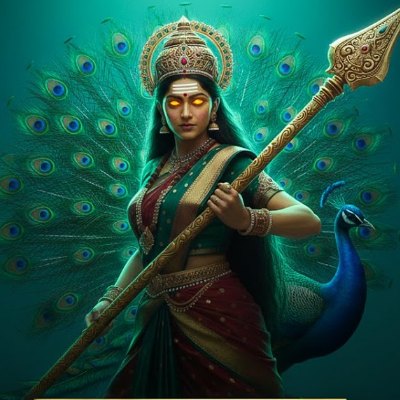
Kaumari's standard iconographic form presents her as a youthful goddess — her youth reflecting Kumara's nature as the eternal youth — with a bright complexion. She carries a spear (shakti), which is Kartikeya's primary weapon, and may also hold a rooster, which is associated with Kartikeya's banner in some traditions. Her vehicle is the peacock, which is Kartikeya's mount and one of the most distinctive elements of his iconography. In some representations she has multiple arms carrying various weapons associated with Kartikeya, and she may wear armour befitting her role as a war goddess. Her appearance in group Saptamatrika sculptures — which are common in temple contexts across India, particularly in Karnataka, Tamil Nadu, and Rajasthan — typically shows her in a martial pose consistent with the other six mothers.
✦ Role in the Devi Mahatmya
In the Devi Mahatmya, Kaumari appears as one of the seven Matrikas who emerge from Kaushiki during the battle against the forces of Shumbha and Nishumbha. She fights collectively with the other Matrikas against the demon armies. The Devi Mahatmya does not assign individual narrative episodes to Kaumari separately from the group. Following the death of Shumbha, the Matrikas including Kaumari are reabsorbed into Kaushiki.
✦ Variant Traditions
The Matsya Purana and Varaha Purana present Kaumari, alongside the other Matrikas, as a dangerous spirit who afflicts children and infants. The Skanda Purana's tradition is particularly significant for Kaumari because of her direct association with Kartikeya: in that text the Matrikas are described as members of Kartikeya's army who were originally malevolent child-harming spirits but were subdued by Kartikeya himself and made into his protective attendants. This narrative is especially resonant for Kaumari, whose very identity is derived from Kartikeya: she is thus simultaneously a power derived from him, a member of his retinue, and — in the Matsya Purana tradition — a spirit potentially harmful to the very children she is, in her protective role, supposed to guard.
In South Indian temple traditions, particularly in Tamil Nadu where Kartikeya-Murugan is among the most widely worshipped deities, Kaumari receives particular emphasis within Saptamatrika shrines. Her worship in this context is closely tied to the broader Murugan cult, and she is sometimes understood as a more specifically South Indian goddess form among the seven mothers.
✦ Theological Significance
Kaumari represents the martial, victorious energy of the divine warrior in feminine form. Kartikeya as the eternal-youth war god is understood as pure, undefeated, ever-vigorous divine power; Kaumari as his Shakti is that same power as an active, dynamic, maternal-martial force. Her youth — encoded in the meaning of her name — suggests a power that is perpetually renewed, inexhaustible, and undimmed by age or battle. In the context of the Saptamatrika group, Kaumari provides the element of youthful martial vigour that complements the creative power of Brahmani, the destructive power of Maheshvari, and the cosmic sovereignty of Vaishnavi.
✦ References
- Primary Sources
- Markandeya Purana, chapters 81–93 (Devi Mahatmya): Primary source for Kaumari as a martial Matrika, narrating her emergence from Kaushiki and her collective role in the battle.
- Matsya Purana: Contains the tradition of Kaumari and the Matrikas as dangerous child-afflicting spirits.
- Skanda Purana: Contains the tradition of the Matrikas including Kaumari as members of Kartikeya's retinue, subdued by him from their originally malevolent state.
- Varaha Purana: Provides additional accounts of the Matrikas in their dangerous aspect.
- Agni Purana: Provides iconographic prescriptions for Kaumari in temple worship.
- Modern Reference Works
- Vidya Dehejia, Yogini: Cult and Temples (National Museum, New Delhi, 1986): Provides analysis of the Matrika tradition and Kaumari's iconographic and cult context.
- Thomas Coburn, Devi-Mahatmya: The Crystallization of the Goddess Tradition (Motilal Banarsidass, 1984): Analyses the Matrika episode and Kaumari's place within it.
- Vettam Mani, Puranic Encyclopaedia (Motilal Banarsidass, 1975): Provides consolidated entries on Kaumari and the Saptamatrikas.