
About
Adi Parashakti — The Primordial Supreme Power, Source of All Creation
Adi Parashakti · Adi Shakti · Para Shakti · Mula Prakriti · Mahashakti · Jagadamba · Bhavani · The Primordial Goddess
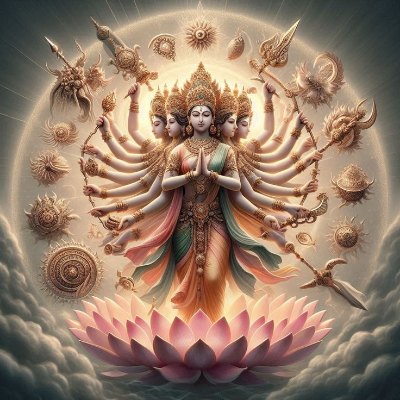
Adi Parashakti is the supreme goddess of the Shakta tradition, conceived as the primordial cosmic power from which all existence emanates. The name designates her as the original (adi), transcendent (para), and absolute power (shakti) — the feminine absolute who is identified in Shakta theology with Para Brahman itself. She is not subordinate to any male deity but is held to be the source from whom Brahma the creator, Vishnu the preserver, and Shiva the destroyer derive both their existence and their respective powers. She is the central subject of the Devi Bhagavata Purana, one of the eighteen Mahapuranas in the Shakta reckoning, and of the Devi Mahatmya, a text embedded within the Markandeya Purana that forms the most widely recited scriptural hymn to the goddess in the Hindu tradition. She also appears in the Kalika Purana, the Brahmanda Purana, and several Tantric Agamas.
✦ The Name
The name Adi Parashakti is a compound of three elements. Adi means primordial, first, or original — that which existed before all else. Para means supreme, transcendent, or beyond — indicating a status surpassing all other powers. Shakti derives from the root shak, meaning to be able or to have power, and denotes the dynamic cosmic energy that animates all existence. Together the name designates the goddess as the original and supreme power underlying all of reality. The epithet Mula Prakriti — the root nature or primordial matter — identifies her as the unmanifest ground from which the manifest world evolves. Mahashakti denotes her as the great power. Jagadamba, meaning mother of the universe, emphasises her role as the generative source of all beings. The name Bhavani, meaning she who gives existence, similarly underscores her creative primacy.
✦ Lineage
- Origin: The Devi Bhagavata Purana presents Adi Parashakti as self-existent and without origin — she is the uncaused cause, not born of any parent. She is identified as Para Brahman in feminine form, the absolute itself.
- Emanations (as described in the Devi Bhagavata Purana): Brahma the creator, Vishnu the preserver, and Shiva the destroyer are said to emerge from her or to receive their powers from her. They are not her children in a biological sense but arise as cosmic functions from her absolute being.
- Principal manifestations: Durga, the warrior goddess who embodies her protective and martial power, and Shatakshi, a form associated with hundred-eyed omniscience, are among the manifestations described in the Devi Bhagavata Purana as arising from or forming part of Adi Parashakti. Lakshmi, consort of Vishnu and goddess of prosperity, and Saraswati, consort of Brahma and goddess of knowledge, are also described in Shakta texts as her manifestations or partial expressions.
✦ Primary Narrative: The Devi Bhagavata Purana Account
The Devi Bhagavata Purana opens with the assertion that in the beginning, before creation, only the Devi existed in her transcendent, unmanifest form. From her own will she brought forth the three principal cosmic functions: Brahma to create, Vishnu to preserve, and Shiva to dissolve. Each of these three was given a consort who was also her own partial manifestation — Saraswati for Brahma, Lakshmi for Vishnu, and Parvati or Maheshvari for Shiva. The Purana further narrates numerous episodes in which the gods, unable to defeat great asuras (demonic powers) through their own strength, appealed to Adi Parashakti, who either acted directly or empowered a form such as Durga or Kali to achieve the victory. Throughout these narratives the Devi is consistently presented as the ultimate source of all divine power rather than as a derived or secondary figure.
✦ Primary Narrative: The Devi Mahatmya Account
The Devi Mahatmya, comprising thirteen chapters of the Markandeya Purana, presents the most widely known narrative cycle of the supreme goddess. The text describes three great battles in which the goddess, manifesting variously as Mahakali, Mahalakshmi, and Mahasaraswati, defeats the asuras Madhu and Kaitabha, the demon-king Mahishasura, and the brothers Shumbha and Nishumbha along with their general Raktabija. In each episode the gods' individual powers are insufficient and they pool their energies, which coalesce into the form of the goddess. The text explicitly identifies the Devi as the supreme power underlying all of reality — both its gracious and its terrible aspects. The Devi Mahatmya closes with the goddess's promise to reappear whenever cosmic order is threatened.
✦ Textual Variants and Inconsistencies
The supreme status of Adi Parashakti as described in the Devi Bhagavata Purana and the Devi Mahatmya is a specifically Shakta theological position and is not accepted across all textual traditions. The Bhagavata Purana, a Vaishnava text, identifies the supreme absolute with Vishnu or Narayana. In that framework, Shakti in the form of Yoga Maya or Mahamaya is a power of Vishnu rather than the supreme principle herself. Similarly, the Shiva Purana identifies Shiva as the absolute and presents Shakti — often in the form of Parvati — as his inseparable consort and power rather than as the primary source from which Shiva proceeds. These are not errors in any individual text but reflect the fundamental divergence between the Shakta, Vaishnava, and Shaiva traditions in their understanding of the ultimate reality.
There is also a textual question regarding the status of the Devi Bhagavata Purana itself. It is accepted as one of the eighteen Mahapuranas in the Shakta tradition, which counts it in place of the Bhagavata Purana (Srimad Bhagavatam). The Vaishnava tradition does not accept this substitution and regards the Bhagavata Purana (Srimad Bhagavatam) as the authentic Mahapurana. This dispute has a direct bearing on the weight given to the Devi Bhagavata Purana's theological claims.
✦ Theological Significance
Within Shakta theology, Adi Parashakti represents the resolution of a fundamental philosophical question: if the absolute is pure, unchanging consciousness, how does dynamic creation arise from it? The answer proposed by the Shakta tradition is that the absolute itself possesses an inherent creative power — Shakti — and that this power is not secondary to or derived from a male principle but is co-essential with the absolute, indeed identical to it. The feminine absolute is thus both the still ground of being (Para Brahman) and the dynamic force of becoming (Shakti). The Tantric traditions elaborate this further through the concept of Shiva-Shakti — the union of the static masculine principle with the dynamic feminine principle — in which neither is complete without the other and Shakti is often presented as the more active and therefore more immediately accessible aspect of the absolute.
✦ Iconography and Worship
Adi Parashakti in her transcendent, unmanifest form has no fixed iconographic representation, as befits an absolute beyond form and attribute. Her worship is primarily conducted through her manifest forms — Durga, Kali, Lakshmi, Saraswati, Parvati, and numerous regional goddesses — each of whom is understood in the Shakta tradition as a partial or complete expression of the one primordial power. The Shri Yantra or Shri Chakra, a geometric diagram of interlocking triangles, is the principal aniconic representation of the goddess in the Tantric tradition, with the central point (bindu) representing Adi Parashakti in her transcendent aspect and the surrounding triangles representing the emanation of creation from her. The Navratri festival, observed twice yearly, is the primary pan-Hindu occasion for her collective worship across her multiple forms. The recitation of the Devi Mahatmya is the central liturgical act of Navratri worship.
✦ Position in the Genealogical Framework
In a genealogical lineage tree structured on a Shakta or composite Puranic framework, Adi Parashakti occupies the position immediately below Para Brahman — or is identified with Para Brahman directly, depending on the strictness of the Shakta position being adopted. She is the source from which the principal divine figures of the tradition — Brahma, Vishnu, Shiva, and their consorts — are said to arise or derive their powers. Her principal manifest forms relevant to the lineage tree include Durga, who embodies her warrior and protective aspect and is described in the Devi Mahatmya and the Devi Bhagavata Purana as arising from the combined energies of the gods at Adi Parashakti's own direction, and Shatakshi, a form described in the Devi Bhagavata Purana as the hundred-eyed manifestation of the goddess who sustains and perceives all of creation.
✦ References
- Devi Bhagavata Purana — The principal Shakta Mahapurana; presents Adi Parashakti as the supreme absolute, source of Brahma, Vishnu, and Shiva, and contains the narratives of her major manifestations including Shatakshi and Durga.
- Devi Mahatmya (Markandeya Purana, Chapters 81–93) — The most widely recited scriptural text dedicated to the goddess; narrates her three great victories over demonic powers and explicitly identifies her as the supreme cosmic power.
- Kalika Purana — An Upapurana that elaborates on the goddess in her Kali and Kamakhya forms and contributes to the understanding of her Tantric aspects.
- Brahmanda Purana — Contains the Lalita Sahasranama, a litany of a thousand names of the goddess that elaborates her attributes and cosmic functions.
- Bhagavata Purana (Srimad Bhagavatam) — Presents the Vaishnava counter-position in which Shakti is Vishnu's power rather than the supreme principle; essential for understanding the sectarian debate.
- Shiva Purana — Presents the Shaiva position in which Shakti is inseparable from but proceeding through Shiva; relevant for the textual variant discussion.
- Shakta Tantras (general) — The Tantric Agamic literature elaborates the philosophical identification of Adi Parashakti with Para Brahman and the Shiva-Shakti theology.
- Coburn, Thomas B. — Devi-Mahatmya: The Crystallization of the Goddess Tradition (1984) — A scholarly study of the Devi Mahatmya's composition, theology, and place in the wider goddess tradition.
- Kinsley, David — Hindu Goddesses: Visions of the Divine Feminine in the Hindu Religious Tradition (1986) — Surveys the major goddess figures including the supreme Devi and her principal manifestations.
- Bhattacharyya, N. N. — History of the Sakta Religion (1974) — Traces the development of Shakta theology and the concept of the supreme goddess across primary sources.