
About
Shatakshi — The Hundred-Eyed Form of the Goddess
Shatakshi · Shataakshi · Shatanetra · Bahula · Shatakshmi
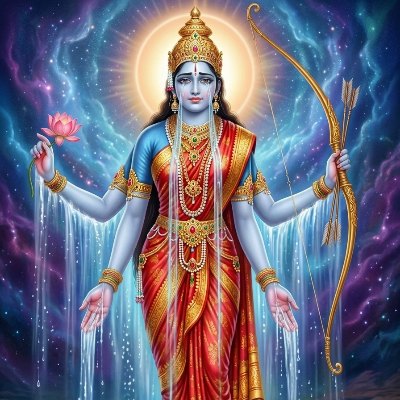
Shatakshi is a manifestation of the supreme Goddess — known across the Shakta tradition by such names as Devi, Ambika, and Mahadevi — who appears in the Devi Bhagavata Purana within the episode of the Asura Durgama's conquest of the three worlds. The name Shatakshi means the hundred-eyed one, and this form of the Goddess is distinguished by her possession of a hundred eyes from which she weeps continuously, her tears falling as rivers and streams to relieve the catastrophic drought and famine that had overtaken the world following Durgama's theft of the four Vedas. Shatakshi is closely related to, and in the Devi Bhagavata Purana is presented as the same Goddess who subsequently manifests as Shakambhari, the nourishing form who provides food to the starving world. Her textual presence is concentrated primarily in the Devi Bhagavata Purana and in the stotra literature of the Shakta tradition, most notably the Lalita Sahasranama.
✦ The Name
The name Shatakshi is a compound of two Sanskrit elements: shata, meaning hundred, and akshi, meaning eye. The name thus means she who has a hundred eyes, or the hundred-eyed one. The hundred eyes signify simultaneously the Goddess's omniscience — her capacity to perceive all suffering across the three worlds — and her boundless compassion, expressed through the continuous flow of tears from those eyes. An alternate form of the name, Shatanetra, uses netra in place of akshi, both words meaning eye in Sanskrit, and carries the same meaning. The name Shatakshmi appearing in some texts is a variant that combines shata with the root of Lakshmi or with akshi in a slightly different phonological form. The epithet Bahula, meaning abundant or many, is occasionally associated with this form in the stotra tradition, referring to the abundance of her eyes and the abundance of the water she provides.
✦ Lineage and Divine Identity
- Ultimate identity: Shatakshi is a form or manifestation of the supreme Goddess, who is identified in the Devi Bhagavata Purana as Mahadevi — the great Goddess who is the primordial power underlying all existence. She is not a separate deity but a specific form assumed by the Goddess in response to the suffering caused by the Asura Durgama's actions.
- Related manifestation: Shakambhari, the vegetable-bearing nourishing form of the same Goddess, is presented in the Devi Bhagavata Purana as the subsequent manifestation of the same divine being who first appeared as Shatakshi. The transition from Shatakshi to Shakambhari within the same episode marks a shift from the Goddess's act of providing water to her act of providing food.
✦ The Narrative of Manifestation
The context of Shatakshi's appearance is the catastrophe wrought by the Daitya Durgama, son of the Daitya Ruru who belonged to the lineage of Hiranyaksha. Durgama had performed severe austerities directed at Brahma, the creator deity, and obtained a boon through which he seized the four Vedas from the gods and the brahmanas. Deprived of the Vedas, the sacrificial order collapsed, the gods lost their strength, and the earth entered a prolonged famine — the Devi Bhagavata Purana describes this as lasting a hundred years — during which rain ceased, rivers dried, vegetation perished, and both humans and animals faced starvation and death.
The rishis, sages, and the afflicted people of the earth turned their prayers to the Goddess. Moved by their suffering and their devotion, the Goddess manifested in the form of Shatakshi — a great divine form possessed of a hundred eyes. From each of those eyes she wept continuously, and her tears, falling upon the parched earth, became rivers and streams that filled the dry watercourses and restored water to the world. This act of divine weeping is presented in the Devi Bhagavata Purana not as an expression of grief but as an act of deliberate compassion — the Goddess choosing to give of herself, through the very medium of her tears, to relieve the thirst of her devotees.
Following this act of water-provision, the Goddess assumed the form of Shakambhari and provided food. She then engaged and destroyed Durgama in battle, recovering the Vedas and restoring the cosmic order. The Shatakshi manifestation is thus the first of two successive nourishing forms that the Goddess assumes before her warrior aspect comes to the fore.
✦ Presence in Stotra Literature
The name Shatakshi appears in the Lalita Sahasranama, the celebrated hymn of a thousand names of the Goddess Lalita Tripurasundari preserved within the Brahmanda Purana. In the Lalita Sahasranama, Shatakshi occurs as one of the divine names of the supreme Goddess, connecting the hundred-eyed form to the broader Shakta theological understanding of the Goddess as omniscient and all-perceiving. The inclusion of this name within a text as significant as the Lalita Sahasranama confirms that the Shatakshi form was integrated into the wider Shakta devotional tradition beyond its narrative context in the Devi Bhagavata Purana.
✦ Theological Significance
The Shatakshi form encapsulates a specific theological principle within the Shakta tradition: that the Goddess's compassion is itself a form of power, capable of producing material and cosmic effects in the world. The hundred eyes that weep rivers are not a symbol of weakness or sorrow but of an omniscient awareness that perceives all suffering simultaneously and a generative capacity that can transform that awareness into relief. The motif of a deity's tears becoming rivers or waters is found elsewhere in the Hindu tradition, but in the Shatakshi episode it is given a particularly structured theological meaning — the Goddess does not send rain through Indra or through the normal mechanisms of the cosmic order, because those mechanisms have broken down under Durgama's dominion. Instead she provides water directly from her own body, bypassing the corrupted order and acting as the ultimate source of sustenance in her own right.
✦ References
- Devi Bhagavata Purana, Book VII: The principal narrative source for the Shatakshi manifestation, providing the full account of the Goddess's appearance with a hundred eyes, the weeping of rivers, and the connection to the Durgama episode.
- Brahmanda Purana — Lalita Sahasranama: Contains Shatakshi as one of the thousand names of the Goddess Lalita, establishing the name's place within the broader Shakta devotional and theological tradition.
- Vettam Mani, Puranic Encyclopaedia (1975): Consulted for cross-referencing the identification of Shatakshi within the Puranic corpus.
- Swami Vijnananda (trans.), The Srimad Devi Bhagavatam (1921): An early English translation of the Devi Bhagavata Purana consulted for the narrative content of the Shatakshi and Shakambhari episodes.