
About
Shakambhari — The Nourishing Goddess Who Bears Vegetation
Shakambhari · Shakambhari Devi · Shakambhari Mata · Shataakshi · Durgamanashini · Bhuri · Bhuri Bhavana
Shakambhari is a manifestation of the supreme Goddess who is venerated across the Shakta tradition as both a narrative figure in the Puranic literature and as an independently worshipped deity with a living cultic and temple tradition. The name Shakambhari means she who nourishes with vegetables or she who bears herbs and plants, and this form of the Goddess is associated with the provision of food, the fertility of the earth, and the sustaining of life at times of cosmic or earthly crisis. She appears most fully in the Devi Bhagavata Purana within the episode of the Asura Durgama — a Daitya of the lineage of Hiranyaksha who stole the four Vedas and brought catastrophic drought and famine upon the world — where she manifests to feed the starving sages and people before destroying Durgama in battle. She is also referenced in the Devi Mahatmya embedded within the Markandeya Purana, and she is the subject of the Shakambhari Upapurana. Her worship is centred at two major temple sites in northern India — at Saharanpur in Uttar Pradesh and at Sambhar in Rajasthan — and she holds the status of a Navadurga, one of the nine forms of Durga venerated in that specific devotional tradition.
✦ The Name
The name Shakambhari is formed from two Sanskrit elements: shaka, meaning vegetables, herbs, or edible plants, and bharana or bhari, from the root meaning to bear, carry, or nourish. The compound thus means she who bears vegetables, she who nourishes with plants, or the sustainer through vegetation. The name captures the Goddess's essential function in the episode that defines this form: she provides food in the form of vegetables, fruits, and roots to a world stripped of its agricultural capacity by prolonged famine.
The epithet Durgamanashini — she who destroys Durgama — is associated with Shakambhari in some texts and in the broader Shakta exegetical tradition, identifying her as the slayer of the Asura Durgama. The name Bhuribhavana or Bhuribhavani, meaning the one who causes abundance, appears in some stotra literature in connection with this form. The Devi Bhagavata Purana also refers to her by the name Shatakshi — the hundred-eyed one — in the immediately preceding stage of the same episode, the two names thus representing two moments in a single continuous divine manifestation rather than two entirely separate beings.
✦ Lineage and Divine Identity
- Ultimate identity: Shakambhari is a form of the supreme Goddess — identified in the Devi Bhagavata Purana as Mahadevi, the primordial divine power — who assumes this particular aspect in response to the suffering caused by Durgama's dominion. She is not a separate deity but a specific manifestation of the one Goddess.
- Related manifestation: Shatakshi, the hundred-eyed form of the same Goddess who immediately precedes Shakambhari within the Durgama episode, providing water through her tears before Shakambhari provides food. Both are sequential forms of the same divine being within that narrative.
- Classification as Navadurga: Shakambhari is included among the Navadurgas — the nine forms of Durga — in the devotional tradition that enumerates these nine aspects. In this classification she is identified as one of the nine primary warrior-and-nourishing forms of the Goddess Durga, each associated with a specific divine function and a specific episode of divine intervention.
✦ The Narrative of Manifestation
The context of Shakambhari's appearance is the cosmic catastrophe brought about by the Daitya Durgama, son of the Daitya Ruru of the Hiranyaksha lineage. Durgama had performed severe austerities and obtained a boon from Brahma through which he seized the four Vedas — the Rigveda, Yajurveda, Samaveda, and Atharvaveda — from the gods and the brahmanas. The loss of the Vedas destroyed the sacrificial order; without sacrifice the gods were weakened and deprived of their celestial abodes, and without the cosmic mechanisms the gods sustain, the earth fell into catastrophic drought. The Devi Bhagavata Purana describes a famine of a hundred years during which no rain fell, rivers and water bodies dried up, vegetation perished, animals died, and human beings faced starvation and death on an immense scale. The sages and rishis, unable to perform their sacred duties, wandered in distress.
The afflicted people, sages, and gods directed their prayers to the Goddess. Responding with compassion, the Goddess first manifested as Shatakshi and wept rivers from her hundred eyes to provide water to the parched earth. She then assumed the form of Shakambhari, described in the Devi Bhagavata Purana as a great divine form filled with and surrounded by an abundance of vegetables, fruits, roots, herbs, and edible plants. From her own body or through her divine power she caused these to appear in abundance, and she distributed this food to the starving sages and people, sustaining them through the continuation of the famine.
The sages who received her sustenance offered their praises and prayers to her in this form, addressing her as Shakambhari and glorifying her as the mother and nourisher of all beings. Following this act of sustenance, the Goddess engaged Durgama's vast army in battle. The demonic forces were destroyed by her divine weapons and her attendant Shaktis. Durgama himself entered the battle and fought directly against the Goddess, but was ultimately slain by her. With his death the four Vedas were freed, the sacrificial order was restored, the gods regained their power, and rain returned to the earth.
✦ Presence in the Devi Mahatmya
The Devi Mahatmya, a text of central importance in the Shakta tradition preserved within the Markandeya Purana and comprising chapters eighty-one through ninety-three of that text, contains a reference to Shakambhari in its concluding passages. In the Devi Mahatmya's account, the Goddess herself declares that she will manifest in the form of Shakambhari in a future age of famine and drought, nourishing the world with vegetables that she will sustain through a prolonged period during which she will eat nothing herself. This declaration is presented as a prophecy within the text's framework, and it connects the Shakambhari form to the broader pattern of the Goddess's repeated interventions across different cosmic ages that the Devi Mahatmya establishes. The Devi Mahatmya's reference to Shakambhari is thus programmatic rather than fully narrative, pointing toward the episode elaborated at greater length in the Devi Bhagavata Purana.
✦ The Shakambhari Upapurana
A text known as the Shakambhari Upapurana is referenced in catalogues of Upapuranic literature and is associated with the cult and temple tradition of Shakambhari, particularly in connection with her worship in Rajasthan and the surrounding region. The Upapurana is understood to contain the mahatmya — the glorification and sacred narrative — of the Goddess in her Shakambhari form, elaborating her mythology, the origin of her principal sacred sites, and the efficacy of her worship. The text's precise content, date, and textual history are not uniformly established in the scholarly literature, and it belongs to the class of regional Upapuranas whose manuscripts have not been as extensively studied as the eighteen Mahapuranas. Its existence and association with the Shakambhari cult are attested in the cataloguing literature, but detailed critical analysis of its contents remains limited in the available secondary scholarship.
✦ Presence in Stotra Literature
Shakambhari is named in the Devi Kavacham, the protective hymn of the Goddess that forms part of the Devi Mahatmya cycle and is recited as an armour-prayer invoking different forms of the Goddess to protect different parts of the body and different directions. In the Devi Kavacham she is invoked as one of the protective divine forms, her name appearing within the sequence of goddesses called upon to guard the devotee. Her presence in this text places her within the liturgical core of the Shakta tradition rather than confining her to a single Puranic narrative.
The Lalita Sahasranama, the hymn of a thousand names of the Goddess Lalita Tripurasundari preserved in the Brahmanda Purana, contains names and epithets that the exegetical tradition has associated with the Shakambhari aspect of the Goddess, connecting her nourishing function to the broader Shakta theological framework of the supreme Goddess as the source of all sustenance and fertility.
✦ Temple Traditions and Regional Worship
Shakambhari is the presiding deity of two major temples in northern India, both of which are active centres of pilgrimage and worship and both of which are associated with the sacred narrative of the Goddess's manifestation and her identity as a provider of nourishment and protection.
The Shakambhari Devi temple at Saharanpur in Uttar Pradesh is one of the principal Shakti Pithas or Shakti shrines of the northern Indian tradition. The temple is situated in the Shivalik foothills of the Himalayas and is considered one of the Siddha Shaktipithas — shrines of established divine power — in the Shakta geographical tradition. The presiding image of the Goddess here is identified as Shakambhari, and the temple draws pilgrims particularly during the Navratri festivals. The site is associated in local tradition with the episode of the Goddess's manifestation during the cosmic famine and her sustaining of the sages with vegetation.
The Shakambhari Mata temple at Sambhar in Rajasthan is associated with the salt lake of Sambhar — one of the largest inland salt lakes in India — and the Goddess here is venerated as Shakambhari Mata, the mother goddess of the region. At this site she holds particular significance as the kuldevi — the clan goddess — of numerous Rajput clans and communities of Rajasthan, who regard her as their ancestral protective deity. The Sambhar tradition connects the Goddess to both the nourishing and protective aspects of her mythology. The Shakambhari Upapurana is specifically associated in some accounts with the elaboration of this site's sacred geography and the origin narrative of the Sambhar temple.
✦ Iconography
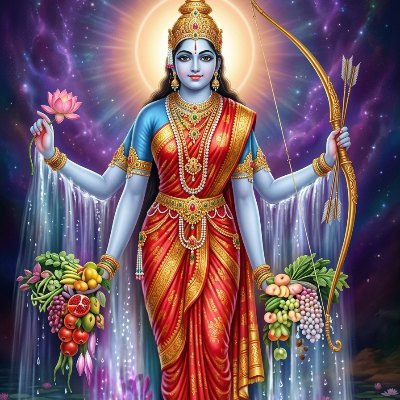
The iconography of Shakambhari as described in the Puranic and Agamic literature presents her with a blue or dark complexion, reflecting her identity as a form of the supreme Goddess who is sometimes described with the complexion of a rain cloud — itself symbolically appropriate for a deity associated with the restoration of water and fertility to the earth. She is depicted bearing or surrounded by vegetables, fruits, roots, and herbs — the shaka that her name invokes — which she holds in her hands or which appear abundantly around her form. In some depictions she holds a bow and arrows, reflecting her warrior aspect as the slayer of Durgama. She may be depicted with multiple arms in the manner of other forms of Durga, each arm bearing a weapon or a symbol of abundance. In the temple traditions of Saharanpur and Sambhar, her murti or sacred image reflects regional iconographic conventions while maintaining the essential attributes of vegetation-bearing and divine power.
✦ Theological and Philosophical Significance
Shakambhari represents one of the most explicitly material and earthly expressions of the Goddess's divine function within the Shakta tradition. Where other forms of the Goddess are primarily associated with cosmic warfare, liberation, wisdom, or royal power, Shakambhari's defining act is the provision of food — the most fundamental form of sustenance and care. This places her within a theological register that emphasises the Goddess as the mother of all beings in the most literal and concrete sense: she feeds her children when no other means of sustenance is available.
The Shakambhari episode in the Devi Bhagavata Purana carries an implicit critique of dependence on the established cosmic order: when that order collapses under Asura dominion, the Goddess does not attempt to restore it through the usual mechanisms but acts directly as the source of nourishment herself. This theological point — that the Goddess is the ultimate ground of sustenance, independent of and prior to any cosmic institution or ritual order — is central to the Shakta understanding of Mahadevi as the supreme independent reality.
Her identity as a Navadurga situates her within the broader theological framework of the nine forms of Durga, in which the Goddess's various aspects — warrior, nourisher, protector, liberator — are understood as complementary expressions of a single supreme divine power. Shakambhari's place in this ninefold scheme emphasises that nourishment and material sustenance are not lesser or merely worldly concerns but expressions of the same divine power that defeats demons and sustains the cosmic order.
✦ Connection to the Wider Genealogy
Shakambhari's narrative identity is inseparable from the Durgama episode, which places her in direct opposition to the Daitya lineage of Hiranyaksha — the ancient line of demonic sovereigns who repeatedly challenge the divine order across Puranic literature. Her destruction of Durgama, son of the Daitya Ruru of the Hiranyaksha line, is the event through which she acquires her principal epithet Durgamanashini and through which some traditions derive one of the etymological roots of the divine name Durga itself. She thus stands at a genealogically and mythologically significant intersection: the point at which the Hiranyaksha Daitya lineage reaches the end of one of its branches, destroyed by the supreme Goddess in her most nourishing and most compassionate form.
✦ References
- Devi Bhagavata Purana, Book VII: The principal narrative source for the Shakambhari episode, providing the full account of the Goddess's manifestation during the famine caused by Durgama, her provision of vegetables and food to the sages, the battle against Durgama, and his destruction.
- Markandeya Purana, Devi Mahatmya (chapters 81–93): Contains the Goddess's own declaration that she will manifest as Shakambhari in a future age of famine and nourish the world with vegetation; this prophetic reference situates Shakambhari within the broader cycle of divine interventions the Devi Mahatmya establishes.
- Devi Kavacham: A protective hymn associated with the Devi Mahatmya cycle in which Shakambhari is invoked as one of the protective forms of the Goddess; establishes her place in the liturgical tradition.
- Brahmanda Purana — Lalita Sahasranama: Contains names and epithets associated with the nourishing aspect of the Goddess that the exegetical tradition connects to the Shakambhari form.
- Shakambhari Upapurana: A regional Upapuranic text associated with the cult of Shakambhari, particularly at Sambhar in Rajasthan; referenced in catalogues of Upapuranic literature as containing the mahatmya and sacred geography of the Goddess in this form. Detailed critical analysis of the text remains limited in available scholarship.
- Swami Vijnananda (trans.), The Srimad Devi Bhagavatam (1921): An early English translation of the Devi Bhagavata Purana consulted for the narrative content of the Shakambhari episode.
- Thomas B. Coburn, Devi Mahatmya: The Crystallization of the Goddess Tradition (1984): A scholarly study of the Devi Mahatmya consulted for context on the Shakambhari reference within that text and her place in the Shakta theological tradition.
- Vettam Mani, Puranic Encyclopaedia (1975): Consulted for cross-referencing the identification of Shakambhari and related figures across the Puranic corpus.
- D. C. Sircar, The Shakta Pithas (1948): Consulted for information on the Shakambhari Devi temple at Saharanpur as a Shakti shrine within the Shakta geographical tradition.