
About
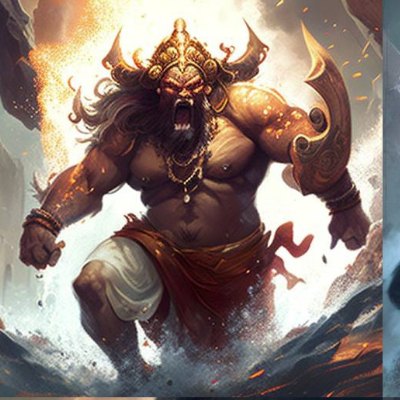
Shambara — Daitya Son of Hiranyaksha, Elder of the Baleyas
Shambara · Utkura · Shambara Daitya · Baleya
Shambara is a Daitya — a member of the race of demonic beings descended from the sage Kashyapa and his wife Diti — who appears in the Vayu Purana and the Brahmanda Purana as the first-named among the five valorous sons of Hiranyaksha, the mighty Daitya lord who conquered the three worlds and was slain by Vishnu in his Varaha avatara. Shambara and his brothers Kalanabha, Mahanabha, Surasantapana, and Sakuni are collectively designated the Baleyas in the Vayu Purana, a group name identifying them as a recognised clan unit within the Daitya warrior tradition. Along with his brothers, Shambara participated in the great cosmic conflict known as the Tarakamaya War — the fifth of the great Devasura Sangramas, or wars between the gods and the demons, triggered by the moon god Soma's abduction of Tara, the wife of the preceptor Brihaspati — in which the Daityas aligned themselves with Soma and Shukracharya against the gods. The Baleyas were ultimately defeated and slain in that war. Shambara is to be carefully distinguished from the celebrated Asura of the same name who appears in the Rigveda and multiple Puranas as a persistent enemy of Indra and who is later developed as the demon who abducts the infant Pradyumna — that Shambara belongs to an entirely separate genealogical line and narrative tradition.
✦ The Name
The name Shambara appears across the Hindu textual tradition as a name borne by more than one figure, and no single consistent etymology is applied to it in the primary sources. In some contexts it carries associations with a barrier or obstruction, while in others it is treated simply as a proper name without explicit etymological gloss. The alternate name Utkura, which some Puranic recensions give in place of Shambara for this particular son of Hiranyaksha, is a variant that appears in texts where the list of Hiranyaksha's sons differs slightly in nomenclature. Both names refer to the same figure within the Hiranyaksha genealogical tradition. The group designation Baleya, applied to Shambara and his four brothers collectively, identifies them as a recognised clan unit within the broader Daitya dynastic tradition.
✦ Distinction from the Vedic and Puranic Shambara
The most celebrated figure named Shambara in the Hindu tradition is an Asura who appears repeatedly in the Rigveda as an enemy defeated by Indra, and who is subsequently developed in the Puranas — particularly the Bhagavata Purana and the Devi Bhagavata Purana — as the demon who abducts the infant Pradyumna, son of Krishna, and is eventually slain by Pradyumna when that hero comes of age. This Shambara belongs to a completely different genealogical and narrative tradition. He is not a son of Hiranyaksha, has no connection to the Tarakamaya War narrative as it pertains to the Baleyas, and is separated from the present figure by both lineage and textual context. The two figures share only their name, and care must be taken in any genealogical or narrative analysis not to conflate them.
✦ Lineage
- Father: Hiranyaksha, a Daitya of supreme power, son of the sage Kashyapa and his wife Diti, daughter of the patriarch Daksha. Hiranyaksha conquered the three worlds, dragged the earth to the floor of the cosmic ocean, and was slain by Vishnu in the Varaha avatara. He is one of the most celebrated Daitya lords of the Puranic tradition.
- Paternal grandfather: Kashyapa, one of the great Prajapati sages and progenitor of both the Deva and Daitya races through his different wives.
- Paternal grandmother: Diti, daughter of the patriarch Daksha, whose children by Kashyapa constitute the Daitya race.
- Paternal uncle: Hiranyakashipu, brother of Hiranyaksha and likewise a son of Kashyapa and Diti, a supreme Daitya sovereign who was destroyed by Vishnu in the Narasimha avatara.
- Brothers: Kalanabha, a Daitya of great power and one of the five Baleyas; Mahanabha, likewise one of the five Baleyas; Surasantapana (also called Bhutasantapana in some recensions), one of the five Baleyas; and Sakuni, the last-named of the five Baleyas, who is noted as the father of the Daitya Vrikasura.
✦ The Baleyas
The five sons of Hiranyaksha — Shambara, Kalanabha, Mahanabha, Surasantapana, and Sakuni — are collectively designated the Baleyas in the Vayu Purana. This group designation identifies them as a recognised clan unit within the Daitya dynastic tradition, distinguished from other Daitya lineages by their descent from Hiranyaksha specifically. The Vayu Purana describes them as Daityas of great power, each of formidable martial ability, and notes that they were considered invincible even to the Devas during their prime. Their collective identity as the Baleyas places them within the broader framework of the Daitya warrior aristocracy whose successive generations repeatedly challenge divine authority across the Puranic cosmic cycles.
✦ The Tarakamaya War
The Tarakamaya War — so named because it arose from the abduction of Tara and is identified in the Puranic tradition as the fifth of the great Devasura Sangramas — is narrated in the Vayu Purana, the Brahmanda Purana, the Vishnu Purana, and the Bhagavata Purana. It must be carefully distinguished from the later Tarakasura War — the sixth Devasura Sangrama — which was caused by the tyranny of the demon Tarakasura and was resolved through the birth and intervention of Kartikeya. The two wars are entirely separate events in Puranic chronology, separated by a significant cosmic interval, and the similarity of their names has given rise to frequent conflation in later literature.
The immediate cause of the Tarakamaya War was the abduction of Tara — the wife of Brihaspati, the preceptor of the gods — by Soma, the moon god. Brihaspati demanded the return of his wife. Soma refused. The refusal drew in the broader divine and demonic orders: the gods, led by Brihaspati and supported by Indra and Shiva, aligned on the side of Brihaspati and demanded Tara's restoration, while the Asuras and Daityas, led by Shukracharya — the preceptor of the demonic races — aligned on the side of Soma. The conflict thus became a full-scale cosmic war between the two great opposing forces of the Puranic universe, with the immediate cause of a single abduction expanding into a confrontation that drew in every major power of the three worlds.
The Baleyas — Shambara and his four brothers — participated in this war as part of the Daitya coalition aligned under Shukracharya's leadership on the side of Soma. Their participation placed them within the demonic forces ranged against the gods in one of the most significant cosmic conflicts of the Puranic tradition. The Vayu Purana and Brahmanda Purana identify the sons of Hiranyaksha among the Daitya warriors who joined this coalition, contributing their considerable martial power — described as sufficient to challenge even the gods — to the demonic side of the conflict.
The war was prolonged and devastating to both sides. The Vishnu Purana and Bhagavata Purana record that the conflict shook the three worlds and caused immense destruction before it was finally resolved. The resolution came through the intervention of Brahma, the creator deity, who commanded Soma to return Tara to Brihaspati. Soma complied, and Tara was restored. The war's aftermath revealed that Tara was pregnant, and the child subsequently born — Budha, identified with the planet Mercury — was established as Soma's son, born of Tara during her captivity. The birth of Budha is considered the significant genealogical consequence of the Tarakamaya War in the Puranic tradition.
For the Baleyas, the war ended in defeat. With the Daitya coalition broken and the gods victorious, Shambara and his brothers were defeated and slain in the course of the conflict's conclusion. The Vayu Purana records their deaths as part of the general destruction of the demonic forces in the war's aftermath. With the deaths of all five brothers, the Baleya generation of the Hiranyaksha line was extinguished in active military terms, with the sole exception of the continuation of the lineage through Sakuni's son Vrikasura.
✦ Theological Significance
The collective story of the Baleyas exemplifies the recurring Puranic theological principle that Daitya power, however immense, is always finite and always subject to dissolution through divine intervention or the working out of cosmic justice. The Baleyas inherit their father Hiranyaksha's strength and his tradition of cosmic opposition, but unlike their father — who received a singular and mythologically elaborate death at the hands of a specific Vishnu avatara — they are swept away in the broader catastrophe of the Tarakamaya War, their end part of a collective defeat. Their alignment with Soma and Shukracharya in a war whose cause was itself morally ambiguous — the abduction of another's wife — further illustrates the Puranic characterisation of the Daityas as forces that consistently align with disruption of the established cosmic and moral order.
✦ Connection to the Wider Genealogy
Shambara stands as the first-named son of Hiranyaksha, placing him at the head of the second generation of the Hiranyaksha branch of the Daitya lineage. His father Hiranyaksha and his granduncle Hiranyakashipu represent the founding generation of the most celebrated Daitya dynasty in the Puranic tradition. Shambara and his brothers represent the continuation of this dynasty into the next generation, and through Sakuni's son Vrikasura the lineage extends into a third generation, though Vrikasura's textual presence is limited primarily to genealogical enumeration in the Vayu Purana and Brahmanda Purana.
✦ References
- Vayu Purana: The principal source for the identification of Shambara as a son of Hiranyaksha, his listing among the five Baleyas, and their participation and defeat in the Tarakamaya War.
- Brahmanda Purana: Corroborates the Vayu Purana's account of the sons of Hiranyaksha and the Baleya grouping; provides additional genealogical detail on the Daitya lineages involved in the Tarakamaya War.
- Vishnu Purana, Book IV: Narrates the Tarakamaya War including Soma's abduction of Tara, the alignment of the divine and demonic forces, and the war's resolution through Brahma's intervention; provides broader context for the conflict in which the Baleyas participated.
- Bhagavata Purana, Book IX: Contains narrative material on the Tarakamaya War and its genealogical consequence — the birth of Budha — providing additional context for the conflict and its aftermath.
- Bhagavata Purana, Book III: The principal source for the biography of Hiranyaksha, Shambara's father, providing the account of his conquest of the three worlds and his destruction by Vishnu in the Varaha avatara.
- Vettam Mani, Puranic Encyclopaedia (1975): Consulted for cross-referencing the identification of the sons of Hiranyaksha and the distinction between the two figures named Shambara in the tradition, and for clarification of the distinction between the Tarakamaya War and the Tarakasura War.
- Wisdomlib — Sons of Hiranyaksha: A modern reference resource consulted for genealogical cross-referencing of the Baleya listing across Puranic texts.