
About
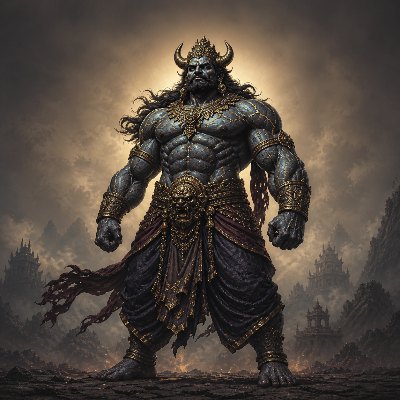
Vajranga — Daitya Son of Kashyapa and Diti, Father of Tarakasura
Vajranga · Vajrangi (masc. variant) · Thunderbolt-Limbed One
Vajranga is a Daitya — a member of the race of asuras born from the sage Kashyapa and his wife Diti — whose story is recorded principally in the Shiva Purana. He is remembered above all as the father of Tarakasura, the great asura whose conquest of the three worlds and subsequent defeat at the hands of Kartikeya, the war-god son of Shiva, forms one of the central narrative arcs of Shaiva Puranic literature. Vajranga's own life is marked by two defining phases: a period of martial supremacy in which he humbled Indra, the king of the gods, and a subsequent turn toward severe ascetic withdrawal. His story is inseparable from that of his mother Diti, whose grief and vengeful purpose gave Vajranga his reason for being, and from that of his wife Varangi, whose suffering during his penance became the catalyst for the birth of Tarakasura.
✦ The Name
The name Vajranga is a compound of two Sanskrit elements: vajra, meaning thunderbolt or diamond, and anga, meaning limb or body. The name therefore signifies one whose body is as hard and indestructible as the vajra, the divine weapon wielded by Indra. This meaning is not merely etymological but narrative: the name describes the nature of the boon granted at his birth, by which his body was made impervious to the weapons of the gods. A variant form, Vajrangi, appears in some recensions but refers to the same figure. The name of his wife, Varangi, is a near-echo of his own, and the similarity underlines her creation as a complement to him.
✦ Lineage
- Father: Kashyapa — one of the seven great primordial sages, a Prajapati and progenitor of gods, demons, humans, and all living beings; his unions with multiple wives gave rise to the principal races of existence.
- Mother: Diti — one of the daughters of Daksha and a principal wife of Kashyapa; she is the mother of the Daitya race and a figure defined throughout the Puranas by her grief at the repeated destruction of her sons by the gods, particularly Indra.
- Wife: Varangi — a woman created by Brahma, the four-faced creator god, specifically to be Vajranga's companion; she is described as beautiful and deeply devoted, and her suffering at Indra's hands during Vajranga's penance becomes the emotional pivot of the narrative.
- Son: Tarakasura — the great Daitya warlord whose austerities won him a boon of near-invincibility and who subsequently conquered the three worlds; he could be slain only by a son of Shiva, the great ascetic god, and his reign of terror over the gods ended only when Kartikeya — born of Shiva's seed — slew him in battle.
- Son: Surapadman — a son of Varangi and Vajranga, mentioned alongside Tarakasura in some Puranic accounts as a powerful Daitya.
- Son: Simhamukha — a third son of Varangi and Vajranga, named in the same accounts; the name means lion-faced.
✦ The Purpose of His Birth
The Shiva Purana places Vajranga's birth within the long-running enmity between Diti and Indra. Diti had suffered the loss of her sons — the earlier generations of Daityas — at the hands of the Devas, and her grief transformed into fierce resolve. She undertook prolonged and extreme penance, lasting, in the reckoning of the text, ten thousand years, with the single purpose of obtaining a son powerful enough to defeat Indra and avenge the destruction of her lineage. Her husband Kashyapa, bound by the logic of ascetic merit and the obligation to grant boons earned through genuine tapas, conceded to her wish. Vajranga was born of this purposeful penance, and his very body bore the mark of his origin: formed as hard and unyielding as the vajra itself, he was constitutionally designed to withstand whatever Indra could bring against him.
✦ The Capture of Indra
Acting on his mother's command, Vajranga moved against the heavens. He proved equal to the task Diti had conceived him for: he conquered the celestial realm, seized Indra, bound him, and brought him as a captive before Diti. The humiliation of the king of the gods — who in the Puranic imagination is the sovereign of the cosmos's ordered hierarchy — was complete. Yet the moment that might have ended in Indra's death was interrupted. Brahma, the creator, and Kashyapa, Vajranga's own father, intervened and appealed for Indra's release. Vajranga, demonstrating a disposition that distinguished him from many of his Daitya kin, listened and relented. Indra was freed.
The act of mercy carried its own irony: Indra's survival in captivity and his release through the intercession of others constituted, in the symbolic grammar of the text, a deeper dishonour than a clean military defeat might have been. Vajranga had shown that Indra's life was his to grant or withhold, and he had chosen to grant it — a demonstration of magnanimity that left the god of heaven alive but diminished.
✦ Renunciation and Penance
Following his victory, Vajranga underwent a transformation that the narrative presents as a genuine change of orientation rather than mere strategy. Disillusioned with the exercise of worldly and martial power, he turned toward asceticism. He undertook severe penance, performing it submerged in water — a particularly austere mode of tapas — with the aim of deepening his spiritual standing rather than extending his political dominion. This withdrawal was total: while he remained in his underwater austerities, the world above continued without him.
✦ Indra's Persecution of Varangi
Brahma, recognising that Vajranga required a companion suited to his nature, created Varangi and gave her to him as his wife. While Vajranga was immersed in his underwater penance, Indra — whose humiliation at Vajranga's hands had not been forgotten — directed his attention toward Varangi. Unable to confront Vajranga directly while he remained in tapas, Indra chose to torment the wife. He appeared before her in a succession of deceptive forms: as a mischievous monkey, as a sheep, and as a snake. Through these disguises he subjected her to harassment and distress, seeking to disturb the household of the man who had bound him and brought him before Diti.
When Vajranga emerged from his penance and returned to find his wife in sorrow, and learned what had been done to her in his absence, his response was not renewed warfare but a further intensification of ascetic effort, this time directed toward a specific end: the birth of a son who would make the gods suffer as his wife had suffered, and as his mother's sons had suffered before him.
✦ The Birth of Tarakasura
Vajranga's second round of penance, undertaken in grief and anger on behalf of Varangi, earned him the boon he sought. The son born of this purposeful asceticism was Tarakasura, who would become the most formidable Daitya antagonist of the Shaiva Puranic tradition. Tarakasura in turn performed his own extraordinary tapas, acquiring a boon that made him effectively invincible to all beings except a son of Shiva — a specification that seemed, at the time, a guarantee of immortality, since Shiva had withdrawn from the world into deep meditation following the death of his wife Sati, the daughter of Daksha. Tarakasura used his near-invincibility to seize the three worlds, driving the gods from their stations and reducing the celestial order to subjugation.
The resolution of Tarakasura's reign required an extraordinary sequence of cosmic events: the gods had to persuade Shiva to take a new wife, Parvati — the daughter of the mountain-king Himavat — and to produce a son. That son, Kartikeya, also known as Skanda and Murugan, was born of Shiva's seed and grew to become the commander of the divine army. It was Kartikeya who finally slew Tarakasura in battle. Vajranga thus stands at the generational root of this entire narrative chain: his penance produced the threat, and the threat necessitated the divine response.
✦ Theological and Narrative Significance
Vajranga occupies a distinctive position among Puranic asura figures by combining martial supremacy with genuine ascetic inclination. He is not presented as a figure of pure malevolence: he obeys his mother, spares Indra when elders intervene, and turns to penance rather than continuing to exploit his military advantage. His anger, when it comes, is ignited not by ambition but by injury done to his wife. This characterisation lends him a degree of moral complexity unusual for a figure whose primary genealogical function is to father the story's principal antagonist.
Within the Shaiva theological framework of the Shiva Purana, Vajranga's story serves the larger architecture of demonstrating why Shiva must enter the world as a husband and father. The chain that runs from Diti's grief through Vajranga's birth, through his penance, through Tarakasura's conquest and near-invincibility, arrives inevitably at the necessity of Shiva's union with Parvati and the birth of Kartikeya. Vajranga is thus a structural hinge between the older layer of Daitya-Deva conflict and the central Shaiva narrative of divine marriage and martial redemption.
✦ Connection to the Wider Genealogy
Vajranga belongs to the Daitya lineage that descends from the primordial sage Kashyapa and his wife Diti. Kashyapa is one of the seven Maharshis — the great sages held to be mind-born sons of Brahma — and his unions with multiple daughters of Daksha produced the races that populate the Puranic cosmos. From Diti came the Daityas; from another wife, Aditi, came the Adityas — the principal gods including Indra. The enmity between Daityas and Adityas is therefore a conflict between half-siblings sharing a father, and Vajranga's capture of Indra is, in genealogical terms, a conflict between the two great branches of Kashyapa's progeny. Vajranga's son Tarakasura extends the Daitya line into the generation that most directly challenges the Shaiva cosmic order, making Vajranga the penultimate link between the ancient Daitya genealogy and the Tarakasura narrative that drives the central drama of Shaiva Puranic mythology.
✦ References
- Shiva Purana, Rudra Samhita, Kumara Khanda: The primary source for the narrative of Vajranga; provides the accounts of Diti's penance, Vajranga's birth, his capture of Indra, his underwater tapas, Indra's harassment of Varangi, and the birth of Tarakasura.
- Shiva Purana, Rudra Samhita, Sati Khanda and Parvati Khanda: Provides the larger Shaiva narrative framework — Sati's death, Shiva's withdrawal, and the sequence of events that Tarakasura's rise sets in motion, establishing the context into which Vajranga's story feeds.
- Vettam Mani, Puranic Encyclopaedia (1975): A modern reference work drawing on multiple Puranic sources; provides a consolidated summary of Vajranga's story and its major episodes.