
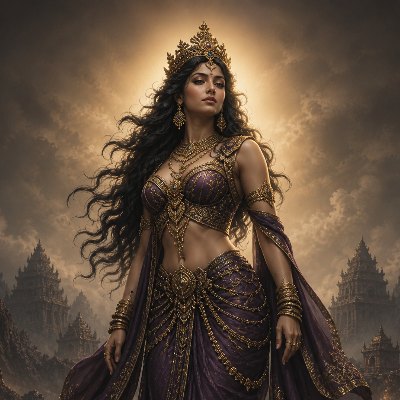
About
Varangi — Mind-Born Daughter of Brahma, Wife of Vajranga, Mother of Tarakasura
Varangi · Vajrangi
Varangi is a figure in the Daitya genealogy whose story is recorded principally in the Shiva Purana and referred to in the Matsya Purana and Skanda Purana. She is remembered as the wife of the Daitya Vajranga — himself the son of the primordial sage Kashyapa and his wife Diti — and as the mother of Tarakasura, the asura whose conquest of the three worlds became the central crisis of Shaiva Puranic mythology. Unlike most figures in the Daitya lineage, Varangi was not born through natural parentage but was created directly by Brahma, the four-faced creator god, as a companion for Vajranga. Her personal narrative is defined by patient endurance under deliberate persecution by Indra, the king of the gods, and by her role in setting in motion the events that led to the birth of Tarakasura.
✦ The Name
The name Varangi carries the sense of one who possesses an elegant or exquisite form, drawn from Sanskrit roots conveying excellence and bodily beauty. It reflects the manner of her creation: Brahma fashioned her with great beauty as a companion befitting Vajranga. The variant form Vajrangi, used in some recensions, echoes the name of her husband Vajranga — whose name means one with a body as hard as the thunderbolt — and underlines her creation as his counterpart. Where his name speaks to indestructible strength, hers speaks to grace and beauty, and the pairing of the two names within the same narrative household is deliberate.
✦ Lineage
- Creator: Brahma — the four-faced creator god, one of the principal deities of the Hindu Puranic tradition, held to be the progenitor of mind-born beings as well as the source of the created world; he fashioned Varangi specifically to serve as Vajranga's wife.
- Husband: Vajranga — a Daitya, son of the sage Kashyapa and Diti, born of Diti's prolonged penance to obtain a son capable of defeating Indra; he captured and bound Indra before releasing him at the intercession of Brahma and Kashyapa, then turned to severe ascetic penance.
- Son: Tarakasura — the great Daitya warlord who acquired a boon of near-invincibility through his own tapas and subsequently conquered the three worlds, subjugating the gods; he could be slain only by a son of Shiva, and his reign ended when Kartikeya — born of the god Shiva and his wife Parvati — slew him in battle.
- Son: Surapadman — a son of Varangi and Vajranga, mentioned alongside Tarakasura in some Puranic accounts as a powerful Daitya.
- Son: Simhamukha — a third son of Varangi and Vajranga, named in the same accounts; the name means lion-faced.
Note: The accounts naming Surapadman and Simhamukha as sons of Varangi are found in sources including the Skanda Purana and Padma Purana traditions. The Shiva Purana account focuses predominantly on Tarakasura. These variant enumerations of her sons reflect the differing emphases of different Puranic recensions rather than a direct contradiction.
✦ Creation and Purpose
Varangi's existence is entirely the result of Brahma's creative act. After Vajranga, having captured and then released Indra at the urging of Brahma and his own father Kashyapa, turned away from martial ambition and resolved to undertake deep ascetic penance, Brahma recognised that Vajranga required a wife. No natural birth is attributed to Varangi: she is a mind-born daughter of Brahma, brought into being for the specific purpose of companionship with Vajranga. The Shiva Purana and Matsya Purana both attest to this mode of her origin. She is endowed with great beauty — a quality consistent with her name — and with a disposition of devotion and steadiness that would prove significant during the period of Vajranga's withdrawal.
✦ Indra's Persecution
The episode that defines Varangi's narrative occurs during the period when Vajranga was engaged in his underwater penance, submerged in a lake in a state of intense ascetic withdrawal and therefore absent from his household. Indra — the king of the gods, who had been captured, bound, and brought before Diti by Vajranga and released only through Brahma's intervention — chose this period of Vajranga's absence to direct his attention toward Varangi.
Unable or unwilling to confront Vajranga directly while he remained in tapas, Indra appeared before Varangi in a series of disguised forms with the intention of tormenting and unsettling her. He came as a mischievous monkey that uprooted trees and caused destruction around her dwelling; as a sheep that devoured the grass of her hermitage; and as a snake that threatened to bite her. He dragged her far from her hermitage in the form of a terrible gust of wind. Each appearance was calculated to disturb her composure, breach her vows, or provoke a reaction that would compromise her own ascetic standing. Varangi endured each instance without breaking her resolve, without resorting to anger, and without acting in ways that would have violated her own conduct. Her patience through this sustained harassment is presented in the texts as a form of strength in itself.
'✦ The Birth of Tarakasura
When Vajranga returned from his penance and found Varangi's disfigured and tormented state, he learned of what Indra had done in his absence. The discovery transformed his grief and protectiveness into a fierce resolve. It was at Varangi's own request — that she be granted a son capable of defeating Indra and conquering the three worlds — that Vajranga undertook a further and more specific round of penance directed toward Brahma. The penance was successful, and the son born of this purposeful tapas was Tarakasura.
Some Puranic accounts specify that Tarakasura remained in Varangi's womb for a thousand years before his birth — a duration that marks the extraordinary nature of the being gestating within her. Tarakasura would go on to perform his own immense austerities, acquiring a boon that rendered him immune to all beings except a son of Shiva. Since Shiva at that time had withdrawn from the world into deep meditation, this boon appeared to constitute effective immortality. Tarakasura used it to seize dominion over the three worlds and drive the gods from their positions. The resolution of this crisis required the gods to arrange the union of Shiva with Parvati, the daughter of the mountain-king Himavat, and the subsequent birth of their son Kartikeya, who slew Tarakasura in battle. Varangi's suffering, and her request for a vengeful son, thus set in motion the entire sequence of events that the Shaiva Puranas present as the cosmic necessity behind Shiva's marriage and Kartikeya's birth.
✦ Theological and Narrative Significance
Varangi's function in the Shaiva Puranic narrative is both structural and thematic. Structurally, she is the generative link between Vajranga's personal disillusionment and Tarakasura's world-historical threat: it is her suffering that provides the emotional occasion, and her explicit request that provides the stated purpose, for the penance that produces Tarakasura. Without Varangi — and without Indra's decision to torment her — the chain of events leading to Kartikeya's birth and Tarakasura's defeat does not begin.
Thematically, Varangi represents a pattern found elsewhere in Puranic literature: the figure whose patient endurance of injustice becomes, precisely because it is unretaliating, a more powerful catalyst for cosmic consequence than any act of direct resistance could have been. She does not curse Indra, does not deploy supernatural power against him, and does not break her own vows in response to his provocations. Her restraint is total. Yet it is the sight of her sorrow — the visible mark of what she endured without complaint — that moves Vajranga to his decisive act of penance. In this sense her suffering, borne quietly, generates a consequence larger than any armed response might have done.
✦ Connection to the Wider Genealogy
Varangi enters the Daitya lineage through her marriage to Vajranga rather than through birth within it. Her husband Vajranga belongs to the line descending from Kashyapa — one of the seven great primordial sages, a Prajapati regarded as the progenitor of the principal races of the cosmos — and from Diti, one of the daughters of the progenitor Daksha and the mother of the Daitya race. Through her sons Tarakasura, Surapadman, and Simhamukha, Varangi extends this line into the generation that poses the most direct challenge to the Shaiva cosmic order in the mythology of the Shiva Purana and related texts. As a mind-born daughter of Brahma married into the Kashyapa-Diti lineage, she occupies an unusual genealogical position: she is of divine creative origin yet fully embedded, through marriage and motherhood, within the Daitya narrative.
✦ References
- Shiva Purana, Rudra Samhita, Kumara Khanda: Primary source for Varangi's creation by Brahma, the episode of Indra's harassment in his various disguised forms, Vajranga's response upon his return, and the penance that produced Tarakasura.
- Matsya Purana: Corroborates the account of Varangi as a mind-born daughter of Brahma created to be Vajranga's wife.
- Skanda Purana: Contains references to Varangi's endurance during Indra's torment and to her sons, including Tarakasura, Surapadman, and Simhamukha.
- Padma Purana: Cited in some traditional accounts for the enumeration of Varangi's three sons — Tarakasura, Surapadman, and Simhamukha — alongside the detail of Tarakasura's extended gestation.
- Vettam Mani, Puranic Encyclopaedia (1975): A modern reference work drawing on multiple Puranic sources; provides a consolidated account of Varangi's story and her place within the Daitya genealogy.
- Wisdomlib (wisdomlib.org), entries for Varangi and Vajranga: A modern reference resource compiling definitions and narrative summaries drawn from Puranic texts; consulted for cross-referencing the primary source details of Varangi's creation, attributes, and narrative role.