
About
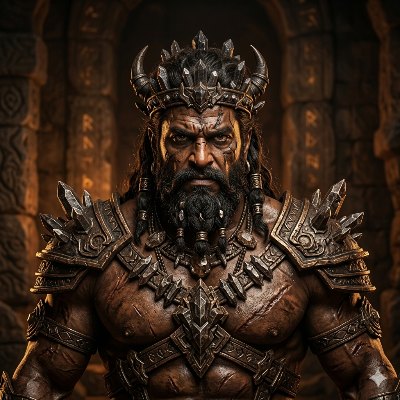
Tarakasura — Daitya Son of Vajranga and Varangi, Conqueror of the Three Worlds
Tarakasura · Taraka · Tarakaasura
Tarakasura is one of the most significant Daitya antagonists in Shaiva Puranic literature, whose story is told at length in the Shiva Purana and referenced across the Skanda Purana, Matsya Purana, Padma Purana, and Kumara Sambhava of Kalidasa. He is the son of the Daitya Vajranga — himself born of the sage Kashyapa and Diti through purposeful penance — and of Varangi, a mind-born daughter of Brahma created to be Vajranga's wife. Through his own extraordinary austerities Tarakasura obtained a boon of near-invincibility that allowed him to conquer the three worlds and subjugate the gods. The conditions of his boon made him immune to all beings except a son of Shiva, the great ascetic god, and since Shiva had withdrawn from the world following the death of his wife Sati, this condition appeared to guarantee permanent dominion. The crisis precipitated by Tarakasura's reign drives the central narrative of Shaiva mythology: the need to bring Shiva out of his ascetic withdrawal, arrange his union with Parvati — daughter of the mountain-king Himavat — and produce a son capable of slaying him. That son was Kartikeya, also known as Skanda and Murugan, who slew Tarakasura in battle and restored the cosmic order.
✦ The Name
The name Taraka derives from a Sanskrit root carrying the sense of one who causes others to cross over, or alternatively one who is a star — the latter association appearing in some secondary interpretations. In the context of his narrative, the name is most commonly understood in its sense of a crossing or passage, though the precise etymological emphasis varies across commentators. The suffix asura, appended to form Tarakasura, designates him as a being of the asura class — in later Puranic usage a category of powerful beings in opposition to the gods. He is referred to in sources simply as Taraka as well as by the fuller compound form.
✦ Lineage
- Father: Vajranga — a Daitya, son of the primordial sage Kashyapa and his wife Diti; born of Diti's ten-thousand-year penance to obtain a son capable of defeating Indra; he captured and bound Indra before releasing him at Brahma's intercession, then undertook severe underwater penance; upon returning to find his wife Varangi distressed by Indra's harassment, he performed further austerities to obtain Tarakasura as a son.
- Mother: Varangi — a mind-born daughter of Brahma, the four-faced creator god, fashioned specifically to be Vajranga's wife; she endured prolonged harassment by Indra during Vajranga's absence and her suffering and her explicit request for a son who could defeat Indra became the occasion for Tarakasura's birth.
- Paternal grandfather: Kashyapa — one of the seven great primordial sages, a Prajapati regarded as the progenitor of the principal races of the cosmos through his unions with the daughters of Daksha.
- Paternal grandmother: Diti — a daughter of the progenitor Daksha and one of the principal wives of Kashyapa; mother of the Daitya race and a figure defined by sustained grief at the destruction of her sons by the gods.
- Brothers: Surapadman and Simhamukha — powerful Daityas named in the Skanda Purana and Padma Purana traditions as sons of Vajranga and Varangi alongside Tarakasura; Simhamukha means lion-faced.
- Sons: Tarakaksha, Kamaksha, and Vidyunmali — named in the Shiva Purana as the three sons of Tarakasura; following their father's death at Kartikeya's hands, they performed their own austerities and obtained from Brahma the three flying cities of gold, silver, and iron respectively, collectively known as Tripura; their eventual destruction by Shiva in his form as Tripurantaka forms a separate major episode in Shaiva Puranic literature.
✦ Birth and Early Life
Tarakasura's birth was not incidental but purposefully sought. After Indra harassed Varangi during Vajranga's absence — appearing before her in disguised forms including a monkey, a sheep, and a snake — Vajranga returned to find his wife sorrowful. At Varangi's own request for a son who could avenge the insults done to her and defeat Indra, Vajranga undertook a further and targeted round of penance directed toward Brahma. The penance was efficacious, and Tarakasura was the boon granted in response to it.
Some Puranic accounts specify that Tarakasura remained within Varangi's womb for a thousand years before his birth — a duration marking the exceptional magnitude of the being gestating within her. He was thus the product of layered acts of purposeful penance: Diti's austerities had produced Vajranga, Vajranga's austerities had produced Tarakasura, and Tarakasura himself would go on to perform his own tapas. Each generation of penance in this lineage was more specifically directed than the last, converging toward the figure whose near-invincibility would compel the gods into their most elaborate and consequential act of cosmic management.
✦ The Penance and the Boon
Having come into the world with the purpose of his birth already inscribed in the circumstances of his parents' lives, Tarakasura undertook his own severe austerities. The Shiva Purana describes his tapas as of extraordinary intensity, performed over a prolonged period on the mountain Pariyatra. The ascetic effort was directed toward Brahma, and Brahma, bound by the principle that genuine austerity must be rewarded, appeared before him.
Tarakasura's request was carefully constructed: he asked that he be rendered immune to death at the hands of any being in existence, with a single specified exception — he could be slain only by a son of Shiva. The exception appeared, at the time of asking, to be no exception at all. Shiva, the great ascetic god, had withdrawn from the world following the death of his first wife Sati — a daughter of the progenitor Daksha — who had immolated herself after her father publicly dishonoured her husband. Shiva was immersed in deep, all-consuming meditation, utterly withdrawn from the world, and showed no inclination toward remarriage or the fathering of children. A son of Shiva was, in practical terms, an impossibility. Tarakasura's boon thus functioned, in his own assessment, as effective immortality.
✦ The Conquest of the Three Worlds
Armed with his boon, Tarakasura moved against the gods. The Shiva Purana describes his conquest as total and systematic. He drove Indra from his throne in the heavens, displaced the gods from their stations, and seized dominion over all three worlds — the heavens, the earth, and the underworld. The gods were subjugated, stripped of their functions, and reduced to a condition of helplessness. The cosmic order — the dharmic arrangement by which each class of being held its proper place and performed its proper role — was overturned.
The gods found themselves without recourse. No deity among them was capable of slaying Tarakasura under the terms of his boon. Their armies were unable to prevail against him. The natural hierarchy of the cosmos, in which the Devas held authority over the Daityas and Asuras, was inverted. Indra and the gods went in supplication first to Brahma, who directed them to Shiva, since only Shiva's son could end Tarakasura's reign. This set in motion the sequence of events that would ultimately resolve the crisis.
✦ The Divine Response: Shiva's Marriage and Kartikeya's Birth
The solution to Tarakasura's dominion required not a military campaign but a cosmic rearrangement. The gods, understanding that only a son of Shiva could slay him, needed to draw Shiva out of his meditation and into a new conjugal union. Parvati, the daughter of Himavat — the king of the mountains — and of Mena, undertook severe austerities of her own to win Shiva as her husband. The god of love, Kamadeva, was sent to disturb Shiva's meditation and awaken desire in him; Shiva, furious at the interruption, opened his third eye and reduced Kamadeva to ash. Parvati nonetheless persisted in her penance, and Shiva, moved by her devotion, ultimately accepted her as his wife.
From Shiva's union with Parvati, or in some accounts from Shiva's seed received by Agni, the fire god, and subsequently carried by the river Ganga to the Sharavana reed forest, was born Kartikeya — also called Skanda, Murugan, Shanmukha, and Subrahmanya. He was appointed commander of the divine armies and sent against Tarakasura. The battle that followed ended with Kartikeya slaying Tarakasura, thus fulfilling the terms of the boon exactly as stated: Tarakasura was indeed slain by a son of Shiva, the one being he had not thought to exclude from his protection.
✦ Textual Variants and Inconsistencies
The broad outline of Tarakasura's story — his birth through purposeful penance, his boon of near-invincibility, his conquest of the three worlds, and his death at Kartikeya's hands — is consistent across the major sources. However, specific details vary between texts.
The birth narrative of Kartikeya, Tarakasura's slayer, differs significantly across sources. The Shiva Purana emphasises his birth from the union of Shiva and Parvati. The Mahabharata and some other accounts describe Kartikeya as born from Shiva's seed deposited in fire and carried by the river Ganga, without direct emphasis on Parvati as birth-mother. The Skanda Purana, dedicated to Kartikeya, gives its own extended account. These variant birth narratives do not affect the identity of Tarakasura's slayer, but they reflect the different theological emphases of different textual traditions.
The enumeration of Tarakasura's brothers also varies. The Shiva Purana focuses on Tarakasura as the primary figure born of Vajranga and Varangi's purposeful penance. The Skanda Purana and Padma Purana name Surapadman and Simhamukha as his brothers, placing all three as sons of the same parents. This expanded sibling group does not contradict the Shiva Purana so much as supplement it, though the relative prominence given to each brother differs markedly across traditions — Surapadman, for instance, is a major figure in South Indian Shaiva traditions associated with the Skanda Purana, where he receives extensive independent treatment.
Kalidasa's Sanskrit mahakavya the Kumara Sambhava — a classical literary treatment of the birth of Kartikeya — covers the same narrative territory as the Puranic accounts but with a poet's selective focus. It does not contradict the Puranic accounts in matters of core genealogy but differs in emphasis, detail, and the relative weight given to different episodes.
✦ Theological Significance
Tarakasura's role in Shaiva Puranic theology is that of the necessary antagonist whose existence compels a chain of divine events that would not otherwise have occurred. His near-invincible reign creates the precise conditions under which Shiva must re-enter the world, take a wife, and father a son. In this sense, Tarakasura is not merely an obstacle to be removed but a structural necessity within the Shaiva theological narrative: without his threat, the marriage of Shiva and Parvati — one of the most theologically and devotionally significant events in the Shaiva tradition — has no urgency, and Kartikeya, the divine commander and war-god revered across South Asia, has no occasion for birth.
Some theological readings within the tradition also understand Tarakasura's name in its sense of one who enables crossing over, interpreting his story as a teaching on the relationship between apparent evil and ultimate divine purpose: the suffering his reign imposed on the gods and the world was the suffering that made the birth of Kartikeya both possible and necessary. This reading is devotional rather than strictly textual, but it reflects how the figure has been interpreted within living traditions of Shaiva and Kaumara worship.
✦ His Sons and the Tripura Episode
Tarakasura's story does not end entirely with his own death. His three sons — Tarakaksha, Kamaksha, and Vidyunmali — performed their own austerities following their father's fall and obtained from Brahma the boon of three great flying cities: one of gold, one of silver, and one of iron. These three cities, collectively called Tripura, became the fortresses of a new Daitya power. The gods were again unable to defeat the sons of Tarakasura through ordinary means, and it was Shiva himself — in his form as Tripurantaka, the destroyer of the triple city — who ultimately brought the three cities down with a single arrow. The Tripura episode thus extends Tarakasura's genealogical legacy into a second major narrative cycle, connecting his lineage directly to one of the most celebrated of Shiva's cosmic deeds.
✦ Connection to the Wider Genealogy
Tarakasura stands at the convergence of two genealogical lines. Through his father Vajranga and paternal grandmother Diti, he belongs to the Daitya lineage descending from the primordial sage Kashyapa — one of the seven Maharshis, a Prajapati and progenitor of multiple cosmic races. Through his mother Varangi, a mind-born daughter of Brahma, he carries a strand of direct divine creative origin into the Daitya bloodline. His own sons — Tarakaksha, Kamaksha, and Vidyunmali — extend the lineage into the Tripura narrative, ensuring that the genealogical consequences of Tarakasura's existence continue across two further generations of Puranic mythology. His death at Kartikeya's hands, and the birth of Kartikeya itself, place Tarakasura at the generational hinge between the older layer of Daitya-Deva conflict rooted in Diti's grief and the fully developed Shaiva theological cosmos centred on Shiva, Parvati, and their divine son.
✦ References
- Shiva Purana, Rudra Samhita, Kumara Khanda: The primary and most detailed source for Tarakasura's birth, his penance and boon, his conquest of the three worlds, the divine response, and his death at Kartikeya's hands; also names his three sons Tarakaksha, Kamaksha, and Vidyunmali.
- Shiva Purana, Rudra Samhita, Yuddha Khanda: Contains the account of the battle between Kartikeya and Tarakasura and the restoration of cosmic order following Tarakasura's defeat.
- Skanda Purana: Provides extended treatment of Kartikeya's birth and his campaign against Tarakasura; names Surapadman and Simhamukha as Tarakasura's brothers and gives them independent narrative treatment particularly within South Indian Shaiva traditions.
- Matsya Purana: Contains references to Tarakasura's lineage and the broader framework of the Daitya-Deva conflict in which his story is embedded.
- Padma Purana: Names the three sons of Vajranga and Varangi including Tarakasura and references the detail of his extended gestation.
- Mahabharata, Shalya Parva: Contains an account of Kartikeya's birth and his role as slayer of Tarakasura, with a variant account of Kartikeya's origin that differs in detail from the Shiva Purana version.
- Kalidasa, Kumara Sambhava: A classical Sanskrit mahakavya treating the events leading to Kartikeya's birth — including Tarakasura's dominion as the precipitating crisis — with a literary poet's selective emphasis rather than comprehensive Puranic scope.
- Vettam Mani, Puranic Encyclopaedia (1975): A modern reference work consolidating Puranic accounts of Tarakasura, his lineage, his boon, and his sons; useful for cross-referencing variant details across primary sources.
- Wisdomlib (wisdomlib.org), entries for Tarakasura, Vajranga, and Kartikeya: A modern reference resource compiling summaries drawn from Puranic texts; consulted for cross-referencing narrative details and textual attributions.