
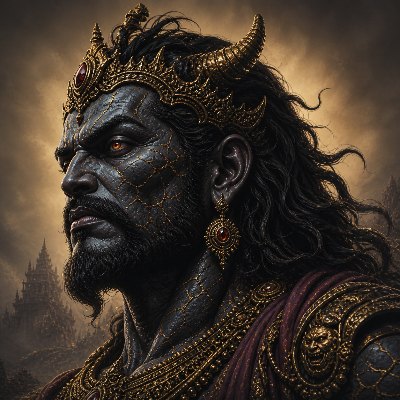
About
Surapadman — Daitya Son of Vajranga and Varangi, Slain by Kartikeya
Surapadman · Sourapadman · Surapadma
Surapadman is a powerful Daitya whose story is told at length in the Skanda Purana and forms a central narrative in the Tamil Shaiva devotional text the Kanda Puranam, also known as the Skanda Purana in its Tamil recension composed by Kachchiappa Sivachariar. He is the son of the Daitya Vajranga — himself born of the sage Kashyapa and Diti through purposeful penance — and of Varangi, a mind-born daughter of Brahma created to be Vajranga's wife. Surapadman is thus the brother of Tarakasura, the great Daitya conqueror of the three worlds, and of Simhamukha, the lion-faced Daitya. Like his brother Tarakasura, Surapadman obtained through severe austerities a boon of extraordinary power and used it to subjugate the gods and seize dominion over the cosmos. His story culminates in his defeat at the hands of Kartikeya — the war-god son of Shiva and Parvati — and in a dramatic transformation at the moment of his death. He is a figure of particular prominence in South Indian Shaiva and Kaumara traditions, where his defeat is understood as one of the signal acts of Kartikeya's divine mission.
✦ The Name
The name Surapadman is a Sanskrit compound of two elements: sura, meaning god or divine being, and padma, meaning lotus. The compound may be interpreted as one who is a lotus among the divine, or one of divine lotus-nature, though in the context of his narrative the name belongs to a Daitya rather than a god — a point that some commentators within the tradition take as reflecting the ambiguity inherent in the Daitya race, which shares its father Kashyapa with the gods themselves. The Tamil form of the name, used extensively in South Indian devotional and temple traditions, is rendered as Soorapadman or Sooran, and the festival of Skanda Shashthi — celebrated widely in Tamil Nadu and among Tamil communities globally — commemorates specifically Kartikeya's victory over Surapadman.
✦ Lineage
- Father: Vajranga — a Daitya, son of the primordial sage Kashyapa and his wife Diti; born of Diti's prolonged penance to obtain a son capable of defeating Indra; he captured and bound Indra before releasing him at the intercession of Brahma and his father Kashyapa, then turned to severe ascetic penance; upon learning of Indra's harassment of his wife Varangi during his absence, he performed further austerities to obtain powerful sons.
- Mother: Varangi — a mind-born daughter of Brahma, the four-faced creator god, fashioned to be Vajranga's wife; she endured prolonged harassment by Indra during Vajranga's penance, and her suffering and her request for sons who could avenge those insults became the occasion for the births of Surapadman and his brothers.
- Paternal grandfather: Kashyapa — one of the seven great primordial sages, a Prajapati regarded as the progenitor of multiple races of the cosmos through his unions with the daughters of Daksha; father of both the Daitya race through Diti and the Adityas — the principal gods including Indra — through another wife, Aditi.
- Paternal grandmother: Diti — a daughter of the progenitor Daksha and one of the principal wives of Kashyapa; mother of the Daitya race, defined throughout the Puranas by her sustained grief at the destruction of her sons by the gods.
- Brother: Tarakasura — the eldest and most prominent of the three brothers in the Sanskrit Puranic tradition; a great Daitya warlord who obtained a boon of near-invincibility and conquered the three worlds; he could be slain only by a son of Shiva, and his reign ended when Kartikeya slew him in battle.
- Brother: Simhamukha — the third brother, whose name means lion-faced; a Daitya figure named alongside Surapadman and Tarakasura in accounts of Vajranga and Varangi's sons; also defeated by Kartikeya.
- Son: Banugopan — named in the Kanda Puranam as a son of Surapadman.
- Son: Agnimukhan — named in the Kanda Puranam as another son of Surapadman.
✦ Birth and the Context of His Origin
Surapadman's birth, like that of his brothers, was the product of purposeful penance rather than natural circumstance. His mother Varangi had endured Indra's harassment — delivered in the disguised forms of a monkey, a sheep, and a snake — during the long period of his father Vajranga's underwater austerities. When Vajranga returned and learned of what had been done to her, and when Varangi made her request for sons who could defeat Indra and avenge the sufferings visited upon the Daitya lineage across generations, Vajranga undertook further tapas directed toward Brahma. The sons born of this penance — Tarakasura, Surapadman, and Simhamukha — each carried within their origin the accumulated grievances of the Daitya line stretching back to Diti's first losses.
The Kanda Puranam, the Tamil Shaiva text that provides the most extensive account of Surapadman, presents him as receiving from birth an extraordinary constitution and capacity for power, consistent with the nature of the boon that produced him. His subsequent austerities would transform this innate capacity into active dominion over the cosmos.
✦ Penance and the Boon
Following the pattern established across the Daitya lineage — in which each generation intensifies its ascetic effort beyond the last — Surapadman undertook prolonged and severe tapas of his own. The Kanda Puranam describes his austerities as extreme: he subjected himself to intense physical ordeals over an extended period, standing on a single leg, enduring heat, cold, and privation, until Brahma appeared before him to grant a boon.
Surapadman asked for sovereignty over all three worlds and near-invincibility against his enemies, along with a lifespan measured in vast cosmic units of time. Brahma granted the boon with the qualification that Surapadman could ultimately be slain — an unavoidable limitation of any boon granted within the Puranic framework — but the terms of his invincibility made him proof against virtually all opposition. Armed with this boon, Surapadman set about establishing his dominion.
✦ The Conquest of the Three Worlds
The Kanda Puranam provides a detailed account of Surapadman's campaign of conquest. He built a great capital city, Mahendra city or Veera Mahendra Puri, described as a magnificent fortress, and from this base extended his power across the heavens, the earth, and the underworld. The gods were defeated, stripped of their functions, and subjugated. Indra and the other Devas were reduced to servitude, forced to perform menial tasks at Surapadman's court. The sun was made to provide heat and light only at Surapadman's command; rain fell at his pleasure; the cosmic functions that the gods had held were placed under his authority.
The condition of the gods under Surapadman's dominion is presented in the Kanda Puranam with considerable narrative detail. Indra himself, the king of the gods who had once humiliated the Daitya lineage by killing Diti's sons and harassing Varangi, was now a prisoner and servant. The cosmic inversion was total. The gods, unable to resist Surapadman by force, were driven to seek divine intervention — intervention that could come only from a son of Shiva, since it was through the birth of such a son that the crisis instigated by Surapadman's brother Tarakasura had earlier been resolved, and the traditions that name Surapadman as a continuing or parallel threat require the same ultimate answer.
✦ The War with Kartikeya
Kartikeya — born of Shiva and Parvati, also known as Skanda, Murugan, Shanmukha, and Subrahmanya — was appointed commander of the divine armies and sent to confront Surapadman. The Kanda Puranam describes the war between Kartikeya's forces and Surapadman's armies at great length, with many individual combats, the deaths of Surapadman's generals and sons, and a series of escalating confrontations before the final meeting between Kartikeya and Surapadman himself.
Among the episodes narrated in the battle sequence is the death of Surapadman's sons, including Banugopan and Agnimukhan, whose falls in battle cause Surapadman profound grief. This grief — of a father for fallen sons — mirrors structurally the grief of Diti for her own destroyed sons that had set the entire chain of Daitya penance and conflict in motion generations earlier. The text thus draws a parallel between the founding sorrow of the lineage and the sorrow that marks its end.
In the final combat, Kartikeya confronted Surapadman directly. Surapadman, drawing on his boon and his own immense power, transformed himself into a vast mango tree in a final act of resistance. Kartikeya split the mango tree with his vel — his divine spear, the weapon given to him by his mother Parvati — cleaving it into two halves. From those two halves, at the moment of destruction, arose a peacock and a rooster: the peacock became Kartikeya's vehicle, which he rides in his iconography across all traditions, and the rooster became the emblem on his battle standard. The transformation of Surapadman at the moment of his defeat — from enemy into the very vehicle and symbol of his conqueror — is one of the most theologically significant moments in the Kanda Puranam and in South Indian Kaumara tradition.
✦ Textual Variants and Inconsistencies
Surapadman's prominence varies significantly between textual traditions. In the Sanskrit Shiva Purana, the primary narrative focus among Vajranga and Varangi's sons falls on Tarakasura; Surapadman and Simhamukha are named but do not receive independent extended treatment in that text. It is the Skanda Purana and, above all, the Tamil Kanda Puranam that elevate Surapadman to the status of primary antagonist in the drama of Kartikeya's martial mission. The Kanda Puranam, composed in Tamil by Kachchiappa Sivachariar at the Kumarakottam temple in Kanchipuram, is the definitive source for the detailed account of Surapadman's life, dominion, war with Kartikeya, and transformation at death. It is not a direct translation of any Sanskrit Purana but an independent Tamil composition drawing on the Skanda Purana tradition and South Indian Shaiva theological frameworks.
The relationship between Tarakasura's story and Surapadman's story also differs across traditions. Some Sanskrit Puranic accounts present Tarakasura as the primary Daitya threat whose defeat by Kartikeya is the central event, with Surapadman as a secondary figure. South Indian traditions, particularly as expressed in the Kanda Puranam and in the Skanda Shashthi observance, treat Surapadman as the principal antagonist and the primary occasion for Kartikeya's martial advent. These two emphases are not strictly contradictory — both brothers are sons of Vajranga and Varangi, both are defeated by Kartikeya — but they reflect the different priorities of the Sanskrit Puranic tradition on the one hand and the Tamil Shaiva tradition on the other.
✦ Theological Significance
Surapadman's transformation at the moment of his defeat carries significant theological weight within South Indian Kaumara tradition. His conversion from enemy to vehicle — from the being who oppressed the gods to the peacock that carries their commander — is interpreted within the tradition as an act of grace rather than mere destruction. Kartikeya's vel does not simply annihilate Surapadman; it transforms him. The Daitya who had inverted the cosmic order becomes, through the touch of divine power, the instrument by which that order is now upheld and celebrated. In this reading, Surapadman's story is ultimately one of redemption through defeat, a pattern consistent with broader Shaiva theological understandings of divine grace operating even through apparently destructive acts.
The festival of Skanda Shashthi, observed over six days in the Tamil month of Aippasi, commemorates the war between Kartikeya and Surapadman. The sixth day, Soorasamharam — the destruction of Sooran — is the culminating celebration, reenacting the final battle and Surapadman's defeat. This festival is among the most widely observed of all Kaumara festivals and represents the living continuation of Surapadman's narrative significance in active religious practice.
✦ Connection to the Wider Genealogy
Surapadman belongs to the Daitya lineage descending from the primordial sage Kashyapa and his wife Diti, through their son Vajranga and his wife Varangi. Through Kashyapa, the Daitya race and the gods share a common father, making the conflict between Surapadman and the Devas a war between half-cousins in the widest genealogical sense: Kashyapa's sons by Aditi are the Adityas — the gods including Indra — while his sons by Diti are the Daityas. Surapadman's defeat and transformation at Kartikeya's hands closes the genealogical arc that began with Diti's grief and extended through Vajranga's birth, his capture of Indra, Varangi's suffering, and the births of three sons whose combined power constituted the most sustained Daitya challenge to the divine order in the Shaiva Puranic tradition. His sons Banugopan and Agnimukhan do not appear to have generated further genealogical lineages of significance in the texts; their deaths in battle precede their father's own defeat, ending that branch of the line within the same narrative.
✦ References
- Kanda Puranam (Tamil Skanda Purana), Kachchiappa Sivachariar: The primary and most detailed source for Surapadman's biography; provides the full account of his birth, penance, boon, conquest of the three worlds, war with Kartikeya, and transformation into the peacock and rooster at the moment of his defeat.
- Skanda Purana (Sanskrit): Names Surapadman alongside Tarakasura and Simhamukha as sons of Vajranga and Varangi; provides the broader framework of the three brothers within the Daitya lineage and their collective role in the narrative of Kartikeya's martial mission.
- Shiva Purana, Rudra Samhita, Kumara Khanda: Names Surapadman and Simhamukha as brothers of Tarakasura and sons of Vajranga and Varangi; the primary focus of this text falls on Tarakasura rather than Surapadman, but it provides the foundational genealogical framework shared by all three brothers.
- Padma Purana: Contains references to the three sons of Vajranga and Varangi including Surapadman within the broader context of the Daitya lineage.
- Vettam Mani, Puranic Encyclopaedia (1975): A modern reference work consolidating Puranic accounts; provides a summary of Surapadman's story and his place within the Daitya genealogy as recorded across Sanskrit and Tamil sources.
- Wisdomlib (wisdomlib.org), entries for Surapadman, Vajranga, and Varangi: A modern reference resource compiling summaries drawn from Puranic texts; consulted for cross-referencing narrative details and textual attributions relating to Surapadman and his lineage.