
About
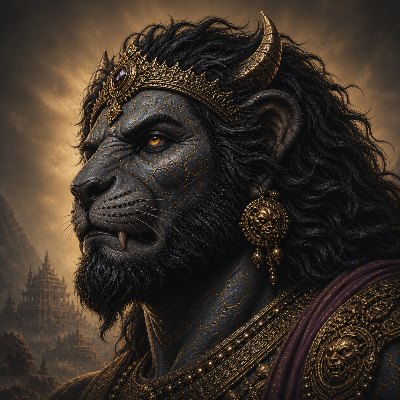
Simhamukha — Daitya Son of Vajranga and Varangi, Lion-Faced Brother of Tarakasura and Surapadman
Simhamukha · Sinhamukha · Simhamukhasura
Simhamukha is a Daitya named in the Skanda Purana and the Tamil Kanda Puranam as the third son of Vajranga and Varangi, and the youngest brother of Tarakasura and Surapadman. He belongs to the Daitya lineage descending from the primordial sage Kashyapa and his wife Diti through their son Vajranga, and his mother Varangi was a mind-born daughter of Brahma, the four-faced creator god. Simhamukha is a figure of distinctly limited textual elaboration in the Sanskrit Puranic tradition, where he is named principally as a member of the group of three brothers born of Vajranga and Varangi's purposeful penance, rather than as a figure with an independently developed narrative. His most substantial treatment occurs in the South Indian Tamil Shaiva tradition, where the Kanda Puranam gives him a defined role in the war between the Daitya forces and Kartikeya — the war-god son of Shiva and Parvati — and records his defeat in that conflict. His name, meaning lion-faced, identifies him as a being of hybrid or monstrous form, a characteristic shared by several figures in the Daitya and Rakshasa traditions of the Puranas.
✦ The Name
The name Simhamukha is a Sanskrit compound of simha, meaning lion, and mukha, meaning face or mouth. It designates a being whose face is that of a lion — a form of hybrid identity well attested across Hindu iconographic and narrative traditions, where lion-faced beings appear in contexts ranging from the divine, as in the form of Narasimha, the man-lion avatar of Vishnu, to the demonic. Among Daitya and Rakshasa figures, leonine features typically signify ferocity, martial power, and a nature that stands outside the norms governing human or divine form. The name Sinhamukha is a phonetic variant found in some regional and vernacular traditions and refers to the same figure. The suffix asura, forming Simhamukhasura, is used in some contexts to underline his identity as a being of the asura class.
✦ Lineage
- Father: Vajranga — a Daitya, son of the primordial sage Kashyapa and his wife Diti; born of Diti's prolonged penance to obtain a son capable of defeating Indra, the king of the gods; he captured and bound Indra before releasing him at the intercession of Brahma and Kashyapa, then turned to severe ascetic penance; upon learning of Indra's harassment of his wife Varangi during his absence, he performed further austerities to obtain powerful sons, of whom Simhamukha was one.
- Mother: Varangi — a mind-born daughter of Brahma, fashioned specifically to be Vajranga's wife; she endured prolonged harassment by Indra during Vajranga's penance — Indra appearing before her in the disguised forms of a monkey, a sheep, and a snake — and her suffering and her request for sons who could avenge those insults became the direct occasion for the births of Tarakasura, Surapadman, and Simhamukha.
- Paternal grandfather: Kashyapa — one of the seven great primordial sages, a Prajapati regarded as the progenitor of multiple races of the cosmos; through his wife Diti he fathered the Daitya race, and through another wife Aditi he fathered the Adityas, the principal gods including Indra, making the Daitya-Deva conflict a war between the two great branches of his progeny.
- Paternal grandmother: Diti — a daughter of the progenitor Daksha and one of the principal wives of Kashyapa; mother of the Daitya race, defined throughout the Puranas by her grief at the repeated destruction of her sons by the gods.
- Brother: Tarakasura — the eldest and most prominent of the three brothers in the Sanskrit Puranic tradition; a great Daitya warlord who through his own austerities obtained a boon of near-invincibility and conquered the three worlds, subjugating the gods; he could be slain only by a son of Shiva, and his reign ended when Kartikeya — born of Shiva and Parvati — slew him in battle.
- Brother: Surapadman — the second brother, prominent particularly in South Indian Shaiva and Kaumara traditions; through his own austerities he established dominion over the three worlds and subjugated the gods; he was defeated by Kartikeya and transformed at the moment of his death into the peacock that became Kartikeya's vehicle and the rooster that became his battle standard emblem.
✦ Birth and the Context of His Origin
Simhamukha's birth shares its occasion and purpose with that of his brothers. His father Vajranga undertook targeted penance directed toward Brahma after discovering that Indra had tormented Varangi during the period of his underwater ascetic withdrawal. Varangi's request — that she be granted sons capable of defeating Indra and avenging the accumulated grievances of the Daitya lineage — was the stated purpose of the penance. The three sons produced by that penance, of whom Simhamukha was one, each carried this origin within them.
Beyond the fact of his birth within this group and his designation as lion-faced, the Sanskrit Puranic texts do not elaborate on Simhamukha's individual character, austerities, or dominion in the manner they do for Tarakasura, nor in the manner the Tamil Kanda Puranam does for Surapadman. His presence in the Sanskrit sources is that of a named member of a significant sibling group rather than an independently developed protagonist.
✦ Role in the War with Kartikeya
The Kanda Puranam, the Tamil Shaiva text composed by Kachchiappa Sivachariar that provides the most detailed South Indian account of the war between the Daitya forces and Kartikeya, gives Simhamukha a role within the broader conflict. He is presented as a commander or significant warrior within the Daitya army during the war that also involves his brothers Tarakasura and Surapadman. He is defeated in the course of that conflict, as are his brothers, by Kartikeya and the divine forces under his command.
The Kanda Puranam does not provide Simhamukha with the same degree of independent narrative elaboration it accords Surapadman, whose extended dominion, war with Kartikeya, and final transformation into the peacock and rooster form a major and theologically developed arc. Simhamukha's defeat is recorded within the framework of the larger conflict rather than as a narrative centrepiece in its own right. His lion-faced form, however, places him within a visually and symbolically distinct register among the Daitya forces, and his name ensures his identification as a figure of specifically martial and ferocious character within the tradition.
✦ Textual Variants and the Limits of the Record
The textual record for Simhamukha is sparse in comparison with those of his brothers. The Shiva Purana names the three sons of Vajranga and Varangi but directs its primary narrative attention toward Tarakasura. The Skanda Purana names all three brothers and situates them within the Daitya lineage. The Padma Purana similarly names the group. The Kanda Puranam provides the most developed narrative context in which Simhamukha appears as a combatant. Beyond these references, no major Sanskrit Puranic text provides Simhamukha with an independent biography, an account of personal austerities, or a description of individual dominion comparable to those accorded his brothers.
There are no significant contradictions between sources regarding Simhamukha's identity or parentage — all texts that name him agree that he is a son of Vajranga and Varangi and a brother of Tarakasura and Surapadman. The variation between sources is one of degree of elaboration rather than factual disagreement. This profile reflects the actual state of the textual record and does not supplement the limited evidence with conjecture.
✦ Connection to the Wider Genealogy
Simhamukha belongs to the Daitya lineage descending from the primordial sage Kashyapa through his wife Diti and their son Vajranga. Through Kashyapa, the Daityas and the principal gods share a common father: Kashyapa's sons by Aditi are the Adityas, the gods who include Indra, while his sons by Diti are the Daityas. The conflict in which Simhamukha participates — the Daitya subjugation of the gods and the divine response through Kartikeya — is therefore, in the widest genealogical sense, a war between the two great branches of Kashyapa's immense progeny. Simhamukha's defeat by Kartikeya, alongside his brothers, closes the genealogical arc of Vajranga and Varangi's line. No further descendants of Simhamukha are recorded in the primary sources consulted, and his branch of the Daitya lineage does not appear to extend beyond him in the textual tradition.
✦ References
- Skanda Purana (Sanskrit): Names Simhamukha alongside Tarakasura and Surapadman as sons of Vajranga and Varangi; provides the primary Sanskrit Puranic attestation of his existence and his place within the three-brother group.
- Shiva Purana, Rudra Samhita, Kumara Khanda: Names the three sons of Vajranga and Varangi, including Simhamukha, within the genealogical framework of the Daitya lineage; the narrative focus of this text falls primarily on Tarakasura.
- Padma Purana: Names the three sons of Vajranga and Varangi, including Simhamukha, within the broader context of the Daitya lineage and the events surrounding the birth of Tarakasura.
- Kanda Puranam (Tamil Skanda Purana), Kachchiappa Sivachariar: The source providing the most narrative context for Simhamukha as a combatant in the war between the Daitya forces and Kartikeya; records his defeat in that conflict alongside his brothers.
- Vettam Mani, Puranic Encyclopaedia (1975): A modern reference work consolidating Puranic accounts; consulted for cross-referencing the identification and placement of Simhamukha within the Daitya genealogy as recorded across Sanskrit sources.
- Wisdomlib (wisdomlib.org), entries for Simhamukha, Vajranga, and Varangi: A modern reference resource compiling summaries drawn from Puranic texts; consulted for cross-referencing the textual attestations of Simhamukha's name and parentage.