
About
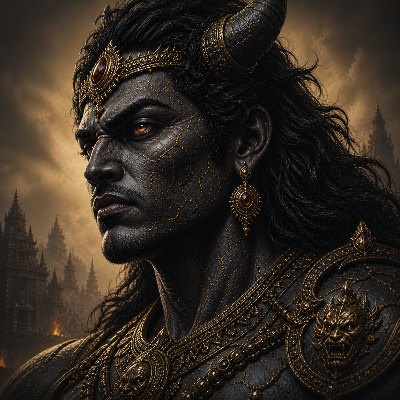
Tarakaksha — Eldest Son of Tarakasura, Lord of the Golden City
Tarakaksha · Tarkaksha · Tripurasura (collective name shared with brothers)
Tarakaksha is the eldest of the three asura brothers collectively known as the Tripurasuras, and the son of the mighty demon Tarakasura — himself the son of the asura Vajranga and his wife Vajrangi — who was slain by Kartikeya, the war-god born of Shiva and Parvati. Along with his brothers Kamalaksha and Vidyunmali, Tarakaksha occupies the central role in one of the most celebrated episodes of Shaiva mythology: the construction and subsequent destruction of the three flying cities known as Tripura. His narrative is preserved most fully in the Shiva Purana (Rudra Samhita, Yuddha Khanda, chapters 1–10), the Linga Purana, the Matsya Purana (chapter 188), and the Padma Purana, with earlier allusions in the Taittiriya Samhita of the Krishna Yajurveda and the Mahabharata. The regional tradition of the Bhimashankar Jyotirlinga in Maharashtra preserves additional details concerning the aftermath of the brothers' destruction.
✦ The Name
The name Tarakaksha is a Sanskrit compound meaning "one whose eyes are like stars" or "the star-eyed one," formed from tara (star) and aksha (eye). It connects him etymologically to his father Tarakasura, whose name derives from the same root tara, meaning star. The collective name Tripurasura, shared by all three brothers, means "the demon of the triple city," from tri (three) and pura (city or fortified settlement), denoting their identity as rulers of the legendary Tripura.
✦ Lineage
- Paternal grandfather: Vajranga, an asura of great power whose name means "one with limbs hard as the thunderbolt"; born to the sage Kashyapa by his wife Diti, who desired a son capable of challenging the gods.
- Paternal grandmother: Vajrangi, wife of Vajranga, created by Brahma to be Vajranga's devoted companion.
- Father: Tarakasura, the formidable asura king who obtained great boons and oppressed the gods until his death at the hands of Kartikeya, the son of Shiva and Parvati.
- Brothers: Kamalaksha, the second brother, lord of the silver city; and Vidyunmali, the youngest, lord of the iron city. Together the three constitute the Tripurasuras.
- Spouse: The Bhimashankar sthalapurana (the local sacred tradition of the Bhimashankar Jyotirlinga temple in the Sahyadri hills of Maharashtra) names Dakini and Shakini as the devoted wives of the Tripurasura brothers collectively. This regional tradition does not consistently assign one wife to each individual brother. No Mahapurana names a specific wife for Tarakaksha by name.
✦ The Penance and the Boon of Three Cities
After the death of their father Tarakasura at the hands of Kartikeya, the three brothers withdrew to Mount Meru — or, in the Shiva Purana's account, to a cave of Mount Sumeru — and undertook an extraordinary course of austerities. For a hundred years they meditated standing on one leg alone; for a further thousand years they subsisted on air alone while continuing their meditation; and for yet another thousand years they stood upon their heads in meditation. This graduated and increasingly severe tapasya pleased Brahma, who appeared before them accompanied by sages, gods, and other beings, and asked them to name their desired boon. The brothers first requested immortality, but Brahma declined, stating that the condition of death for all born beings lay beyond his power to abrogate. They then asked for three magnificent cities — each described as a flying fortress capable of movement through the worlds — which would align once every thousand years into a single combined city called Tripura, and which could be destroyed only by a single arrow shot at the precise moment of alignment. Tarakaksha requested a golden city situated in heaven. Brahma granted the peculiar boon and commanded the Danava architect Maya to construct the three cities: the golden city for Tarakaksha in the heavenly realm, a silver city for Kamalaksha in the intermediate sky, and an iron city for Vidyunmali on the earth.
✦ Rule of the Three Cities and the Period of Virtue
The three brothers populated their cities and flourished greatly, eventually extending their dominion across the three worlds and displacing the gods from their positions of authority. Despite their power, the Shiva Purana records that during their early period of rule the brothers and the inhabitants of their cities remained devoted worshippers of Shiva and upholders of dharma. The text emphasises that it was precisely this virtue that rendered them invincible: so long as they remained righteous and devout, no force could overcome them. When the gods appealed to Shiva to destroy the brothers, Shiva himself initially declined on the grounds that they were still his devotees and were conducting themselves rightly. The gods then approached Vishnu, who devised a plan to undermine the brothers' virtue.
✦ The Deception and the Fall from Virtue
Vishnu fashioned an illusory ascetic figure — called Arihat in some recensions — who had shaved his head, wore soiled garments, and preached a philosophy opposed to the Vedas and to the worship of Shiva. Narada was instrumental in bringing this false teacher to the attention of Vidyunmali first; once Vidyunmali accepted the new teaching, Tarakaksha and Kamalaksha followed in turn. The inhabitants of all three cities abandoned Vedic observance and ceased to worship the Shiva linga. Now that the brothers had become unrighteous, the gods returned to Shiva and successfully besought him to destroy Tripura. Tarakaksha, along with his brothers and their entire asura populations, perished when Shiva loosed a single blazing arrow — fashioned from Vishnu and Agni — at the precise moment the three cities merged into alignment, reducing all three fortresses to ash. The Shiva Purana notes that only Maya, the architect who had built the cities, survived by the grace of Shiva.
✦ Textual Variants and Inconsistencies
The order of birth and the assignments of the cities vary between texts. The Shiva Purana and the Wikipedia-summarised Tripurasura tradition assign the golden city to Tarakaksha, the silver to Kamalaksha, and the iron to Vidyunmali. The Linga Purana gives the same assignment. However, the Jatland Wiki summary of a Puranic recension names the third brother not as Kamalaksha but as Viryavana, assigning the silver city to Viryavana and the iron city to Vidyunmali, and makes no mention of Kamalaksha at all. A Nepalese account in the Swasthani Brata Katha names the three asuras as Maya, Tarakaksha, and Bidyutaprabha, a variant set entirely. The Bhimashankar sthalapurana presents a somewhat localised version of the Tripura narrative in which a single demon called Tripurasura (not the trio of brothers) does penance in the Bhimashankar forest and is granted immortality by Shiva himself on a conditional basis, before violating the condition and being destroyed. These local variants differ significantly from the Mahapuranic account in structure though they share the core theme of destruction by Shiva.
✦ Connection to the Wider Genealogy
Tarakaksha belongs to the Daitya lineage descending from the sage Kashyapa and his wife Diti, whose sons were known as Daityas and whose descendants included many of the most powerful asuras of Puranic myth. His grandfather Vajranga was of this lineage, and his father Tarakasura was one of its most formidable representatives. The destruction of Tarakasura by Kartikeya — the son born of Shiva and Parvati specifically to fulfil this purpose — forms the direct cause of Tarakaksha's own story, as the three brothers undertake their penance explicitly in response to their father's death. The episode of the destruction of Tripura by Shiva is one of the foundational narratives of Shaivism, establishing Shiva's supreme power even over beings protected by Brahma's own boon.
✦ References
- Primary Sources
- Taittiriya Samhita (Krishna Yajurveda): Contains the earliest allusion to three asura citadels of iron, silver, and gold — the proto-mythic basis of the Tripura legend.
- Shiva Purana, Rudra Samhita, Yuddha Khanda, chapters 1–10: The most detailed Mahapuranic account of the three brothers, their penance, the building of the cities, the deception by Vishnu's illusory preacher, and the final destruction by Shiva.
- Linga Purana: Contains an account of the Tripura episode with substantially the same narrative; confirms the assignment of the golden city to Tarakaksha.
- Matsya Purana, chapter 188: Referenced in the Shiva Purana's own footnotes as a parallel source for the burning of Tripura.
- Padma Purana: Contains a version of the narrative; the Tripurantaka Wikipedia article notes its account names Kamalaksha alternatively as Virayavana.
- Mahabharata: Contains earlier, less detailed allusions to the Tripura episode and Shiva's role as destroyer of the three cities.
- Swasthani Brata Katha (Nepal): A Nepalese sacred text with a variant account naming the asuras as Maya, Tarakaksha, and Bidyutaprabha.
- Bhimashankar Sthalapurana / Bhimashankar temple tradition (Maharashtra): The local sacred tradition of the Bhimashankar Jyotirlinga temple; preserves details about the wives of the Tripurasuras (Dakini and Shakini) and their fate after the destruction of the cities; provides the origin of the toponym "Dakinyam Bhimashankaram."
- Secondary Sources
- Wikipedia, "Tripurasura": Summary of Mahapuranic accounts with textual comparisons; notes the Taittiriya Samhita precedent and Nepalese variant.
- Wikipedia, "Tripurantaka": Summarises the Padma Purana and iconographic tradition.
- Wisdomlib.org, Shiva Purana English translation (J.L. Shastri): Provides translated text of the Yuddha Khanda chapters on Tripura.
- Bhimashankar.net.in (official Bhimashankar temple site): Records the sthalapurana tradition regarding Dakini and Shakini as wives of Tripurasura and the origin of the name Dakinyam Bhimashankaram.