
About
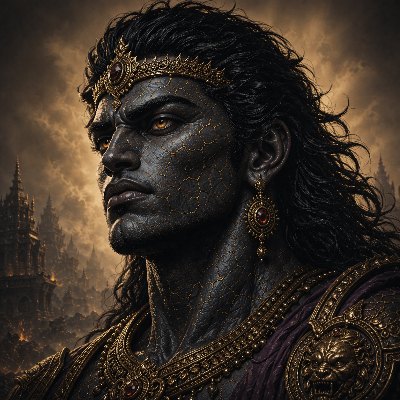
Kamalaksha — Second Son of Tarakasura, Lord of the Silver City
Kamalaksha · Virayavana (variant name in Padma Purana) · Tripurasura (collective name shared with brothers)
Kamalaksha is the second of the three asura brothers known collectively as the Tripurasuras, and the son of Tarakasura, the powerful asura king slain by Kartikeya. His narrative is inseparable from that of his brothers Tarakaksha (the eldest) and Vidyunmali (the youngest), as the three figures act together throughout the tradition. He is identified as the lord of the silver city built in the sky by the Danava architect Maya. His story is recorded principally in the Shiva Purana (Rudra Samhita, Yuddha Khanda), the Linga Purana, the Matsya Purana, and the Padma Purana. The Bhimashankar sthalapurana of Maharashtra preserves additional details concerning the wives of the Tripurasura brothers and the events that followed the destruction of the cities.
✦ The Name
The name Kamalaksha is a Sanskrit compound meaning "lotus-eyed," from kamala (lotus) and aksha (eye), a name traditionally associated with beauty and divine grace. One commentator, drawing on the epithet, notes that the name evokes a reddish hue, linking it visually to the colour of lotus petals. In the Padma Purana's account of the same narrative, the second brother is named Virayavana or Viryavana rather than Kamalaksha, representing a significant textual inconsistency between sources.
✦ Lineage
- Paternal grandfather: Vajranga, an asura of great power, born of the sage Kashyapa and his wife Diti.
- Paternal grandmother: Vajrangi, wife of Vajranga, created by Brahma.
- Father: Tarakasura, the great asura king who oppressed the gods and was ultimately slain by Kartikeya.
- Brothers: Tarakaksha, the eldest, lord of the golden city in the heavenly realm; and Vidyunmali, the youngest, lord of the iron city on the earth.
- Spouse: The Bhimashankar sthalapurana names Dakini and Shakini collectively as the devoted wives of the Tripurasura brothers. The tradition does not consistently assign one wife exclusively to Kamalaksha. No Mahapurana names an individual wife for Kamalaksha.
✦ The Penance, the Boon, and the Silver City
Following the death of their father Tarakasura, Kamalaksha joined his brothers Tarakaksha and Vidyunmali in an intensive course of austerities on Mount Meru or Sumeru. The graduated penance — one hundred years on one leg, a thousand years subsisting on air, a thousand years standing upon the head — pleased Brahma, who appeared and offered them a boon. When immortality was declined as beyond Brahma's power to grant, the brothers requested three flying cities that could be destroyed only by a single arrow at the moment of their periodic alignment. Kamalaksha's portion was a city of silver, situated in the intermediate space between heaven and earth. The Shiva Purana and the Linga Purana are consistent on this point; Kamalaksha received the silver city while Tarakaksha received the golden one and Vidyunmali the iron one.
✦ Virtue, Deception, and Destruction
Kamalaksha and his brothers initially ruled their cities as worshippers of Shiva and upholders of dharma, and the Shiva Purana explicitly records that this virtue rendered the cities invincible. The gods, unable to overcome the brothers by force, prevailed upon Vishnu to devise a stratagem. An illusory teacher propagating an anti-Vedic doctrine was sent among the asuras; Narada is described as having brought this teacher to the city of Vidyunmali first. Once Vidyunmali accepted the false doctrine, Kamalaksha and Tarakaksha followed in turn. With the brothers no longer performing Shiva's worship, Shiva agreed to destroy Tripura and loosed a single arrow at the moment of alignment, consuming all three cities and their inhabitants in fire. Kamalaksha perished with his brothers at this moment.
✦ Textual Variants
The name of the second brother differs between sources. The Shiva Purana, the Linga Purana, and related texts consistently name him Kamalaksha. The Padma Purana, however, refers to the second brother as Virayavana or Viryavana, and pairs the name Kamalaksha with the first brother in one reading, creating a conflation. The Jatland Wiki summary of a Puranic recension names the three brothers as Vidyunmali, Tarakaksha, and Viryavana, omitting Kamalaksha entirely. These inconsistencies are genuine textual variants rather than scribal errors, and reflect the fluid transmission of the Tripura narrative across different Puranic traditions.
✦ References
- Primary Sources
- Shiva Purana, Rudra Samhita, Yuddha Khanda, chapters 1–10: Principal source; assigns the silver city to Kamalaksha and narrates the full episode of penance, boon, virtue, deception, and destruction.
- Linga Purana: Parallel account consistent with the Shiva Purana on the city assignments and narrative sequence.
- Matsya Purana, chapter 188: Parallel source for the burning of Tripura, referenced in the Shiva Purana commentary.
- Padma Purana: Contains a variant that names the second brother Virayavana rather than Kamalaksha.
- Bhimashankar Sthalapurana / Bhimashankar temple tradition (Maharashtra): Names Dakini and Shakini as the collective wives of the Tripurasura brothers; provides the post-destruction narrative and origin of the name "Dakinyam Bhimashankaram."
- Secondary Sources
- Wikipedia, "Tripurasura" and "Tripurantaka": Summarises Mahapuranic accounts and notes variant names in different Puranic versions.
- Wisdomlib.org, Shiva Purana English translation: Translated chapters on the Tripura episode.
- Bhimashankar.net.in (official Bhimashankar temple site): Documents the sthalapurana tradition.