
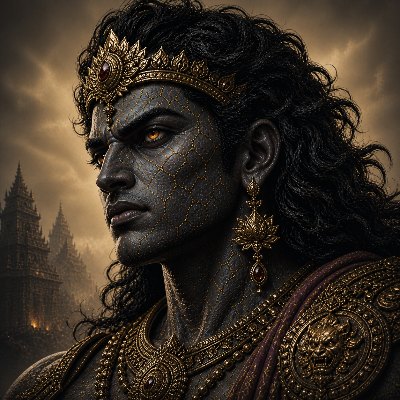
About
Vidyunmali — Youngest Son of Tarakasura, Lord of the Iron City
Vidyunmali · Vidyunmali · Viddyunmali · Bidyutaprabha (Nepalese variant) · Tripurasura (collective name shared with brothers)
Vidyunmali is the youngest of the three asura brothers who together constitute the Tripurasuras, and the son of the great asura king Tarakasura. Of the three brothers, Vidyunmali is particularly notable within the narrative because the process of their collective moral subversion begins with him: it is to his city and to him personally that the illusory Vaishnavite teacher first comes, and it is Vidyunmali who first accepts the false doctrine that sets in motion the brothers' downfall. He is the lord of the iron city, situated on the earth. His story is recorded in the Shiva Purana (Rudra Samhita, Yuddha Khanda), the Linga Purana, the Matsya Purana, the Padma Purana, and the Mahabharata, and is also touched upon in the Skanda Purana. The Bhimashankar sthalapurana of Maharashtra preserves a regional tradition regarding the wives of the brothers.
✦ The Name
The name Vidyunmali is a Sanskrit compound meaning "one wreathed in lightning" or "one who wears lightning as a garland," from vidyut (lightning) and mali (one who wears a garland). It denotes great luminous power and ferocity. In the Nepalese tradition of the Swasthani Brata Katha, the corresponding figure is named Bidyutaprabha, meaning "one of lightning-brightness," a closely related formation preserving the same root.
✦ Lineage
- Paternal grandfather: Vajranga, an asura born of the sage Kashyapa and Diti, possessed of strength compared to the thunderbolt.
- Paternal grandmother: Vajrangi, created by Brahma as Vajranga's devoted wife.
- Father: Tarakasura, the asura king who oppressed the three worlds and was slain by Kartikeya.
- Brothers: Tarakaksha, the eldest, who ruled the golden city in the heavenly realm; and Kamalaksha, the second, who ruled the silver city in the sky.
- Spouse: The Bhimashankar sthalapurana names Dakini and Shakini collectively as the devoted wives of the Tripurasura brothers. No Mahapurana names an individual wife for Vidyunmali.
✦ The Penance and the Iron City
After the death of their father Tarakasura, Vidyunmali joined his brothers in severe austerities on Mount Meru or Sumeru. The penance that all three performed was progressive in its intensity: a hundred years of meditation on one leg, a thousand years of subsisting on air alone, and a final thousand years of inversion upon the head. Brahma appeared and granted the unusual boon of three periodically aligning flying cities, destructible only by a single arrow at the moment of conjunction. Vidyunmali received the iron city, constructed on the terrestrial plane.
✦ The First to Fall: Vidyunmali and the Deceptive Teacher
Within the narrative, Vidyunmali holds a structurally pivotal position as the first of the brothers to be subverted. Having established that the brothers' virtue rendered them indestructible, Vishnu fashioned an illusory ascetic — called Arihat — who carried a bag, wore soiled garments, and taught a philosophy opposed to the Vedas and to the worship of Shiva. Narada brought this teacher first to the outskirts of Vidyunmali's city, where the teacher demonstrated his illusory powers. Narada then visited Vidyunmali directly and reported that the teacher was extraordinarily learned. The Shiva Purana records Vidyunmali's reasoning: if the great sage Narada himself had accepted this teacher's doctrine, he should do likewise. Vidyunmali accepted the false religion, and his brothers Tarakaksha and Kamalaksha followed in sequence, as did the entire populations of the three cities. This is the only moment in the narrative where Vidyunmali acts individually rather than as one of a collective, and it makes him the proximate cause of the brothers' destruction. Once all three brothers had abandoned Vedic practice and ceased to worship the Shiva linga, Shiva agreed to intervene and destroyed the three cities and their inhabitants with a single arrow.
✦ The Skanda Purana Episode of the Golden Airplane
The Jatland Wiki compilation, drawing on the Skanda Purana, preserves a separate episode specifically concerning Vidyunmali: he is described as possessing a glowing golden aerial vehicle that shone so brilliantly that it caused the disappearance of night, angering the sun-god. The sun-god retaliated by directing his rays to melt the vehicle. This in turn enraged Shiva, who attacked the sun-god; the sun-god fled and eventually fell at Kasi (Varanasi), and that place became known as Lolarka. This episode is independent of the Tripura destruction narrative and appears to be a tradition specific to the Skanda Purana.
✦ Textual Variants
One recension preserved in the Jatland Wiki names the three brothers as Vidyunmali, Tarakaksha, and Viryavana — placing Vidyunmali first, not last — and assigns the silver city to Viryavana rather than to a figure called Kamalaksha. The Nepalese tradition of the Swasthani Brata Katha names the corresponding figure Bidyutaprabha. These variants indicate that the name and position of the third brother were less fixed in textual transmission than those of Tarakaksha.
✦ References
- Primary Sources
- Shiva Purana, Rudra Samhita, Yuddha Khanda, chapters 1–10: Principal source; assigns the iron city to Vidyunmali; records the sequence of deception beginning with his city.
- Linga Purana: Parallel account with consistent city assignments.
- Skanda Purana: Preserves the episode of Vidyunmali's golden aerial vehicle, the conflict with the sun-god, and the Lolarka tradition at Kasi.
- Matsya Purana, chapter 188: Parallel source for the Tripura burning.
- Padma Purana: Variant account of the Tripura episode.
- Swasthani Brata Katha (Nepal): Names the corresponding figure Bidyutaprabha.
- Bhimashankar Sthalapurana / Bhimashankar temple tradition (Maharashtra): Names Dakini and Shakini as collective wives of the Tripurasura brothers.
- Secondary Sources
- Wikipedia, "Tripurasura": Summarises major Puranic accounts and regional variants.
- Jatland.com, "Tarakasura": Preserves a Puranic recension naming the brothers as Vidyunmali, Tarakaksha, and Viryavana, and records the Skanda Purana episode of the golden airplane.
- Wisdomlib.org, Shiva Purana English translation: Translated text of the relevant chapters.
- Bhimashankar.net.in (official Bhimashankar temple site): Documents the sthalapurana tradition.