
About
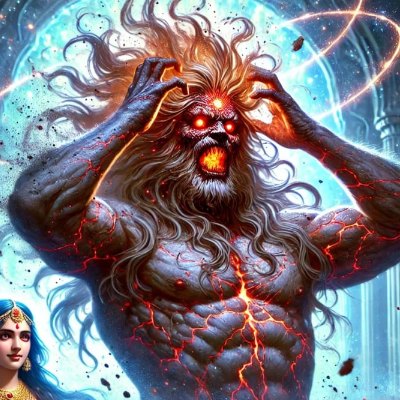
Vrikasura — The Asura Who Received the Touch-of-Death Boon from Shiva
Vrikasura · Vrika · Bhasmasura (name used in regional literature for a closely related figure)
Vrikasura is the asura whose account is recorded in the Bhagavata Purana (Skanda 10, chapter 88) as the son of the demon Sakuni. He is the figure who, through a severe and gruesome course of penance at Kedarnath, obtained from Shiva the devastating boon that any being on whose head he placed his hand would die instantly. Having received the boon he immediately attempted to use it on Shiva himself, forcing the god to flee across the three worlds until Vishnu intervened in the guise of a young brahmin student and, through a combination of flattery and psychological misdirection, caused Vrikasura to touch his own head, destroying him instantly. A closely related figure named Bhasmasura, whose identical narrative is preserved principally in regional literature — particularly the Marathi devotional work Shivaleelamrita — and referenced in some Puranic glossaries, is distinguished from the Bhagavata Purana Vrikasura by name, by the form Vishnu takes in the deception (Mohini rather than a brahmin student), and by origin details. These two figures share a common narrative archetype but are textually distinct; this profile treats them with care. The designation "Vrikasura II" in the reference context of this genealogical series distinguishes the present figure from an older Vrikasura — a wolf-demon appearing in the Mahabharata (Vana Parva) — who is entirely unrelated.
✦ The Names
The name Vrika means wolf in Sanskrit, a name carrying connotations of predatory ferocity. As Vrikasura — asura being the general term for a demon — the compound denotes "the wolf-demon." The name does not in this context describe a werewolf or canine form but rather characterises the figure's savage and ungrateful nature: one who, like a wolf, turns upon the hand that fed it. The name Bhasmasura, used for the closely related regional figure, is a compound of bhasma (ash, sacred ash) and asura, meaning "the ash-demon," directly referencing the nature of the boon — the power to reduce everything to ash. The Wisdomlib Puranic encyclopaedia entry on Bhasmasura notes explicitly that this name is not attested in any Sanskrit Purana but appears in the Marathi text Shivaleelamrita and in regional oral tradition, whereas Vrikasura is the name used in the Bhagavata Purana. Secondary sources occasionally treat the two names as synonymous; this conflation, while understandable given the narrative similarity, is technically inaccurate at the textual level.
✦ Lineage
- Ancestral line: Vrikasura belongs to the Daitya race, which traces its origin to the sage Kashyapa — one of the great Prajapatis or progenitor sages of the tradition — and his wife Diti, daughter of the patriarch Daksha. The Daityas as a class are the elder demonic cousins of the Devas, who share the same father Kashyapa but are born of different mothers.
- Placed within the line of: Hiranyaksha, the eldest or prominent son of Kashyapa and Diti, a Daitya lord of immense power who conquered the three worlds and was slain by Vishnu in his Varaha avatara. Vrikasura is placed within this lineage in the present genealogical system; the intervening generations are not attested in the primary sources.
- Father: Sakuni, an asura, referred to in the Bhagavata Purana (10.88) by the address Shakuneya — "son of Sakuni" — which Vishnu uses when speaking to Vrikasura in his brahmin student disguise. This Sakuni's own parentage and lineage are not detailed anywhere in the chapter; the Bhagavata Purana provides no genealogical information about him beyond his name. He is a figure of a later Puranic era and is a distinct individual from the primordial Sakuni of the Hiranyaksha Daitya lineage — that earlier Sakuni being the son of the asura Hiranyaksha and grandson of the sage Kashyapa by his wife Diti, a figure of the earliest ages of creation whose son, designated Vrikasura I in this genealogical series, is recorded in the Vayu Purana and Brahmanda Purana as a warrior in the Tarakamaya War. The two figures share only a name; their eras, lineages, and narrative contexts are entirely separate.
- Origin variant (Bhasmasura tradition): The regional Bhasmasura tradition, as recorded in the Shivaleelamrita and summarised in the Wisdomlib Puranic encyclopaedia, states that this figure was born directly from the bhasma — the sacred ash — on Shiva's own body, giving him a supernatural rather than genealogical origin. This origin is not present in the Bhagavata Purana's Vrikasura account.
✦ Narada's Counsel and the Decision to Propitiate Shiva
The Bhagavata Purana account opens with Vrikasura encountering the sage Narada on the road. He asked Narada which of the three great gods — Brahma, Vishnu, or Shiva — was most quickly and easily pleased, and which would therefore be the most efficient target for a demon seeking power through penance. Narada counselled him to propitiate Shiva, explaining that Shiva is rapidly gratified by even slight devotion, citing the examples of Ravana and the demon Bana, both of whom received extraordinary boons from Shiva through relatively modest austerities. Narada also cautioned, implicitly, that Shiva becomes equally quickly angered by offence — a warning Vrikasura failed to heed in the sequel.
✦ The Penance at Kedarnath
Following Narada's advice, Vrikasura made his way to Kedarnath — the high Himalayan shrine of Shiva — and began a course of penance of unusual and harrowing intensity. Unlike the graduated meditative austerities characteristic of some Puranic penances, Vrikasura's method was one of extreme physical self-immolation: he cut portions of his own flesh and offered them directly into the sacred fire as oblations to Shiva. Despite the severity and prolonged duration of this offering, Shiva did not appear. Growing increasingly desperate and frantic, Vrikasura resolved to offer his own head. He prepared to behead himself as the ultimate oblation. At that very moment Shiva appeared before him, restrained his hand, and touched him with his own hand so that his wounds were healed. The Bhagavata Purana presents this intervention as an act of Shiva's characteristic compassion and swiftness in responding to devotion, however extreme its form.
✦ The Boon and the Immediate Treachery
Shiva asked Vrikasura to name his desired boon. Vrikasura requested that any being upon whose head he placed his hand would die at once. Shiva granted this boon. The moment the boon was conferred, Vrikasura turned to use it immediately upon Shiva himself, intending to kill the very god who had just healed and rewarded him. The Bhagavata Purana presents this as an act of profound ingratitude and the epitome of asura character: the receipt of a boon from Shiva followed by an immediate attempt to destroy the boon-giver. Shiva, confronted by the weapon he had created, was unable to withdraw the boon. He turned and fled, and Vrikasura pursued him through heaven, earth, and all the intervening worlds. The gods were paralysed: to intervene physically would bring them within range of Vrikasura's lethal touch.
✦ Vishnu's Intervention: The Brahmin Student Disguise
Vishnu, perceiving the cosmic emergency, appeared before Vrikasura in the form of a young brahmin student — not, as in the regional Bhasmasura accounts, in the feminine form of Mohini. This distinction is textually significant: the Bhagavata Purana, which is a Mahapurana and the primary Sanskrit source for this narrative, specifies the brahmin student disguise, whereas the Mohini form belongs to the regional and Shaiva Purana-influenced traditions. Vishnu as the brahmin student greeted Vrikasura with apparent admiration and respect, and engaged him in flattering conversation. He then gently cast doubt on the reliability of the boon, suggesting that Shiva — being lord of ghosts and goblins and sometimes known to sport with demons — might have deceived Vrikasura. How could such a distinguished demon trust the word of such a god without testing it first? The only way to know whether the boon was genuine, Vishnu suggested, was to test it immediately on his own head. Blinded by arrogance and persuaded by the charm of Vishnu's maya, Vrikasura placed his own hand upon his own head and died at once, reduced by his own boon.
✦ The Bhasmasura Variant: Regional Tradition and the Mohini Form
The regional figure Bhasmasura, whose name and story appear in the Marathi Shivaleelamrita and are referenced in secondary sources including the Wisdomlib Puranic encyclopaedia and the Cologne Digital Sanskrit Dictionaries (where the name appears in Bilhana's Vikramankadeva-charita), shares the essential narrative structure of the Vrikasura story but differs in several details. In the Bhasmasura tradition, the demon is born from Shiva's own sacred ash rather than being the son of the asura Sakuni. The boon's formulation is the same — reduction to ash by the touch of the hand — but the term used is bhasma (ash) rather than the more general "death." Most distinctively, in the Bhasmasura tradition it is Vishnu in the form of Mohini — the enchanting female avatar — who intervenes, engaging the demon in a seductive dance called the Muktanritya in some versions. During the dance Mohini gradually introduces the gesture of placing a hand on the head, and when Bhasmasura mirrors this gesture he destroys himself. The Mohini form connects this version of the story to a broader cluster of Mohini narratives in the Puranas, including the churning of the ocean episode. A further variant, mentioned in secondary sources, has Shiva pursuing the demon to Varanasi during the flight, and Shiva appearing as a bull in that city before the crisis is resolved.
✦ Vishnu's Address to Shiva After the Demon's Death
The Bhagavata Purana records that after Vrikasura's self-destruction, Vishnu addressed Shiva directly with a reflection on the theological meaning of the event. Vishnu's statement, paraphrased from the Bhagavata Purana, conveys the following: the demon was ultimately destroyed by his own accumulated sins, for no one who offends a great being — and most of all the father of the worlds — can remain safe or happy. The passage functions as a theological commentary on the narrative, affirming Shiva's supreme status even within a Vaishnava text, and emphasising the theme of self-destruction through impiety toward one's benefactor.
✦ The Distinction from Vrikasura I
In this genealogical series, Vrikasura I designates a distinct and earlier figure: the son of the primordial asura Sakuni of the Hiranyaksha Daitya lineage, who is in turn the son of Hiranyaksha and the grandson of the sage Kashyapa by his wife Diti. That Vrikasura I belongs to the earliest ages of creation and is recorded in the Vayu Purana and Brahmanda Purana within the genealogical enumeration of the Hiranyaksha lineage, where he appears among the valorous sons of Sakuni and is associated with the Tarakamaya War — the great conflict fought over the abduction of Tara, wife of Brihaspati. His mention in those texts is confined to genealogical enumeration; no individual narrative of his deeds or death is preserved in the consulted passages. The present figure, Vrikasura II, belongs to a later Puranic era entirely. He is the son of a different Sakuni — one whose own lineage is unspecified in the Bhagavata Purana — and his story is one of individual moral failure, boon misuse, and self-destruction, with no connection to the Hiranyaksha lineage or to the Tarakamaya War. The two figures share only the name Vrikasura and the patronymic Sakuni; in every other respect — era, lineage, narrative, textual source, and thematic significance — they are separate individuals.
✦ Theological Significance
The narrative of Vrikasura and its regional parallel in the Bhasmasura tradition serve several interconnected theological functions in the texts that preserve them. Most directly, both stories illustrate the danger inherent in Shiva's readiness to grant boons: he is characterised in the Bhagavata Purana itself as the deity who is most rapidly pleased and most rapidly angered, and the story shows the cosmic consequences of this divine liberality when exploited by a morally corrupt recipient. The narrative also demonstrates the complementary relationship between Shiva and Vishnu within the Puranic tradition — Vishnu's maya, or divine illusion, resolves what Shiva's power alone cannot. At the deepest level, the story is a sustained meditation on the theme of self-destruction through ingratitude and arrogance: the very power granted to the demon becomes the instrument of his annihilation, because he lacked the wisdom to use it rightly. The figure of Vrikasura or Bhasmasura has consequently become a byword in Indian discourse for self-inflicted ruin — a characterisation that extends from classical literature into modern political and philosophical commentary.
✦ References
- Primary Sources
- Bhagavata Purana, Skanda 10, chapter 88: The principal Sanskrit Mahapuranic source; names the figure Vrikasura, identifies him as son of Sakuni, records the encounter with Narada, the penance at Kedarnath, the boon, the flight of Shiva, the intervention of Vishnu as a young brahmin student, and the theological address to Shiva after the demon's death.
- Shivaleelamrita (Marathi devotional text): The principal source for the Bhasmasura variant; names the figure Bhasmasura, gives his origin as born from Shiva's sacred ash, and records Vishnu's intervention in the Mohini form rather than as a brahmin student.
- Vikramankadeva-charita (Bilhana): A Sanskrit literary work in which the name Bhasmasura appears in the Cologne Digital Sanskrit Dictionaries as a named asura, representing one of the earliest attested uses of the name in Sanskrit literature outside the regional devotional tradition.
- Mahabharata, Vana Parva: Contains the unrelated Vrikasura I, a wolf-demon; noted here for the purpose of distinguishing the two figures sharing the same name.
- Secondary Sources
- Wikipedia, "Bhasmasura": Summarises both the Bhagavata Purana Vrikasura account and the regional Bhasmasura tradition; notes explicitly that Bhasmasura does not appear in the Sanskrit Puranas and belongs to regional literature; records the Mohini and brahmin-student variants.
- Wisdomlib.org, "Bhasmasura: 7 definitions": Provides the Puranic encyclopaedia entry explicitly stating no Sanskrit Purana contains the Bhasmasura name; summarises the Shivaleelamrita account; references Bilhana's text.
- Grokipedia, "Bhasmasura": Summarises variant accounts across the Bhagavata Purana, Shiva Purana, Skanda Purana, and regional traditions; notes the son-of-Sakuni detail and the brahmin-student versus Mohini distinction.
- Exoticindiaart.com, "Shiva and Vishnu": Summarises the Bhagavata Purana 10.88 account including Narada's advice, the nature of the penance, and Vishnu's post-destruction address to Shiva.
- Hindu-blog.com, "Story of Vishnu and Shiva and Demon Vrika": Summarises the Bhagavata Purana account and notes the structural parallels and distinctions between the Vrikasura and Bhasmasura narratives.