
About
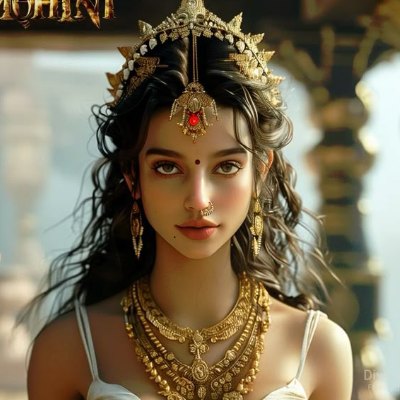
Mohini — The Enchantress Form of Vishnu
Mohini · Mohinim · Jaganmohini · Hariharaputra's mother (functional epithet) · Mayam Ashito Mohinim (earliest descriptive phrase in the Mahabharata)
Mohini is the female avatar of Vishnu, the only such form in the Vaishnava avatar tradition, and one of the most widely attested transformative episodes in all of Puranic and epic literature. She appears when Vishnu assumes an enchantingly beautiful female body — described consistently across texts as supernaturally captivating and irresistible to both gods and demons — for the purpose of deploying divine illusion, or maya, to restore cosmic order at moments when male force alone is insufficient. Her earliest appearance in Sanskrit literature is in the Mahabharata's account of the Samudra Manthana, or churning of the ocean of milk, where she is not yet named but described through a phrase that later yields her name. She appears subsequently in the Ramayana (Bala Kanda), the Vishnu Purana, the Bhagavata Purana (Skanda 8, chapters 9 and 12), the Brahmanda Purana, the Padma Purana, the Shiva Purana, the Agni Purana, the Ganesha Purana, and in regional and folk traditions across South and Southeast Asia. In the Bhagavata Purana she is formalised as the thirteenth avatar in the extended list of twenty-four avatars of Vishnu. Her narrative connects her to events of cosmic consequence — the distribution of amrita after the churning of the ocean, the destruction of the Bhasmasura class of demon, and the begetting of the deity Ayyappa through union with Shiva — though many of these connections are attested differently across different texts and traditions.
✦ The Name
The name Mohini derives from the Sanskrit root moh, meaning to infatuate, enchant, perplex, or delude. It is the feminine form of an agent noun, meaning literally "she who enchants" or "the enchantress." The closely related noun moha denotes desire, infatuation, or delusion — one of the fundamental afflictions of the mind in Indian philosophical thought — so the name identifies this form of Vishnu as the personification of that power as it operates cosmically and strategically in the service of dharma. Wikipedia notes that the name Mohini does not appear in the earliest textual references: the Mahabharata refers to Vishnu's female form through the descriptive phrase mayam ashito mohinim, meaning "assuming the illusion of an enchantress," and the name Mohini crystallises from this phrase only in later textual tradition. The epithet Jaganmohini — "she who enchants the world" — is used in regional temple traditions, notably at the Jaganmohini-Kesava Swamy temple at Ryali in Andhra Pradesh.
✦ Lineage and Avatar Status
- Source deity: Vishnu, the preserver deity of the Hindu triad. Mohini is not a separate being but a temporary transformative form assumed by Vishnu through the power of his divine maya. She has no independent existence, parentage, or continuous personal history between her appearances.
- Avatar enumeration: The Bhagavata Purana (Skanda 1, chapter 3, verse 17) lists Mohini as the thirteenth in the extended series of twenty-four avatars of Vishnu. She does not appear in the standard Dashavatara (ten-avatar) list. The Bhagavata Purana verse in question identifies this avatar as the form Vishnu assumed to captivate the asuras and distribute the amrita to the gods.
- Son (Brahmanda Purana): Maha-Shasta, "the Great Chastiser," born of the union of Shiva and Mohini. This deity is identified in South Indian regional traditions primarily as Ayyappa of Kerala and as Aiyanar of Tamil Nadu. Ayyappa is referred to as Hariharaputra — "the son of Hari (Vishnu) and Hara (Shiva)."
- Variant origin (Brahmavaivarta Purana): The Brahmavaivarta Purana gives a wholly different account in which Mohini is not a form of Vishnu at all, but an apsara created by Shiva who falls in love with Brahma. In this version, Vishnu's role is secondary and explanatory. This is a significant textual variant that contradicts the Mahapuranic mainstream.
✦ The Samudra Manthana: The First and Principal Episode
The episode of the churning of the ocean of milk — the Samudra Manthana — constitutes the first and foundational context for the Mohini form. The gods and demons together churned the cosmic ocean using Mount Mandara as a churning rod and the serpent Vasuki as a rope, in order to produce the amrita, the nectar of immortality. When the amrita finally emerged in a pot, the asuras seized it and refused to share it with the gods. It was at this crisis that Vishnu assumed the Mohini form. The Mahabharata, which contains the earliest account, describes the female form as supernaturally beautiful and capable of bewildering all who looked upon it. Vishnu-Mohini approached the assembled gods and demons and offered to distribute the amrita impartially, a mediation that both sides accepted, drawn entirely by her appearance. Mohini then proceeded to seat the gods and demons separately and began serving the nectar — to the gods alone, until it was exhausted, with none remaining for the demons. The demons, bewitched, did not comprehend what was happening until it was too late. The demon Svarbhanu disguised himself as a god to receive a portion of amrita; the sun-god Surya and the moon-god Chandra identified him and informed Vishnu, who immediately assumed his own form and severed Svarbhanu's head with the Sudarshana Chakra. Because Svarbhanu had already swallowed a small amount of amrita, his head survived the decapitation and became the immortal Rahu, while his body became Ketu. The Bhagavata Purana (Skanda 8) expands this account considerably, and it is in this text that Mohini's appearance is described in detail and that her status as a formal avatar of Vishnu is established. The Padma Purana and Brahmanda Purana also retell the episode. The Brahmanda Purana contains a theologically distinctive variant in which Vishnu, before assuming the Mohini form, meditates upon the Great Goddess Maheshvari and thereby acquires her divine feminine form — a framing that situates the transformation within a Shakta theological context.
✦ The Encounter with Shiva and the Birth of Maha-Shasta
After the Samudra Manthana episode, the Bhagavata Purana (Skanda 8, chapter 12) records that Shiva, having heard reports of the Mohini form that had confounded the asuras, came with his wife Parvati to visit Vishnu at his residence. Shiva asked Vishnu to demonstrate the Mohini transformation so he might witness it directly. Vishnu agreed and resumed the Mohini form. Shiva, overcome by desire upon seeing Mohini, abandoned his composure — an event the text presents as remarkable given Shiva's reputation for profound self-restraint — and pursued her. Parvati watched in shame. Shiva eventually grasped Mohini, who freed herself and fled further; the pursuit continued until Shiva's seed fell to the ground. The Bhagavata Purana does not explicitly describe the birth of a child from this episode, though the discharge of Shiva's seed is recorded. The Brahmanda Purana's version of this event is more explicit: the seed falls to the earth and from it is born Maha-Shasta, who is identified in South Indian traditions as Ayyappa and as Aiyanar. The Brahmanda Purana account specifies that Mohini disappears once Shiva recovers himself, and Shiva returns home with Parvati. A variant account within the Ayyappa tradition states that Mohini herself gives birth to Ayyappa after Shiva impregnates her, but notes that Mohini has no real womb as Vishnu is male and the female form is a divine illusion, and that in one telling the child springs from Vishnu's thigh.
✦ Mohini and Hanuman: Variant Accounts
Two variant accounts connect the Shiva-Mohini encounter to the birth of Hanuman rather than to Ayyappa. The Shiva Purana records that Shiva's seed was discharged not through physical contact but by the mere sight of Mohini; the seed fell to earth and was collected, then poured into the ear of the apsara Anjani, who subsequently gave birth to Hanuman. The Agni Purana presents yet another variant in which drops of Shiva's seed, falling to the ground as he pursued Mohini, became lingas — Shiva's sacred symbols — and also generated Hanuman. These accounts are not harmonised with the Brahmanda Purana's birth of Maha-Shasta, and the texts in question do not attempt to reconcile them. The co-existence of these accounts reflects the different regional and sectarian emphases of the texts in which they appear: the Brahmanda Purana and Ayyappa tradition are southern and Shaiva-Vaishnava in orientation; the Shiva Purana and Agni Purana variants serve to connect Hanuman to a dual Shaiva-Vaishnava parentage.
✦ Mohini and the Bhasmasura Episode
The regional tradition, preserved principally in the Marathi devotional text Shivaleelamrita and referenced in secondary compilations, records Mohini as the form Vishnu assumes to destroy the demon Bhasmasura, who had received from Shiva the boon that any being on whose head he placed his hand would be reduced to ash. Bhasmasura turned to use this boon on Shiva himself, forcing Shiva to flee. Vishnu assumed the Mohini form, engaged Bhasmasura in a seductive dance called the Muktanritya in some accounts, and gradually led him through dance gestures to place his own hand on his own head, at which moment the boon consumed him. It is essential to note that this episode, as recorded in the Bhagavata Purana, does not involve the Mohini form at all: in that text, Vishnu assumes the form of a young brahmin student rather than Mohini to destroy the equivalent figure Vrikasura. The Mohini involvement in the ash-demon episode belongs specifically to the regional Bhasmasura tradition and to later retellings influenced by that tradition, not to the Sanskrit Mahapuranic account. The Vishnu Purana is noted in some secondary sources as associating Mohini with the Bhasmasura episode, though this requires further textual verification.
✦ Mohini and Virochana: The Ganesha Purana Episode
The Ganesha Purana (dated by scholars approximately 900 to 1400 CE) contains a lesser-known episode in which the wise asura king Virochana — son of Prahlada and grandson of Hiranyakashipu — had received from the sun-god Surya a magical crown that rendered him invincible and protected him from all harm. Vishnu, assuming the Mohini form, enchanted Virochana through her supernatural beauty, stole the protective crown from him while he was bewitched, and subsequently killed him. This episode does not appear in the principal Mahapuranic treatments of Virochana, where his story is primarily one of philosophical dialogue with Indra about the nature of the self.
✦ Mohini and Aravan: South Indian Folk Tradition
A significant South Indian folk tradition, not attested in any Sanskrit Mahapurana, records a Mohini episode in the context of the Kurukshetra War. The Mahabharata hero Aravan — also called Iravan, the son of Arjuna and the Naga princess Ulupi — agreed to sacrifice himself before the war to secure the Pandavas' victory. Aravan had never married and did not wish to die unmarried. The women of the Pandava camp refused to become the wife of a man who would die within a day. Krishna then assumed the Mohini form and married Aravan, spending a night with him. After Aravan's sacrifice the following day, Mohini-Krishna mourned as his widow before reverting to the male form. This tradition is central to the identity and ritual practices of the hijra and transgender communities of Tamil Nadu, who re-enact the mourning of Aravan's death through the Koovagam festival. In this tradition, Krishna rather than Vishnu is the agent of the Mohini transformation, which reflects the South Indian theological tendency to identify Krishna and Vishnu fully, and the episode is treated as a manifestation of Krishna's compassion.
✦ Textual Variants and Inconsistencies
The Mohini tradition presents several layers of textual inconsistency that must be acknowledged. First, the name itself is absent from the Mahabharata and develops from a descriptive phrase into a proper name only in the Puranic elaboration. Second, the status of Mohini as a formal avatar of Vishnu is established only in the Bhagavata Purana; earlier texts describe the transformation without using avatar terminology. Third, the Brahmavaivarta Purana presents an entirely divergent account in which Mohini is an apsara created by Shiva, not a form of Vishnu, making her origin non-Vaishnava in that text. Fourth, the offspring of the Shiva-Mohini encounter varies by text: the Brahmanda Purana yields Maha-Shasta, identified with Ayyappa; the Shiva Purana and Agni Purana yield Hanuman via different mechanisms; and some Ayyappa traditions record a biological birth from Mohini's own body, with the theological complication addressed through the detail of Vishnu's thigh. Fifth, the Brahmanda Purana uniquely frames the transformation as Vishnu meditating upon Maheshvari to acquire the female form, a Shakta framing that does not appear in other texts. These variants reflect not scribal inconsistency but the genuine diversity of sectarian and regional traditions that all drew upon the Mohini figure for their own theological purposes.
✦ Theological Significance
The Mohini form occupies a distinctive position in Vaishnava theology as the moment at which Vishnu's preserving function operates through total concealment of divine identity. In all other avatars, Vishnu descends in a form — human, animal, or composite — that retains some marker of divinity. In the Mohini form, Vishnu assumes not merely a different body but a different gender and an identity wholly defined by seduction and illusion, operating through the very instrument — desire, moha — that dharmic practice aims to overcome. The texts present this not as a contradiction but as the supreme flexibility of divine maya: the preserver deploys the cosmos's own most powerful binding force — erotic fascination — as an instrument of cosmic liberation. The episode of Shiva being overcome by Mohini also serves a specific theological function: even the ascetic god most celebrated for conquering desire is shown to be subject to Vishnu's maya, a claim that supports Vaishnava assertions of Vishnu's supreme sovereignty. The Brahmanda Purana's framing of the transformation through meditation on Maheshvari further opens a Shakta reading in which the female divine principle is the ultimate source of the enchanting power, and Vishnu is her vehicle rather than her originator.
✦ Iconography and Worship
Mohini is depicted iconographically as a woman of surpassing beauty, typically shown carrying the pot of amrita. In some South Indian sculptural traditions, including the Hoysala temple carvings datable to approximately 1117 CE at sites including Belur and Halebid, Mohini is shown as a bracket figure playing musical instruments — the vina, the damaru, and other instruments — or as a dancer or huntress. These representations treat Mohini as a semi-independent goddess figure rather than purely a transient form of a male deity, reflecting the extent to which she was accorded independent devotional status in regional traditions. The Jaganmohini-Kesava Swamy temple at Ryali in Andhra Pradesh contains a unique dual icon: the front face represents the male Vishnu while the back face represents the female Mohini, together forming a composite Hari-Hara type image connecting the Mohini identity with Shiva. The Mohiniattam classical dance form of Kerala derives its name from Mohini and is traditionally performed exclusively by women, its movements understood to embody the seductive grace of the enchantress. Worship of Mohini as an independent deity is concentrated in Maharashtra, Goa, and parts of South India; in Maharashtra she is identified with the goddess Mhalsa, who in that tradition is the wife of the deity Khandoba, an incarnation of Shiva.
✦ References
- Primary Sources
- Mahabharata, Adi Parva (Samudra Manthana episode): Earliest attestation of the Mohini form; no name given, described through the phrase mayam ashito mohinim; records the distribution of amrita and the decapitation of Svarbhanu.
- Ramayana, Bala Kanda: Brief retelling of the Samudra Manthana episode including the enchanting female form of Vishnu.
- Vishnu Purana: Retells the Samudra Manthana episode; describes the transformation as Vishnu's maya; associated in secondary sources with the Bhasmasura episode, though this requires primary-text verification.
- Bhagavata Purana, Skanda 1, chapter 3, verse 17: Lists Mohini as the thirteenth of the twenty-four avatars of Vishnu.
- Bhagavata Purana, Skanda 8, chapters 9 and 12: The fullest Mahapuranic account of both the Samudra Manthana episode and the subsequent encounter of Shiva with Mohini; records Shiva's loss of composure and the discharge of his seed.
- Brahmanda Purana: Records the Narada-Shiva-Vishnu sequence; describes the birth of Maha-Shasta from Shiva's seed; contains the distinctive variant of Vishnu meditating on Maheshvari before transforming.
- Padma Purana: Retells the Samudra Manthana episode with the Mohini form.
- Shiva Purana: Records the discharge of Shiva's seed by the mere sight of Mohini; seed poured into Anjani's ear producing Hanuman.
- Agni Purana: Records Shiva's semen falling as lingas and generating Hanuman during the pursuit of Mohini.
- Ganesha Purana (c. 900–1400 CE): Records the episode of Mohini stealing the protective crown of the asura king Virochana and his subsequent death.
- Brahmavaivarta Purana: Contains the variant account in which Mohini is an apsara created by Shiva rather than a form of Vishnu; presents the Brahma-Mohini episode.
- Shivaleelamrita (Marathi devotional text): Principal source for the Bhasmasura-Mohini dance episode.
- Kanda Puranam (Tamil Shaiva text): Records the birth of Shasta identified with Aiyanar in the context of the Shiva-Mohini union.
- Secondary Sources
- Wikipedia, "Mohini": Comprehensive summary of all major textual attestations, regional variants, and iconographic traditions; notes the evolution of the name from the descriptive Mahabharata phrase.
- Wisdomlib.org, Bhagavata Purana English translation, Skanda 8, chapter 12: Translated text of the Shiva-Mohini encounter.
- Theprint.in, excerpt from Alka Pande, Devi and Her Avatars: Discusses the question of Mohini's avatar status, the Brahmavaivarta Purana variant, the Aravan folk tradition, and the Rahu origin story.
- Wikipedia, "Ayyappa": Records the variant accounts of Ayyappa's birth from the Shiva-Mohini union across different regional traditions.