
About
Maha-Shasta — The Divine Son of Shiva and Mohini, Worshipped as Ayyappa and Aiyanar
Maha-Shasta · Shasta · Sastha · Dharma Shasta · Hariharaputra · Hariharasuta · Ayyappa · Ayyappan · Manikanta · Manikandan · Aiyanar · Ayyanar · Cattan · Sattan · Nattarayan · Ayyanayake (Sinhala)
Maha-Shasta is a Hindu deity born of the union of Shiva and Mohini — the female form assumed by Vishnu during the churning of the cosmic ocean — whose birth is recorded in the Brahmanda Purana and the Skanda Purana (Shankara Samhita), and alluded to in the Bhagavata Purana (Skanda 8). He is identified across South Indian traditions under several regional names: as Ayyappa or Dharma Shasta in Kerala, as Aiyanar or Cattan in Tamil Nadu, and as Ayyanayake in Sri Lanka. The epithet Hariharaputra — "son of Hari (Vishnu) and Hara (Shiva)" — is his most theologically defining appellation, expressing his unique identity as the offspring of the two supreme deities of Vaishnavism and Shaivism, an identity that is itself the reason for his existence: only a being simultaneously the son of both Shiva and Vishnu could fulfil the cosmic purpose of destroying the demoness Mahishi, who held precisely this boon as her condition of invincibility. His principal function across all regional traditions is that of a guardian of dharma, a protector of boundaries, and a destroyer of specific demonic threats. The generic title Shasta is a Sanskrit term meaning teacher, guide, or ruler. The form Dharma Shasta, his most widely used Puranic designation, identifies him as the upholder of dharma. In Kerala he is most popularly known as Ayyappa, an honorific formed from the Tamil-Malayalam words ayya and appa, both meaning father or lord, used to address the deity as the supreme protector-father. The name Manikanta or Manikandan — meaning "one with a bell around the neck" — belongs to the regional devotional narrative of his earthly sojourn in the Pandalam kingdom. He appears as a major deity in the Brahmanda Purana, Skanda Purana, Padma Purana, and in the Tamil devotional corpus including the Tevaram hymns of Appar and Thirujnanasambandar (7th century CE), the Tamil epic Silappatikaram (4th–5th century CE), and the Kanda Puranam (14th century Tamil version of the Skanda Purana). The Bhutnathopakhyanam, a Kerala devotional text specifically dedicated to this deity, preserves the most detailed narrative of his earthly mission.
✦ The Names
The Sanskrit title Shasta or Sastha derives from a root meaning to rule, to teach, or to chastise, and thus encompasses the roles of teacher, lord, and disciplinarian. Maha-Shasta — "the Great Chastiser" or "the Great Teacher" — is the form of the name that appears in the Brahmanda Purana's account of his birth. Dharma Shasta specifically designates him as the lord of dharma, the cosmic moral order. Hariharaputra and Hariharasuta are Sanskrit epithets meaning son of Hari (Vishnu) and Hara (Shiva), the most theologically precise designations of his dual parentage. The name Ayyappa is widely used in Kerala and combines ayya (lord or father in Tamil-Malayalam) with appa (father or protector), conveying the sense of the supreme divine father. Manikanta or Manikandan, meaning "one wearing a gem-bell around the neck" from mani (jewel or bell) and kanta (throat or neck), refers to the identifying mark with which the divine infant was found on the banks of the Pampa river by the Pandalam king. Aiyanar and its variants Ayyanar and Cattan represent the Tamil regional form of the deity, attested epigraphically from the 3rd century CE in the Arcot district and literarily in Silappatikaram. The agamic text Dyana Ratnavali and the Tamil song Shasta Varavu record eight forms of the deity collectively called the Ashta-Shasta, of which Dharma Shasta is specifically identified with Ayyappa.
✦ Lineage
- Father (Shaiva parentage): Shiva, the great ascetic deity and destroyer of the Hindu triad. Shiva's seed, discharged during his pursuit of or union with Mohini following the churning of the cosmic ocean, is the generative source of Maha-Shasta according to the Brahmanda Purana and Bhagavata Purana.
- Father (Vaishnava parentage): Vishnu in the female form of Mohini — the enchantress form assumed by Vishnu during the Samudra Manthana to distribute the amrita to the gods. Mohini is Vishnu's temporary transformative form rather than a continuous personal identity; Maha-Shasta is therefore simultaneously the son of both Shiva and Vishnu, expressed through the epithet Hariharaputra.
- Foster father: King Rajashekhara of Pandalam, a ruler of the Pandalam dynasty — a branch of the Pandya royal lineage that migrated from Tamil Nadu to Kerala around 903 CE — who found the divine infant on the banks of the Pampa river and raised him as his own son, naming him Manikanta. This detail belongs to the Kerala regional devotional tradition preserved in the Bhutnathopakhyanam and in Kerala folklore, not to any Sanskrit Mahapurana.
- Consorts (Puranic tradition): Poorna and Pushkala, named in the Skanda Purana, Padma Purana, and Brahmanda Purana as the two wives of Dharma Shasta. Poorna's name means completeness and Pushkala's means prosperity or abundance. These two consorts are depicted alongside the deity in the Adi-Shasta and Dharma Shasta iconographic forms worshipped in many temples of Tamil Nadu and Kerala; the Achankovil Shasta temple in Kerala specifically enshrines the householder form of the deity with his two wives. The Sabarimala form of the deity is, by contrast, specifically brahmachari — celibate — and the consorts are not represented there.
- Regional identification with Aiyanar: In Tamil Nadu, Shasta is identified with Aiyanar, a guardian deity whose earliest epigraphic attestation dates to the 3rd century CE. Aiyanar is accompanied in some traditions by two wives similarly named Poorna and Pushkala, a parallelism that reinforces the identification of the two deities across regional traditions.
✦ The Birth: Cosmic Purpose and Mahishi's Boon
The theological necessity of Maha-Shasta's birth is inseparable from the boon of the demoness Mahishi. Mahishi was the sister of the buffalo-demon Mahishasura, who had been slain by the goddess Durga, the fierce aspect of Parvati. Driven by grief and a desire for revenge against the gods, Mahishi performed severe penance and received a boon from Brahma that she could be killed only by a being who was simultaneously the son of Shiva and the son of Vishnu — a condition she regarded as cosmically impossible, since Shiva and Vishnu are male deities of different theological traditions incapable of producing a child through any ordinary means. Empowered by this boon, Mahishi conquered heaven, drove Indra from his throne, and subjected the gods to terror and oppression. The gods, unable to overcome her, appealed to Vishnu, who recognised that the only solution was to fulfil the impossible condition of her boon by assuming the Mohini form — which he had recently displayed during the Samudra Manthana — and uniting with Shiva, so that a son bearing the combined power of both deities might be born. The Brahmanda Purana records the birth of Maha-Shasta from Shiva's seed falling to the earth during his encounter with Mohini; the Skanda Purana (Shankara Samhita) records Indra himself narrating the circumstances of this birth. From this divine origin, Maha-Shasta carries within himself the combined power of Shaivism and Vaishnavism, and it is precisely this dual divine essence that renders him the only being capable of killing Mahishi. The birth thus serves a dual theological purpose: it resolves an immediate cosmic crisis and simultaneously embodies the unity of the two great theistic streams of Hinduism.
✦ The Earthly Sojourn: The Manikanta Narrative
It is essential to state clearly at the outset of this section that the narrative of Manikanta — the divine infant found by the Pandalam king, raised as a prince, and sent on a quest for tiger's milk — does not appear in any Sanskrit Mahapurana. This narrative is preserved in the Bhutnathopakhyanam, a Kerala devotional text specific to the Ayyappa tradition, and in Malayalam regional folklore, the Aithihyamala, and oral tradition. No Purana mentions the Mahishi killing in the context of the Pandalam narrative, the 41-day deeksha, the Sabarimala pilgrimage, or the Pandalam dynasty story. The devotional tradition of the Sabarimala temple itself acknowledges this distinction: the Puranas provide the theological identity of Dharma Shasta while the regional texts and agamic literature provide the practical and narrative framework of Ayyappa worship. With this caveat clearly stated, the narrative is presented as follows. After his birth, the divine child was placed by the gods on the banks of the Pampa river in Kerala. King Rajashekhara of Pandalam, who was childless and had been praying to Shiva for an heir, was hunting in the forest when he heard the cries of an infant. Following the cries to the riverbank, he found the glowing child wearing a golden bell around his neck. A sage appeared and advised the king to adopt the child. The king named him Manikanta — "one with a bell at the throat" — and raised him with great affection as his own son. Manikanta grew showing extraordinary abilities in martial arts, scholarship, medicine, and governance. When the king prepared to formally anoint him as crown prince, the queen, who had since given birth to a biological son, contrived to remove Manikanta from the succession. She feigned a fatal illness and, on the advice of conspiring court physicians, declared that only the milk of a living tigress would cure her. The court assumed this to be an impossible task that would result in the young prince's death in the forest. Manikanta volunteered for the mission and entered the forest.
✦ The Killing of Mahishi
During his journey through the forest on his quest for tiger's milk, Manikanta encountered the demoness Mahishi, who had been continuing her reign of terror against the gods and cosmic order. His encounter with her fulfilled the cosmic purpose of his birth. The Kerala devotional tradition, as recorded in the official Sabarimala temple account, describes Manikanta seizing Mahishi by the horns and hurling her to the earth near the banks of the Azhutha river. A fierce battle followed, and Manikanta mounted upon her body and performed a violent, ecstatic divine dance — described as reverberating through both the earth and the heavens, frightening even the gods with its cosmic intensity — as the demoness died beneath him. At the moment of her death, Mahishi was released from an ancient curse and transformed from her buffalo-demoness form back into her original celestial identity as a beautiful woman named Leela. The tradition records that Leela herself had been cursed, along with her companion Datta who had been cursed to become the buffalo-demon Mahishasura — killed earlier by Durga — and that both curses were now dissolved through the intervention of Hariharaputra. Leela in her restored form is venerated at Sabarimala as Malikapurathamma, the mother-goddess whose shrine stands on a small hillock adjacent to the main temple, and who is regarded as a devoted attendant of Ayyappa.
✦ The Return to Pandalam and the Establishment of Sabarimala
After slaying Mahishi, Lord Shiva appeared to Manikanta and confirmed that his earthly mission was complete, though one task remained — to return to Pandalam and reveal his divine identity. Manikanta returned to the palace not on foot but riding upon Indra, who had assumed the form of a tigress in honour of Hariharaputra's victory, accompanied by other gods disguised as tigers and tigresses. The sight of the young prince arriving at the palace gates mounted on a tiger and surrounded by the great cats revealed his divine nature beyond doubt. The king fell at his feet in devotion. The queen and the court minister, whose conspiracy had sent Manikanta into the forest, were forgiven. Manikanta declared that his time in the human world was complete, and he instructed the king to build a temple for him at Sabarimala — a hill deep within the forests of the Western Ghats — shooting an arrow to mark the site. The king built the temple, and the tradition records that the sage Parashurama, an avatar of Vishnu who is said to have created Kerala by hurling his axe into the sea, carved and installed the primary idol of Ayyappa. The Sabarimala Sree Dharma Sastha Temple has no ancient or medieval inscription confirming these events; the earliest surviving written record referencing the temple dates to 1818, when Lieutenant B. S. Ward described approximately ten to fifteen thousand devotees attending the annual January festival, indicating the shrine was already well established by that time. A mortgage document of the Pandalam royal family dated 1793 references the temple's revenue, establishing its existence by the late eighteenth century at the latest.
✦ Vavar: The Muslim Warrior Companion
One of the most distinctive and widely attested elements of the Ayyappa devotional tradition is the figure of Vavar — also called Vavarswami — a Muslim warrior whose shrine at Erumely stands as a mandatory stop on the Sabarimala pilgrimage, and whose presence is considered integral to the completion of the sacred journey. Vavar does not appear in any Sanskrit Puranic source; his story belongs entirely to the regional Kerala devotional tradition. The accounts of his identity and origins vary significantly. One version holds that Vavar was an Arab pirate or sea-raider who came to loot the Kerala coast and was defeated in battle by Manikanta; struck by the divine youth's valor, he became his most devoted companion and military lieutenant. A second version identifies him as a Sufi mystic or Islamic teacher who joined forces with Ayyappa to defeat lawless elements in the region. A third tradition holds that Vavar was among the loyal Muslim cavalry soldiers — described as Rawthers — who accompanied the Pandalam royal family when they migrated from the Pandya kingdom to Kerala around 903 CE, and that his connection to Manikanta predated the famous encounter. Regardless of which account of his origins is followed, the tradition is consistent on the outcome: Ayyappa is said to have personally instructed that a mosque be built for Vavar at Erumely and a shrine maintained for him at Sabarimala. The Vavar shrine at Sabarimala, known as Vavaru Nada, contains no idol in conformity with Islamic tradition and is maintained by a Muslim priest believed to be a descendant of Vavar's lineage. Pilgrims traditionally visit the Vavar Juma Mosque at Erumely and offer prayers and break a coconut there before beginning the forest trek to Sabarimala — a practice called Pettathullal. This syncretic tradition, in which a Hindu pilgrimage to one of South India's most important shrines incorporates the mandatory veneration of a Muslim companion-saint, is widely regarded as one of the most remarkable expressions of Hindu-Muslim religious co-existence in the subcontinent.
✦ The Two Narrative Layers: Cosmic and Historical Time
A critical observation must be made about the structure of the Maha-Shasta and Ayyappa traditions: they are composed of two entirely distinct narrative layers that belong to different orders of time and cannot be chronologically reconciled with each other. The first layer — the birth from Shiva and Mohini, the cosmic purpose of destroying Mahishi, and the divine identity of Hariharaputra — belongs to mythological cosmic time, the timeless era of Puranic narrative in which gods, demons, and divine beings interact outside any historical chronology. This layer is attested in the Brahmanda Purana and the Skanda Purana. The second layer — the Pandalam adoption, the childhood at the royal court, the quest for tiger's milk, and the encounter with the medieval Muslim warrior Vavar — belongs to a historical or semi-historical frame, set in the Kerala of approximately the 10th to 12th centuries CE, a period during which Arab traders and Muslim communities were well established along the Malabar coast. The devotional tradition synthesises these two layers by presenting Manikanta as the earthly manifestation or incarnation of the divine Maha-Shasta, sent into human form to accomplish in historical time what was already determined in cosmic time. Scholars including Paul Younger have noted that supplementary legends linking other Hindu deities and mythologies to Ayyappan appeared in the late Middle Ages, suggesting that the synthetic tradition as it exists today is the product of a long process of gradual theological elaboration rather than a single original composition.
✦ The Ashta-Shasta: Eight Forms
The Tamil song Shasta Varavu and the agamic text Dyana Ratnavali record eight principal forms of the deity collectively called the Ashta-Shasta. These are Aadhi Maha-Shasta, the primordial and supreme form; Dharma Shasta, the righteous guardian identified specifically with Ayyappa; Gnana Shasta, the embodiment of wisdom; Kalyana Varadha Shasta, the granter of prosperity and auspiciousness; Sammohana Shasta, the enchanter; Santhana Prapti Shasta, the bestower of progeny; Veda Shasta (also called Brahma Shasta), associated with Kartikeya as the teacher of sacred knowledge; and Veera Shasta, the heroic aspect. These eight forms reflect the range of devotional and functional roles the deity has assumed across different regional traditions and sectarian contexts.
✦ The Five Shasta Temples and the Parashurama Tradition
The Sabarimala Wikipedia article records that five Shasta temples — at Kulathupuzha, Aryankavu, Achankovil, Sabarimala, and Ponnambalmedu — are linked by tradition to Parashurama, the sixth avatar of Vishnu who is said to have created Kerala by reclaiming land from the sea. Each of these five temples is associated with a different life-stage or mode of the deity: Kulathupuzha venerates him as a child deity; Aryankavu as an adolescent brahmachari; Achankovil as a householder in the grihastha stage, shown seated on a horse with his two wives Poorna and Pushkala; Sabarimala as a forest-dweller in the vanaprastha stage, in the specifically celibate brahmachari form; and Ponnambalmedu or Kantamala as the supreme yogi. This five-temple framework maps the deity's identity onto the traditional four ashrama stages of Hindu life, presenting him as the presiding deity of each stage in succession.
✦ Textual Attestation and Historical Development
The earliest epigraphic evidence for Aiyanar-Shasta comes from the Arcot district of Tamil Nadu, dated to the 3rd century CE, reading "Ayanappa; a shrine to Cattan." A 4th century CE inscription from Uraiyur near Tiruchirapalli follows. Literary references in the Tamil Sangam classics Purananuru and Akananuru, and in the Tamil epic Silappatikaram (4th–5th century CE), identify Cattan as a fierce protector accompanying the protagonists. From the 7th century CE, the Saivite Nayanar poet Appar in his Tevaram hymns praises Shiva as the father of Cattan and describes Shasta as the offspring of Shiva and Tirumal (Vishnu). Thirujnanasambandar similarly extols Shasta-Aiyanar in the Tevaram as a celibate, invincible warrior devoted to righteousness. The Brahmanda Purana — dated by scholars to approximately 350–950 CE — contains the Sanskrit Mahapuranic attestation of the Hariharasuta birth narrative. The Kanda Puranam, a 14th century Tamil rendering of the Skanda Purana by Kacchiyapa Shivacharyar, narrates the history of Aiyanar in the Maha Chattan Patalam, confirming and elaborating the Brahmanda Purana account. Independent temple traditions for Shasta are known from the 11th century CE in Kerala; prior to that period, Shasta veneration occurred within the temples of Shiva and Vishnu. The Sabarimala tradition in its current developed form, with the Pandalam royal family connection, is dateable to the medieval period, with the earliest surviving written temple reference from 1793 and the first Western description from 1818.
✦ Iconography and Worship
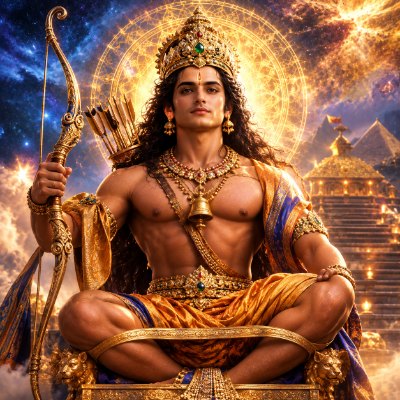
Maha-Shasta is typically depicted as a youthful figure in a yogic seated posture, with a yogapatta — a meditative belt — binding his knees in the characteristic posture of deep meditation. He is shown with a bow and arrow, and in many forms rides a horse or tiger. The bell or jewelled ornament at the throat is a distinguishing mark, referenced by the name Manikanta. In the Adi-Shasta and Dharma Shasta forms he is shown with his two consorts Poorna and Pushkala seated on either side; Poorna on his right is described as dark-complexioned, holding a varamudra (gesture of blessing) and a blue lotus, while Pushkala on his left is described as yellow-complexioned, holding a noose. The Sabarimala brahmachari form omits the consorts entirely. The Subhrabeda Agama provides iconographic specifications for the Shasta form, and the Sivagama corpus of southern Shaiva Siddhanta — including the Purva Karana, Amsumtbheda, and Suprabhedagama texts — contains references to his worship and iconography. The Sabarimala idol was crafted, according to an inscription on the old bronze image, by an artisan named Prabhakar Acharya in Kollam Era 1085, corresponding to 1910 CE — though the shrine itself substantially predates this particular image. Sabarimala is one of the largest annual pilgrimage sites in the world, with an estimated ten to fifteen million devotees visiting during the principal festival season of Mandala Pooja and Makaravilakku each year.
✦ Theological Significance
Maha-Shasta occupies a theologically distinctive position as perhaps the most explicit embodiment of Shaiva-Vaishnava synthesis in all of Hindu sacred tradition. His very existence depends upon and expresses the unity of Shiva and Vishnu, and his Hariharaputra identity has been used across centuries as a devotional and theological argument for the essential oneness of the two great theistic traditions that have sometimes stood in tension with each other. The Tevaram poets of the 7th century CE — working within a Shaiva bhakti framework — nevertheless celebrate Shasta as the son of both Shiva and Vishnu without theological discomfort, indicating that the syncretic identity was already well established by that period. In later Vedantic interpretation, particularly in the tradition associated with Adi Shankaracharya — who is identified in some hagiographies as a divine soul-portion of Shasta — the two consorts Poorna and Pushkala are reinterpreted as symbolic of the two spiritual paths of jnana (knowledge) and bhakti (devotion) rather than as literal wives, recasting the deity's iconography in an advaiticframework. The celibate Sabarimala form of the deity further transforms the warrior-guardian into an ascetic ideal, making his pilgrimage tradition one of the most demanding in Hinduism in terms of preparatory discipline — the 41-day vratham of celibacy, simplicity, vegetarianism, and spiritual observance — and embedding the syncretic Vavar tradition as an expression of the universality of dharmic protection that transcends religious boundaries.
✦ References
- Primary Sources
- Brahmanda Purana (c. 350–950 CE): Principal Mahapuranic source for the birth of Hariharasuta from the union of Shiva and Mohini; records the birth of Maha-Shasta from Shiva's seed; contains hymns to Shasta and identifies his consorts Poorna and Pushkala.
- Skanda Purana, Shankara Samhita (also transmitted as Kanda Puranam in Tamil): Contains the birth narrative of Hariharaputra-Shasta as narrated by Indra; one of the primary Sanskrit Puranic sources for the deity's origin and cosmic purpose.
- Bhagavata Purana, Skanda 8, chapter 12: Records the Shiva-Mohini encounter from which Maha-Shasta is born; does not name the deity explicitly but the seed discharge episode is the generative event.
- Padma Purana: Contains references to Dharma Shasta with his consorts Poorna and Pushkala.
- Sivagama corpus (Purva Karana, Amsumtbheda, Suprabhedagama): Shaiva Siddhanta agamic texts containing iconographic specifications and worship references for Shasta.
- Subhrabeda Agama: Contains iconographic description of the Shasta form as worshipped in agamic temple tradition.
- Dyana Ratnavali (agamic text): Records the Ashta-Shasta, the eight forms of the deity.
- Shasta Varavu (Tamil devotional song): Enumerates the eight forms of Shasta; attested in the Tamil devotional corpus.
- Tevaram of Appar (7th century CE): Saivite bhakti hymns identifying Shasta as the son of Shiva and Tirumal (Vishnu); one of the earliest devotional attestations of the Hariharaputra identity.
- Tevaram of Thirujnanasambandar (7th century CE): Extols Shasta-Aiyanar as a celibate invincible warrior devoted to dharma.
- Silappatikaram (Tamil epic, 4th–5th century CE): Mentions Cattan as a fierce protector; one of the earliest literary attestations of the Aiyanar-Shasta tradition.
- Kanda Puranam (14th century CE, Tamil version of Skanda Purana by Kacchiyapa Shivacharyar): Narrates the history of Aiyanar in the Maha Chattan Patalam, confirming the Brahmanda Purana birth account.
- Bhutnathopakhyanam (Kerala devotional text): The principal source for the Manikanta-Pandalam narrative, the Mahishi killing in the regional devotional framework, and the establishment of the Sabarimala temple; not a Sanskrit Mahapurana.
- Sabarimala Sthala Puranam: A regional purana recording the Ayyappan tradition and its connection to the Sabarimala shrine.
- Secondary Sources
- Wikipedia, "Ayyappan": Comprehensive summary of the Malayalam folklore tradition, the Pandalam narrative, and scholarly assessments of the tradition's historical layering.
- Wikipedia, "Shasta (deity)": Summarises Puranic, epigraphic, and literary attestations across Tamil Nadu and Kerala; records the Ashta-Shasta framework and the five Sabarimala-linked temples.
- Wikipedia, "Aiyanar": Documents the earliest epigraphic evidence (3rd century CE, Arcot district); records the Brahmanda Purana Sanskrit attestation from the 7th century CE onward; notes the identification of Aiyanar with Shasta and Ayyappa.
- Wikipedia, "Sabarimala Temple": Records the 1793 mortgage document and the 1818 B. S. Ward description as the earliest surviving written references to the temple; notes the Mala Araya tribal community's prior ritual claims.
- Wikipedia, "Mahishi (demoness)": Records Mahishi's identity as sister of Mahishasura, her boon from Brahma, her conquest of heaven, and the tradition of her redemption as Leela-Malikapurathamma.
- Wikipedia, "Vavar": Summarises the variant traditions concerning Vavar's identity and the religious significance of the Erumely mosque and Sabarimala shrine.
- Bhaktibharat.org, "Ayyappa Deeksha Guide": Provides a carefully researched statement confirming that the Manikanta-Pandalam story, Mahishi Vadham in the regional devotional context, the 41-day deeksha, and the Sabarimala pilgrimage do not appear in any Sanskrit Mahapurana, and that the Puranas provide only the theological identity of Dharma Shasta.
- Sabarimala.kerala.gov.in (official Sabarimala temple authority): Records the official account of Manikanta's adoption, the Mahishi episode, and the establishment of the Sabarimala temple.
- Paul Younger, cited in Wikipedia "Ayyappan": Notes that supplementary legends linking other Hindu mythologies to Ayyappan appeared in the late Middle Ages, indicating the gradual synthetic development of the tradition.