
About
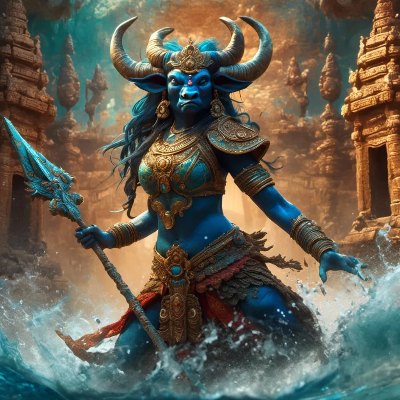
Mahishi — The Buffalo Demoness Slain by Maha-Shasta, Redeemed as Malikapurathamma
Mahishi · Leela (previous celestial identity) · Malikapurathamma (redeemed form venerated at Sabarimala)
Mahishi is a she-buffalo demoness whose narrative is central to the origin of the deity Maha-Shasta — known in Kerala as Ayyappa or Dharma Shasta and worshipped at Sabarimala — for it was to fulfil the specific conditions of her invincibility boon that Maha-Shasta was born. She is the sister of Mahishasura, the great buffalo-demon slain by the goddess Durga in the Devi Mahatmya section of the Markandeya Purana, and her narrative is set in motion by the grief and rage that followed her brother's destruction. She obtained from Brahma the boon that she could be killed only by a being simultaneously the son of both Shiva and Vishnu — a condition she believed to be biologically impossible — and used this invincibility to conquer heaven and drive Indra from his throne. Her narrative is preserved principally in the Bhutnathopakhyanam, a Kerala devotional text dedicated to the Ayyappa tradition (also spelled Sree Bhoothanaathopakhyaanam), and in the associated traditions of the Sabarimala temple. The Bhutnathopakhyanam is identified in the Grokipedia summary of the Mahishi article as belonging to the Bhoothanatha Upakhyana section of the Brahmanda Purana, though this attribution requires caution: the Brahmanda Purana is a Sanskrit Mahapurana, but the Mahishi narrative in its full form as it is known in the Sabarimala tradition is not attested in the widely available translated Sanskrit chapters of that Purana and may represent a regional or later stratum of the text. No Sanskrit Mahapurana narrates Mahishi's story as a complete self-contained episode in the passages available for consultation. Her previous celestial identity — as Leela, the wife of the sage Dattatreya — is recorded in the Sabarimala temple's own traditional account and in the Malikapurathamma temple tradition at Sabarimala. After her death at the hands of Maha-Shasta, Leela was released from her demonic form and is venerated at Sabarimala as Malikapurathamma, the mother-goddess whose shrine stands adjacent to the main Ayyappa temple.
✦ The Names
The word Mahishi is a Sanskrit feminine noun meaning she-buffalo or queen-consort, derived from the same root as Mahisha (buffalo, or buffalo-demon). As an epithet it designates the female counterpart of the buffalo lineage. In the Puranic genealogy of Mahishasura, this same word Mahishi is used as a title for his mother — the she-buffalo with whom the asura Rambha united — creating a potential naming confusion that must be noted: the mother of Mahishasura is called Mahishi in some sources (notably the Wisdomlib Puranic Encyclopaedia), while the sister of Mahishasura who is the subject of the present profile is also called Mahishi. These are two distinct individuals who share a name that in both cases derives from their buffalo nature. The name Leela means sport, play, or divine pastime in Sanskrit, and is applied to Mahishi's previous celestial identity as the wife of Dattatreya before her curse-driven rebirth. The name Malikapurathamma is the Tamil-Malayalam compound name of her redeemed form, meaning approximately "the mother of the palace" or "the mother enshrined at the hillock," from malika (palace or elevated structure) and purathamma (the mother who is outside, or the mother of the sacred enclosure), referring to her position in the subsidiary shrine outside the main sanctum at Sabarimala.
✦ Lineage
- Previous celestial identity — husband: Dattatreya, the divine sage who is identified in the Sabarimala tradition as having emerged from the combined human forms taken by the three members of the divine trinity — Brahma, Vishnu, and Shiva — in order to establish dharma on earth. It is Dattatreya's curse upon his wife Leela that initiates the chain of events leading to Mahishi's existence.
- Previous celestial identity — parentage of Leela: Leela is recorded in the Sabarimala tradition as the daughter of the sage Galava — born simultaneously with Dattatreya when the three consorts of the trinity, Saraswati, Lakshmi, and Parvati, collectively took birth as a single daughter of Galava. She was given in marriage to Dattatreya.
- Father (as Mahishi, the demoness): Karambaasura, recorded in the Sabarimala temple tradition as the asura father into whose family Leela was reborn following Dattatreya's curse. Karambaasura is identifiable with Karambha, the asura mentioned in the Vamana Purana account of Mahishasura's lineage as the brother of Rambha and son of Danu, the asura king — indicating that Mahishi was born into the same broad asura family as Mahishasura, though as his cousin or relative rather than as a full sibling in this telling. The Sabarimala tradition's phrase that Mahishi "had a grievance against the gods for their role in her cousin Mahishasura's death" is consistent with this reading.
- Brother (relationship): Mahishasura, the great buffalo-demon whose defeat at the hands of the goddess Durga is celebrated in the Devi Mahatmya section of the Markandeya Purana and at the festival of Navratri. The Wikipedia article on Mahishi describes him as her brother; the Sabarimala tradition describes him as her cousin, consistent with the Karambaasura parentage. The discrepancy reflects the difference between the broader popular tradition — which calls Mahishi simply the sister of Mahishasura — and the more specific Sabarimala textual tradition, which places her in the family of Karambaasura rather than directly as the daughter of Rambha alongside Mahishasura.
- Slayer: Maha-Shasta, also known as Ayyappa, Dharma Shasta, and Hariharaputra — the son of Shiva and Mohini (the female form of Vishnu), born specifically to fulfil the conditions of Mahishi's invincibility boon. He is the deity worshipped at the Sabarimala temple.
- Redeemed form: Malikapurathamma, venerated at Sabarimala in a subsidiary shrine on a hillock adjacent to the main Ayyappa temple. In this form Leela is identified as the combined manifestation of Saraswati, Lakshmi, and Parvati.
✦ Leela, Dattatreya, and the Origin of the Curse
The Sabarimala and Malikapurathamma temple traditions record that Mahishi's existence was not her original nature but the result of a curse arising from a domestic and philosophical dispute between the sage Dattatreya and his wife Leela. Dattatreya, who had completed the householder stage of life, endeavoured to lead his wife toward renunciation and self-realisation, the ultimate goal of human existence according to the non-dual philosophical tradition he embodied. Leela refused, asserting her role as his patta-mahishi — his principal queen and consort — and her right to remain in the householder life. The word patta-mahishi, meaning chief queen or principal wife, is itself significant: in choosing it to assert her position, Leela unwittingly supplied the very term that would become her curse. Dattatreya, angered by her refusal to accept liberation, cursed her to be born as a Mahishi — a she-buffalo — in an asura family. Leela retaliated by cursing Dattatreya himself to be born as a Mahisha — a male buffalo — an exchange of curses whose consequences would be integral to the eventual resolution of Mahishi's story. In due course Leela was reborn as Mahishi, the daughter of Karambaasura.
✦ The Penance, the Boon, and the Conquest of Heaven
Born into the asura family of Karambaasura and carrying a grievance against the gods for their role in the death of Mahishasura, Mahishi undertook severe and prolonged austerities directed at Brahma. When Brahma appeared and asked her to name her desired boon, Mahishi requested that she be killed only by a son born of the union of Shiva and Vishnu. She framed this condition with deliberate calculation: Mahishasura had received a boon of invulnerability against all male beings, yet had been killed by the goddess Durga — a female divine force — and Mahishi wished to foreclose any similar stratagem. More fundamentally, she believed that since Shiva and Vishnu were both male deities, the production of a son from their union was biologically impossible and that her boon therefore amounted to invulnerability in perpetuity. Brahma granted the boon. Empowered by it, Mahishi launched a campaign of terror against the three worlds, conquered the heavenly realm of Svarga, deposed Indra from his throne, and subjected the gods to sustained oppression. The gods, unable to overcome her by any means, appealed to Vishnu and the divine trinity for intervention.
✦ Dattatreya as Sundara Mahisha: The Stratagem of Luring Mahishi to Earth
The resolution of the cosmic crisis required not only the birth of Maha-Shasta but also a stratagem to bring Mahishi down from the heavenly realm to earth where she could be engaged in battle. This is where Dattatreya's counter-curse upon himself — to be born as a male buffalo — came into operation. The Sabarimala tradition records that Dattatreya was transformed into a handsome male buffalo called Sundara Mahisha, whose beauty and presence captivated Mahishi completely. Vishnu directed Sundara Mahisha to approach Mahishi in the heavenly realm and lure her away. When the beautiful buffalo appeared before her, Mahishi, entirely overcome, abandoned her throne and followed him down to earth, forgetting her campaign of revenge against the gods. This device brought her to the earthly realm — specifically to the forests of the Western Ghats near the Pampa and Azhutha rivers — where Maha-Shasta, incarnate as the young prince Manikanta of Pandalam, was destined to encounter her.
✦ The Battle and Death at the Hands of Maha-Shasta
The Bhutnathopakhyanam and the Sabarimala temple tradition record that Manikanta, while passing through the forest on his quest to obtain tiger's milk for his foster mother, witnessed Mahishi's continued attacks against the gods in the heavenly realm. His sense of justice aroused, Manikanta ascended to the celestial plane, seized Mahishi by her horns, and hurled her down to earth. She fell on the banks of the Azhutha river in Kerala, at a place now identified as Kallidumkunnu. A fierce battle followed on the ground, in which Mahishi, armed with her many boons and formidable powers, gave fierce resistance. Ultimately Manikanta prevailed, and standing upon her body, he performed a violent and ecstatic divine dance whose reverberations extended through the earth and through all the realms of the gods, alarming even the assembled deities with its cosmic intensity. As Mahishi drew her last breath beneath the dancing Maha-Shasta, the curse of Dattatreya was finally dissolved and Leela emerged from the dying buffalo form, her original celestial nature restored.
✦ Redemption, Request, and the Establishment of Malikapurathamma
Upon her release from the buffalo form, Leela — restored to her original beauty as a celestial woman who embodied the combined essence of Saraswati, Lakshmi, and Parvati — prostrated before Maha-Shasta and offered her devotion. She requested that she be taken as his consort. Maha-Shasta declined on the grounds that his present earthly manifestation as Manikanta was specifically a brahmachari form — a celibate form — assumed for the purpose of upholding dharma, and that he could not take a consort in this avatar. However, acknowledging both her devotion and her exalted nature as the combined manifestation of the three great goddesses, he agreed that she would be venerated at a special shrine adjacent to his own temple at Sabarimala. From that time she has been known and worshipped as Malikapurathamma — the mother goddess of the hillock — whose shrine stands on a small hill to the right of the main Ayyappa temple at Sabarimala. The devotional tradition records that Malikapurathamma waits eternally for Maha-Shasta to fulfil his promise to take her as his consort once his brahmachari mission is complete, and that during the Makaravilakku festival season her idol is carried in procession to a site called Sharankutti where she awaits a sign, returning after three successive nights without it.
✦ The Naming Ambiguity: Mahishi the Mother versus Mahishi the Sister
A significant genealogical ambiguity in the sources surrounding Mahishasura must be noted here. In the Vamana Purana, Devi Bhagavata Purana, and the Wisdomlib Puranic Encyclopaedia account of Mahishasura's lineage, the she-buffalo with whom the asura Rambha — son of Danu — mated and who gave birth to Mahishasura is also called Mahishi, meaning she-buffalo. This is the same generic word used as the name and title of the demoness in the present profile. The two figures are distinct: Mahishasura's mother is a she-buffalo from the realm of the Yakshas who became Rambha's consort; the Mahishi of the present profile is — in the full Sabarimala tradition — Leela reborn as the daughter of Karambaasura, described as Mahishasura's sister or cousin. The shared name arises from the shared buffalo nature and does not indicate identity between the two figures. Secondary sources that describe Mahishi simply as "the sister of Mahishasura" without further genealogical detail are not technically wrong — the sisterly relationship is consistently attested — but they conflate different textual layers that the Sabarimala tradition distinguishes more carefully.
✦ Textual Source Honesty
The profile of Mahishi presents an unusual textual situation that must be stated clearly. No Sanskrit Mahapurana narrates her complete story — the curse of Dattatreya, the boon from Brahma, the conquest of heaven, the luring by Sundara Mahisha, the battle with Manikanta, and the redemption as Malikapurathamma — as a unified episode in the chapters available for consultation. The Grokipedia article on Mahishi attributes her narrative to the Bhoothanatha Upakhyana section of the Brahmanda Purana, and if this attribution is accurate it would give the narrative Mahapuranic standing. However, the full Mahishi narrative as described above is most clearly and consistently attested in the Bhutnathopakhyanam, a Kerala regional devotional text specific to the Ayyappa tradition, and in the oral tradition and sthalapurana of the Sabarimala and Malikapurathamma temples. Her connection to the Mahishasura lineage — as his sister — is a consistent element across all sources. Her previous identity as Leela, her curse by Dattatreya, her parentage from Karambaasura, the Sundara Mahisha stratagem, and the full details of her redemption are specific to the Kerala regional tradition. This profile is transparent about these source distinctions throughout.
✦ References
- Primary Sources
- Bhutnathopakhyanam (Sree Bhoothanaathopakhyaanam), Kerala devotional text: The principal narrative source for Mahishi's complete story — her previous identity as Leela, the curse of Dattatreya, her birth as the daughter of Karambaasura, her penance, her boon, her conquest of heaven, the Sundara Mahisha stratagem, her battle with Manikanta, and her redemption as Malikapurathamma. Attributed in some secondary sources to the Bhoothanatha Upakhyana section of the Brahmanda Purana.
- Brahmanda Purana, Bhoothanatha Upakhyana section: Cited as the Mahapuranic source for the Mahishi narrative in the Grokipedia article; if this attribution is accurate, it gives the narrative a Sanskrit Mahapuranic attestation. The full narrative is not present in the widely translated Sanskrit chapters of this Purana as consulted.
- Markandeya Purana, Devi Mahatmya (chapters 81–93): Principal source for the narrative of Mahishasura — Mahishi's brother — his parentage from Rambha, his conquest of heaven, and his slaying by Durga. Provides the context within which Mahishi's revenge motivation is set.
- Vamana Purana, chapter 17: Records the genealogy of Mahishasura through Rambha and the she-buffalo; identifies Karambha as Rambha's brother and the son of Danu; provides the lineage context for identifying Karambaasura with Karambha.
- Devi Bhagavata Purana: Records the account of Rambha's union with the she-buffalo and the birth of Mahishasura; uses the term Mahishi for the she-buffalo mother, distinguishable from the sister-demoness of the present profile.
- Sabarimala temple tradition and Malikapurathamma temple tradition (Kerala): Preserves the complete narrative of Leela, Dattatreya's curse, the Sundara Mahisha episode, the battle, and the establishment of the Malikapurathamma shrine; the most detailed available account of Mahishi's origin and fate.
- Secondary Sources
- Wikipedia, "Mahishi (demoness)": Summarises the Bhutnathopakhyanam account; records the Leela-Dattatreya backstory and the redemption as Malikapurathamma.
- Wikipedia, "Mahishasura": Records Mahishasura's parentage from Rambha; identifies Mahishi as his sister; provides the Markandeya Purana, Vamana Purana, and Devi Bhagavata Purana references for his genealogy.
- Wisdomlib.org, Puranic Encyclopaedia, "Story of Mahisha": Records the Vamana Purana account of Rambha, Karambha, and the she-buffalo lineage; uses Mahishi as the name of the she-buffalo mother of Mahishasura, documenting the naming ambiguity.
- Grokipedia, "Mahishi (demoness)": Attributes the Mahishi narrative to the Bhoothanatha Upakhyana section of the Brahmanda Purana; summarises the penance, boon, conquest of heaven, and defeat by Ayyappa.
- Sabarimala.net and Chettikulangara.org (Malikapurathamma temple documentation): Record the complete Leela-Dattatreya-Mahishi-Malikapurathamma narrative including the Karambaasura parentage, the Sundara Mahisha stratagem, and the ritual of the Makaravilakku procession.
- Sabarimala.kerala.gov.in (official Sabarimala temple authority): Records the official account of the Mahishi battle near the Azhutha river and the establishment of the Malikapurathamma shrine.